Schengen Visa Documents 2026: The Complete Checklist for All Applicants
Reviewed by Visard Visa Operations Team · Last updated: 21 May 2026 · Based on EU Schengen Visa Code (Regulation (EC) No 810/2009) and EES rollout April 2026.
A complete Schengen visa application requires 10 core documents: a valid passport, the harmonised application form (Annex I of the Visa Code), 1 biometric photo, travel medical insurance (€30,000 minimum), proof of accommodation, round-trip flight reservation, proof of sufficient funds, residence permit/visa for your country of residence, employment or study evidence, and a cover letter explaining your trip. Beyond these core documents, each Schengen consulate adds country-specific requirements, Portugal uses the €75+€40/day rule, France requires €120/day, and Turkey applicants need the Vukuatlı Nüfus Kayıt Örneği with QR code. This 2026 guide gives you the complete document checklist plus audience-specific additions for UK, UAE, Ireland, and Turkey residents.
The 10 Core Documents Required for Every Schengen Visa Application
Valid Passportissued within the last 10 years, valid 3+ months past your Schengen exit, at least 2 blank pages
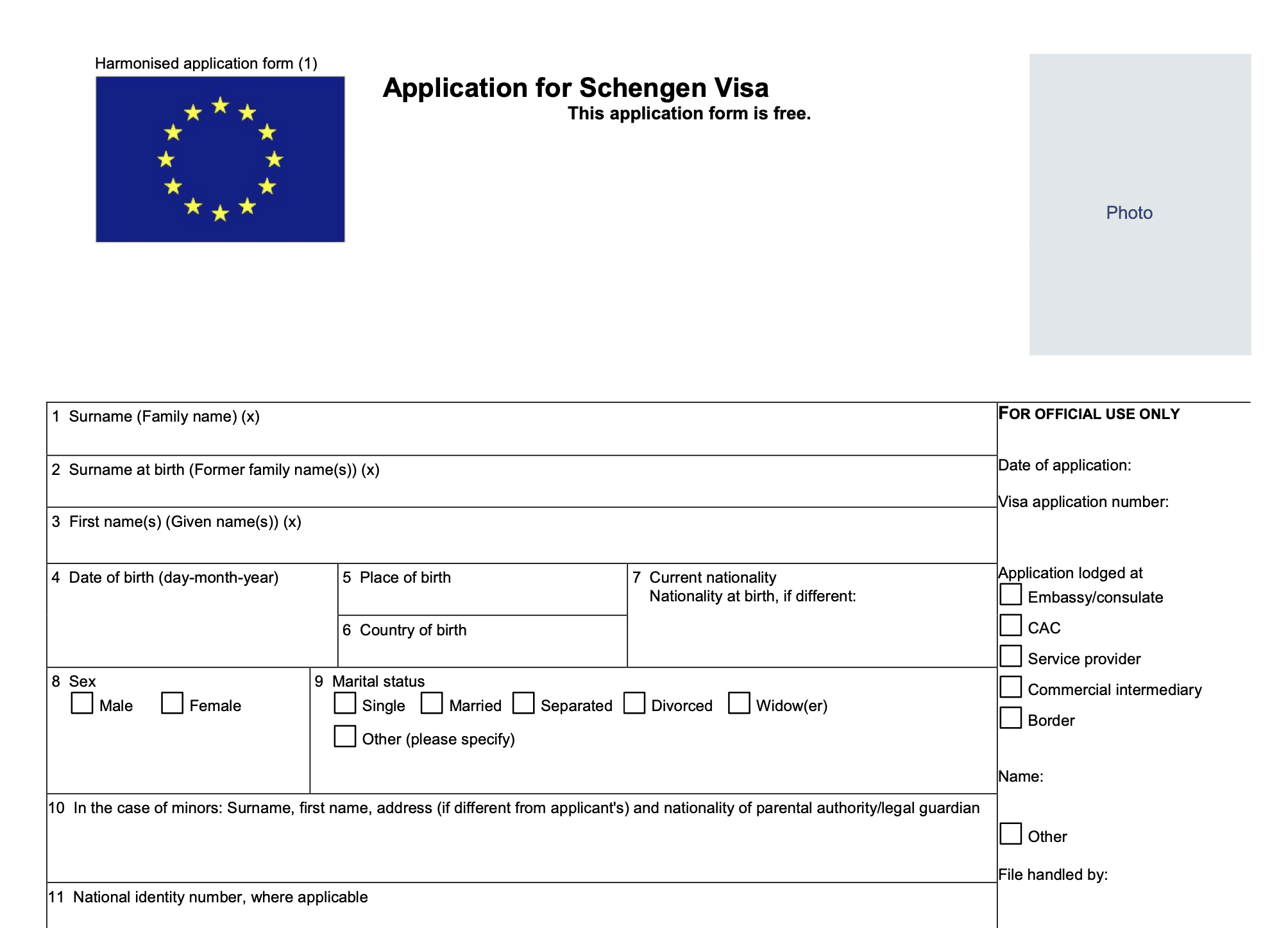
Schengen Visa Application Form (Annex I)the harmonised EU form, signed on both pages
Biometric Photo1 photo, 35×45mm, white background, max 6 months old, ICAO standards
Travel Medical Insuranceminimum €30,000 coverage, valid across entire Schengen Area, covers medical emergencies and repatriation
Proof of Accommodationhotel bookings or formal invitation letter from host
Flight Itineraryround-trip reservation with PNR (do not purchase ticket before approval)
Financial Proof3 to 6 months of bank statements showing sufficient funds for your stay
Residence Permit / Visafor your country of residence, valid for the duration of stay plus 3 months
Employment / Study Evidenceemployer letter with salary and leave dates, or student enrollment letter
Cover Letterexplaining purpose of visit, travel dates, and itinerary
What Changed for 2026 Document Requirements
UK applicants: Physical BRP cards expired 31 December 2024. You must provide a UKVI Share Code generated from your online UKVI account, plus a printed eVisa status page. Share Codes expire 30 days after generation.
EES (Entry/Exit System) live since 10 April 2026. Border crossings now record fingerprint + facial biometric data. The 90/180-day quota is tracked automatically by EU systems, overstays trigger immediately.
Schengen visa fee: €90 for adults (raised from €80 in June 2024). Children 6–12 pay €45. Under 6 free.
EU VAP (Visa Application Platform) rollout: Built by eu-LISA, the unified online portal launches in 2026. France, Italy, and Estonia already accept fully online submissions. Transition through 2031.
ETIAS launches Q4 2026€20 fee for visa-exempt nationals only. Does not apply to visa-required applicants who continue using the Annex I form via consulate channels.
Bulgaria and Romania: Full Schengen members since 1 January 2025, land border checks lifted. Their consulates issue standard Schengen visas now.
Cyprus: NOT in Schengen yet. Cyprus issues national visas only; however, holders of valid multi-entry Schengen visas can enter Cyprus for up to 90 days.
Document 1: Valid Passport, Detailed Requirements
Requirement | Detail |
|---|---|
Issuance | Within the last 10 years |
Validity | At least 3 months past your planned Schengen exit (or last exit for multi-trip) |
Blank pages | Minimum 2 blank visa pages |
Condition | Original passport, no damage; must contain holder's signature |
Copies needed | Photocopy of all pages excluding blank ones |
Previous Schengen visas | Photocopies of any from the last 3 years, strengthens MEV cascade eligibility |
Other foreign visas | Optional: UK, USA, Canada, Japan, Australia visas strengthen credibility |
Document 2: Schengen Visa Application Form (Annex I)
The Schengen visa application form is laid down in Annex I of Regulation (EC) No 810/2009 (the Visa Code). It is the same harmonised form for all 29 Schengen states, only the consulate's portal may differ. Complete the form via:
France, Germany: TLScontact
Italy, Netherlands, Austria, Czech Republic, Sweden, Finland, Norway, Denmark, Croatia, Malta, Greece, Portugal: VFS Global
Spain: BLS International
Belgium: Official Visa on Web (VOW) portal
Hungary: AS Visa Solutions (Turkey applicants)
Iceland: Nyidanmark / ApplyVisa (via Denmark in many regions)
See our field-by-field guide to the Annex I form for completing the 37 required fields correctly.
Document 3: Biometric Photo, Schengen Specifications
1 recent biometric photo (max 6 months old)
Dimensions: 35mm × 45mm
White background (pure white, not off-white)
Face covering 70–80% of frame, 31–36mm from chin to top of head
Neutral expression, mouth closed
No filters, no digital editing
No head coverings (except mandatory religious headwear)
Glasses: no darkened lenses, must not cover eyes
Document 4: Travel Medical Insurance Coverage
Minimum coverage: €30,000
Valid across all 29 Schengen states (not just your destination)
Covers emergency medical treatment, hospital care, and repatriation in case of death
Must cover the entire duration of stay (including transit)
Must not exclude COVID-19 (Denmark and Iceland specifically require this)
For multi-entry visa applications: choose multi-trip insurance to demonstrate intent
Document 5: Proof of Accommodation
Acceptable forms of accommodation proof:
Hotel bookings covering every night of stay
Vacation rental confirmation (Airbnb, Booking.com) with applicant's name
Invitation letter from host (must include host's name, address, residence permit copy, and confirmation of length of stay)
Portugal-specific: Term of Responsibility signed by host and legally recognised
Informal invitations or arrangements are not accepted. Dates must match flight reservations exactly.
Document 6: Flight Itinerary
Round-trip flight reservation with PNR code visible
For multi-country Schengen trips: detailed itinerary showing each leg + transport between countries
Do not purchase the ticket before visa approvalevery consulate explicitly recommends against pre-purchase
If travelling by land: vehicle registration and insurance documents
Document 7: Financial Proof, By Schengen Country
Daily subsistence requirements vary by destination:
Country | Daily subsistence | Notes |
|---|---|---|
France | €120 | Higher in Paris; lower if accommodation prepaid |
Germany | €45 | Standard |
Italy | €45–€80 | Varies by length of stay (sliding scale) |
Netherlands | €55 | Standard |
Spain | €120 | Minimum €1,080 total regardless of trip length |
Portugal | €75 + €40/day | Fixed legal calculation |
Austria | €100 | Standard |
Switzerland | CHF 100 (~€105) | Standard |
Czech Republic | €50 | Standard |
Hungary | ~€56 | Equivalent to HUF 22,000/day |
Slovenia | €70 | Standard |
Denmark (incl. Iceland) | DKK 500 (~€67) | Iceland visas processed via Denmark in many regions |
Norway | €70 | Standard |
Sweden | €50 | Standard |
Lithuania | €50 | Standard |
Latvia | €30 | Standard |
Estonia | €60 | Online via EU VAP early adopter |
Provide bank statements stamped and signed for the last 3 months (some countries require 6 months: e.g., Austria/Liechtenstein via Ireland).
Document 8: Residence Permit, By Audience Country
UK Residents
UKVI Share Code generated within 30 days of your VFS appointment
Printed copy of your eVisa status page from gov.uk
UK residence must be valid 1 month past your return date
UAE Residents
Original Emirates ID (presented at VFS) plus photocopy (front and back)
UAE residence visa valid for at least 3 months past your Schengen exit
VFS centres in Dubai and Abu Dhabi (you can apply at any UAE centre regardless of which emirate issued your residence)
Ireland Residents
Original Irish Residence Permit (IRP) card plus photocopy
IRP must be valid for duration of stay plus 3 months
Holders of "Stamp 4 EU FAM" may be exempt from the Schengen visa requirement, confirm before applying
Turkey Residents
Tam Tekmil Vukuatlı Nüfus Kayıt Örneği (complete civil registry extract) with readable QR code
Obtain from e-Devlet or Nüfus Müdürlüğü, within 3 months
For non-Turkish nationals: valid Turkish residence permit (Ikamet izni)
Entry-exit document (Yurda Giriş/Çıkış Belgesi) from e-Devlet or police station
Document 9: Employment / Study Evidence
If employed:
Employer letter on company letterhead with job title, salary, leave dates, return confirmation
Payslips for last 3 months
Turkey-specific: SGK statement of employment + SGK service document, both with QR codes
If self-employed / business owner:
Business registration documents
Business bank statements (3 months)
Tax returns
Turkey-specific: Faaliyet Belgesi (Company activity certificate)
If student:
Enrollment letter from your institution
Student ID
Permission letter from school for absence
Financial sponsor documents
Turkey-specific: Student certificate from YÖK with QR code
If retired: Pension certificate or proof of regular income
If unemployed / housewife / dependant: Sponsor's no-objection certificate + sponsor's employment letter and bank statements
Document 10: Cover Letter, What to Include
A strong cover letter explains:
Purpose of your visit (tourism, business, family, study)
Specific itinerary with dates and cities
Your ties to your country of residence (employment, family, property)
Your travel history (previous visas, especially Schengen)
If applying for multi-entry: recurring travel reason and frequency expectation
Sources of funding for the trip
Keep the letter to 1 page, signed, dated, and matching all other documents (no inconsistencies between cover letter, flight bookings, hotel reservations).
Additional Documents for Specific Visa Types
Business Visa
Invitation letter from the Schengen company you'll visit
Company registration documents of the inviting company
Conference/event tickets or registration confirmations
Past business correspondence demonstrating relationship
Family Visit Visa
Invitation letter from the host (signed, with their address and contact)
Proof of family relationship (birth certificate, marriage certificate)
Copy of host's passport or residence permit
If host covers expenses: host's bank statements and employment letter
Student Visa (short-term)
Acceptance letter from Schengen educational institution
Course details and duration
Proof of tuition payment or scholarship
Minors (under 18)
Birth certificate
Both parents' passport copies and residence permits
If travelling alone or with one parent: notarised consent from non-travelling parent(s)
School permission letter (if travelling during term)
Document Translation Requirements
Documents not in English (or the consulate's national language) must be translated by a certified/sworn translator. Both original and translated versions must be submitted. Common documents requiring translation:
Birth certificates
Marriage certificates
Bank statements (if non-English bank)
Tax documents
Court rulings (for custody cases)
Visard Data, Top Document Mistakes in 2025–2026
Across visa applications processed via Visard's appointment-monitoring service in 2025 and early 2026, the most frequent document errors among UK, UAE, Ireland, and Turkey applicants were:
UK: Expired UKVI Share Code or missing eVisa status page printout (#1 cause of UK technical refusals)
UAE: UAE residence visa expiring within 3 months of Schengen exit
Ireland: Bank statements older than 1 month at submission
Turkey: Vukuatlı Nüfus Kayıt Örneği without readable QR code, or older than 3 months
All: Travel insurance covering only one country instead of full Schengen Area
All: Photo background not pure white, or photo older than 6 months
All: Date format inconsistency between application form and supporting documents
Common Document Mistakes That Cause Rejection
Submitting an expired residence permit (UK BRP, UAE residence visa, Irish IRP, Turkish ikamet)
Bank statements not stamped and signed by the bank
Travel insurance with single-country coverage
Photo not meeting ICAO biometric standards
Unsigned application form (or signed only on one page)
Undeclared previous Schengen visa refusals (detected via VIS)
Documents not translated when required
Hotel booking dates not matching flight reservation
For a deeper analysis, see our guide to common Schengen visa rejection reasons.
How Visard Helps After You Prepare Your Documents
Once your documents are ready, the next challenge is securing a VFS, TLS, or BLS appointment in London, Dublin, Dubai, Abu Dhabi, or Istanbul, slots open and close within seconds.
Visard's automated appointment service monitors official portals every 3 seconds and either notifies you or auto-books slots:
Frequently Asked Questions, Schengen Visa Documents
How many documents do I need for a Schengen visa?
10 core documents are required for every application: passport, application form, biometric photo, travel insurance, accommodation proof, flight itinerary, financial proof, residence permit, employment/study evidence, and cover letter. Additional documents apply based on visa type (business, family visit, student, minor) and destination country.
Do I need to translate my documents into English?
Documents not in English (or the consulate's national language) must be translated by a certified translator. Both original and translated versions are submitted together.
How long should my passport be valid for a Schengen visa?
At least 3 months past your planned exit from the Schengen Area. The passport must also be issued within the last 10 years and have at least 2 blank pages.
Can I use online banking statements instead of bank-stamped statements?
Most consulates require statements stamped and signed by the bank. Online/printed statements are usually only accepted with a bank stamp confirming authenticity. Confirm with your destination consulate.
Is travel insurance from my home country valid?
Yes, provided the policy explicitly covers the entire Schengen Area (not just one country) with at least €30,000 coverage including emergency medical treatment and repatriation. Confirm "Schengen-wide" wording before purchase.
Do I need to buy my flight tickets before applying?
No, every consulate explicitly recommends against pre-purchase. A flight reservation with PNR code is sufficient. Purchase only after visa approval.
What if I have a previous Schengen visa refusal?
Declare it honestly on the application form (Field 31). Undeclared refusals are detected via the EU Visa Information System (VIS) and trigger new refusals. Include a brief explanation of the previous refusal reason in your cover letter.
Are documents requirements the same for all 29 Schengen countries?
The 10 core documents are universal under the EU Visa Code. Each consulate adds country-specific requirements (e.g., Portugal's €75+€40/day formula, Belgium's language preference form, France's higher daily subsistence). Check the destination consulate's specific checklist.
Related Guides
Key Takeaways
10 core documents are universal for every Schengen visa application
Each Schengen consulate adds country-specific requirements (daily subsistence, host invitation format)
UK: UKVI Share Code replaces BRP since Dec 2024
UAE: Emirates ID + 3-month residence validity required
Ireland: IRP card; "Stamp 4 EU FAM" may be exempt
Turkey: Vukuatlı Nüfus Kayıt Örneği with QR code mandatory
EES live since April 2026, biometric border tracking automatic
Bulgaria + Romania full Schengen since Jan 2025; Cyprus NOT in Schengen yet
€90 adult consular fee; €45 for children 6–12; free under 6
Schengen Visa Documents 2026: The Complete Checklist for All Applicants
Reviewed by Visard Visa Operations Team · Last updated: 21 May 2026 · Based on EU Schengen Visa Code (Regulation (EC) No 810/2009) and EES rollout April 2026.
A complete Schengen visa application requires 10 core documents: a valid passport, the harmonised application form (Annex I of the Visa Code), 1 biometric photo, travel medical insurance (€30,000 minimum), proof of accommodation, round-trip flight reservation, proof of sufficient funds, residence permit/visa for your country of residence, employment or study evidence, and a cover letter explaining your trip. Beyond these core documents, each Schengen consulate adds country-specific requirements, Portugal uses the €75+€40/day rule, France requires €120/day, and Turkey applicants need the Vukuatlı Nüfus Kayıt Örneği with QR code. This 2026 guide gives you the complete document checklist plus audience-specific additions for UK, UAE, Ireland, and Turkey residents.
The 10 Core Documents Required for Every Schengen Visa Application
Valid Passportissued within the last 10 years, valid 3+ months past your Schengen exit, at least 2 blank pages
Schengen Visa Application Form (Annex I)the harmonised EU form, signed on both pages
Biometric Photo1 photo, 35×45mm, white background, max 6 months old, ICAO standards
Travel Medical Insuranceminimum €30,000 coverage, valid across entire Schengen Area, covers medical emergencies and repatriation
Proof of Accommodationhotel bookings or formal invitation letter from host
Flight Itineraryround-trip reservation with PNR (do not purchase ticket before approval)
Financial Proof3 to 6 months of bank statements showing sufficient funds for your stay
Residence Permit / Visafor your country of residence, valid for the duration of stay plus 3 months
Employment / Study Evidenceemployer letter with salary and leave dates, or student enrollment letter
Cover Letterexplaining purpose of visit, travel dates, and itinerary
What Changed for 2026 Document Requirements
UK applicants: Physical BRP cards expired 31 December 2024. You must provide a UKVI Share Code generated from your online UKVI account, plus a printed eVisa status page. Share Codes expire 30 days after generation.
EES (Entry/Exit System) live since 10 April 2026. Border crossings now record fingerprint + facial biometric data. The 90/180-day quota is tracked automatically by EU systems, overstays trigger immediately.
Schengen visa fee: €90 for adults (raised from €80 in June 2024). Children 6–12 pay €45. Under 6 free.
EU VAP (Visa Application Platform) rollout: Built by eu-LISA, the unified online portal launches in 2026. France, Italy, and Estonia already accept fully online submissions. Transition through 2031.
ETIAS launches Q4 2026€20 fee for visa-exempt nationals only. Does not apply to visa-required applicants who continue using the Annex I form via consulate channels.
Bulgaria and Romania: Full Schengen members since 1 January 2025, land border checks lifted. Their consulates issue standard Schengen visas now.
Cyprus: NOT in Schengen yet. Cyprus issues national visas only; however, holders of valid multi-entry Schengen visas can enter Cyprus for up to 90 days.
Document 1: Valid Passport, Detailed Requirements
Requirement | Detail |
|---|---|
Issuance | Within the last 10 years |
Validity | At least 3 months past your planned Schengen exit (or last exit for multi-trip) |
Blank pages | Minimum 2 blank visa pages |
Condition | Original passport, no damage; must contain holder's signature |
Copies needed | Photocopy of all pages excluding blank ones |
Previous Schengen visas | Photocopies of any from the last 3 years, strengthens MEV cascade eligibility |
Other foreign visas | Optional: UK, USA, Canada, Japan, Australia visas strengthen credibility |
Document 2: Schengen Visa Application Form (Annex I)
The Schengen visa application form is laid down in Annex I of Regulation (EC) No 810/2009 (the Visa Code). It is the same harmonised form for all 29 Schengen states, only the consulate's portal may differ. Complete the form via:
France, Germany: TLScontact
Italy, Netherlands, Austria, Czech Republic, Sweden, Finland, Norway, Denmark, Croatia, Malta, Greece, Portugal: VFS Global
Spain: BLS International
Belgium: Official Visa on Web (VOW) portal
Hungary: AS Visa Solutions (Turkey applicants)
Iceland: Nyidanmark / ApplyVisa (via Denmark in many regions)
See our field-by-field guide to the Annex I form for completing the 37 required fields correctly.
Document 3: Biometric Photo, Schengen Specifications
1 recent biometric photo (max 6 months old)
Dimensions: 35mm × 45mm
White background (pure white, not off-white)
Face covering 70–80% of frame, 31–36mm from chin to top of head
Neutral expression, mouth closed
No filters, no digital editing
No head coverings (except mandatory religious headwear)
Glasses: no darkened lenses, must not cover eyes
Document 4: Travel Medical Insurance Coverage
Minimum coverage: €30,000
Valid across all 29 Schengen states (not just your destination)
Covers emergency medical treatment, hospital care, and repatriation in case of death
Must cover the entire duration of stay (including transit)
Must not exclude COVID-19 (Denmark and Iceland specifically require this)
For multi-entry visa applications: choose multi-trip insurance to demonstrate intent
Document 5: Proof of Accommodation
Acceptable forms of accommodation proof:
Hotel bookings covering every night of stay
Vacation rental confirmation (Airbnb, Booking.com) with applicant's name
Invitation letter from host (must include host's name, address, residence permit copy, and confirmation of length of stay)
Portugal-specific: Term of Responsibility signed by host and legally recognised
Informal invitations or arrangements are not accepted. Dates must match flight reservations exactly.
Document 6: Flight Itinerary
Round-trip flight reservation with PNR code visible
For multi-country Schengen trips: detailed itinerary showing each leg + transport between countries
Do not purchase the ticket before visa approvalevery consulate explicitly recommends against pre-purchase
If travelling by land: vehicle registration and insurance documents
Document 7: Financial Proof, By Schengen Country
Daily subsistence requirements vary by destination:
Country | Daily subsistence | Notes |
|---|---|---|
France | €120 | Higher in Paris; lower if accommodation prepaid |
Germany | €45 | Standard |
Italy | €45–€80 | Varies by length of stay (sliding scale) |
Netherlands | €55 | Standard |
Spain | €120 | Minimum €1,080 total regardless of trip length |
Portugal | €75 + €40/day | Fixed legal calculation |
Austria | €100 | Standard |
Switzerland | CHF 100 (~€105) | Standard |
Czech Republic | €50 | Standard |
Hungary | ~€56 | Equivalent to HUF 22,000/day |
Slovenia | €70 | Standard |
Denmark (incl. Iceland) | DKK 500 (~€67) | Iceland visas processed via Denmark in many regions |
Norway | €70 | Standard |
Sweden | €50 | Standard |
Lithuania | €50 | Standard |
Latvia | €30 | Standard |
Estonia | €60 | Online via EU VAP early adopter |
Provide bank statements stamped and signed for the last 3 months (some countries require 6 months: e.g., Austria/Liechtenstein via Ireland).
Document 8: Residence Permit, By Audience Country
UK Residents
UKVI Share Code generated within 30 days of your VFS appointment
Printed copy of your eVisa status page from gov.uk
UK residence must be valid 1 month past your return date
UAE Residents
Original Emirates ID (presented at VFS) plus photocopy (front and back)
UAE residence visa valid for at least 3 months past your Schengen exit
VFS centres in Dubai and Abu Dhabi (you can apply at any UAE centre regardless of which emirate issued your residence)
Ireland Residents
Original Irish Residence Permit (IRP) card plus photocopy
IRP must be valid for duration of stay plus 3 months
Holders of "Stamp 4 EU FAM" may be exempt from the Schengen visa requirement, confirm before applying
Turkey Residents
Tam Tekmil Vukuatlı Nüfus Kayıt Örneği (complete civil registry extract) with readable QR code
Obtain from e-Devlet or Nüfus Müdürlüğü, within 3 months
For non-Turkish nationals: valid Turkish residence permit (Ikamet izni)
Entry-exit document (Yurda Giriş/Çıkış Belgesi) from e-Devlet or police station
Document 9: Employment / Study Evidence
If employed:
Employer letter on company letterhead with job title, salary, leave dates, return confirmation
Payslips for last 3 months
Turkey-specific: SGK statement of employment + SGK service document, both with QR codes
If self-employed / business owner:
Business registration documents
Business bank statements (3 months)
Tax returns
Turkey-specific: Faaliyet Belgesi (Company activity certificate)
If student:
Enrollment letter from your institution
Student ID
Permission letter from school for absence
Financial sponsor documents
Turkey-specific: Student certificate from YÖK with QR code
If retired: Pension certificate or proof of regular income
If unemployed / housewife / dependant: Sponsor's no-objection certificate + sponsor's employment letter and bank statements
Document 10: Cover Letter, What to Include
A strong cover letter explains:
Purpose of your visit (tourism, business, family, study)
Specific itinerary with dates and cities
Your ties to your country of residence (employment, family, property)
Your travel history (previous visas, especially Schengen)
If applying for multi-entry: recurring travel reason and frequency expectation
Sources of funding for the trip
Keep the letter to 1 page, signed, dated, and matching all other documents (no inconsistencies between cover letter, flight bookings, hotel reservations).
Additional Documents for Specific Visa Types
Business Visa
Invitation letter from the Schengen company you'll visit
Company registration documents of the inviting company
Conference/event tickets or registration confirmations
Past business correspondence demonstrating relationship
Family Visit Visa
Invitation letter from the host (signed, with their address and contact)
Proof of family relationship (birth certificate, marriage certificate)
Copy of host's passport or residence permit
If host covers expenses: host's bank statements and employment letter
Student Visa (short-term)
Acceptance letter from Schengen educational institution
Course details and duration
Proof of tuition payment or scholarship
Minors (under 18)
Birth certificate
Both parents' passport copies and residence permits
If travelling alone or with one parent: notarised consent from non-travelling parent(s)
School permission letter (if travelling during term)
Document Translation Requirements
Documents not in English (or the consulate's national language) must be translated by a certified/sworn translator. Both original and translated versions must be submitted. Common documents requiring translation:
Birth certificates
Marriage certificates
Bank statements (if non-English bank)
Tax documents
Court rulings (for custody cases)
Visard Data, Top Document Mistakes in 2025–2026
Across visa applications processed via Visard's appointment-monitoring service in 2025 and early 2026, the most frequent document errors among UK, UAE, Ireland, and Turkey applicants were:
UK: Expired UKVI Share Code or missing eVisa status page printout (#1 cause of UK technical refusals)
UAE: UAE residence visa expiring within 3 months of Schengen exit
Ireland: Bank statements older than 1 month at submission
Turkey: Vukuatlı Nüfus Kayıt Örneği without readable QR code, or older than 3 months
All: Travel insurance covering only one country instead of full Schengen Area
All: Photo background not pure white, or photo older than 6 months
All: Date format inconsistency between application form and supporting documents
Common Document Mistakes That Cause Rejection
Submitting an expired residence permit (UK BRP, UAE residence visa, Irish IRP, Turkish ikamet)
Bank statements not stamped and signed by the bank
Travel insurance with single-country coverage
Photo not meeting ICAO biometric standards
Unsigned application form (or signed only on one page)
Undeclared previous Schengen visa refusals (detected via VIS)
Documents not translated when required
Hotel booking dates not matching flight reservation
For a deeper analysis, see our guide to common Schengen visa rejection reasons.
How Visard Helps After You Prepare Your Documents
Once your documents are ready, the next challenge is securing a VFS, TLS, or BLS appointment in London, Dublin, Dubai, Abu Dhabi, or Istanbul, slots open and close within seconds.
Visard's automated appointment service monitors official portals every 3 seconds and either notifies you or auto-books slots:
Frequently Asked Questions, Schengen Visa Documents
How many documents do I need for a Schengen visa?
10 core documents are required for every application: passport, application form, biometric photo, travel insurance, accommodation proof, flight itinerary, financial proof, residence permit, employment/study evidence, and cover letter. Additional documents apply based on visa type (business, family visit, student, minor) and destination country.
Do I need to translate my documents into English?
Documents not in English (or the consulate's national language) must be translated by a certified translator. Both original and translated versions are submitted together.
How long should my passport be valid for a Schengen visa?
At least 3 months past your planned exit from the Schengen Area. The passport must also be issued within the last 10 years and have at least 2 blank pages.
Can I use online banking statements instead of bank-stamped statements?
Most consulates require statements stamped and signed by the bank. Online/printed statements are usually only accepted with a bank stamp confirming authenticity. Confirm with your destination consulate.
Is travel insurance from my home country valid?
Yes, provided the policy explicitly covers the entire Schengen Area (not just one country) with at least €30,000 coverage including emergency medical treatment and repatriation. Confirm "Schengen-wide" wording before purchase.
Do I need to buy my flight tickets before applying?
No, every consulate explicitly recommends against pre-purchase. A flight reservation with PNR code is sufficient. Purchase only after visa approval.
What if I have a previous Schengen visa refusal?
Declare it honestly on the application form (Field 31). Undeclared refusals are detected via the EU Visa Information System (VIS) and trigger new refusals. Include a brief explanation of the previous refusal reason in your cover letter.
Are documents requirements the same for all 29 Schengen countries?
The 10 core documents are universal under the EU Visa Code. Each consulate adds country-specific requirements (e.g., Portugal's €75+€40/day formula, Belgium's language preference form, France's higher daily subsistence). Check the destination consulate's specific checklist.
Related Guides
Key Takeaways
10 core documents are universal for every Schengen visa application
Each Schengen consulate adds country-specific requirements (daily subsistence, host invitation format)
UK: UKVI Share Code replaces BRP since Dec 2024
UAE: Emirates ID + 3-month residence validity required
Ireland: IRP card; "Stamp 4 EU FAM" may be exempt
Turkey: Vukuatlı Nüfus Kayıt Örneği with QR code mandatory
EES live since April 2026, biometric border tracking automatic
Bulgaria + Romania full Schengen since Jan 2025; Cyprus NOT in Schengen yet
€90 adult consular fee; €45 for children 6–12; free under 6
Related posts
Latvia Visa from the UK 2026: Documents and EUR 90 Fee
Switzerland Visa Requirements from the UK 2026
Slovenia Visa from the UK 2026: Documents and Fees
Cyprus Visa from the UK: BRP Holders and Non-UK Passports
Lithuania Visa from the UK 2026: Documents and Share Code

Iceland Visa from the UK 2026: Documents and Fees
Do You Need a Visa for Finland from the UK? 2026 Rules
Is Bulgaria in Schengen? UK Travel Rules for 2026
Estonia Visa Requirements from the UK 2026

Do You Need a Visa for Croatia from the UK? 2026 Rules
Related posts
Related posts