
Updated: 21 May 2026
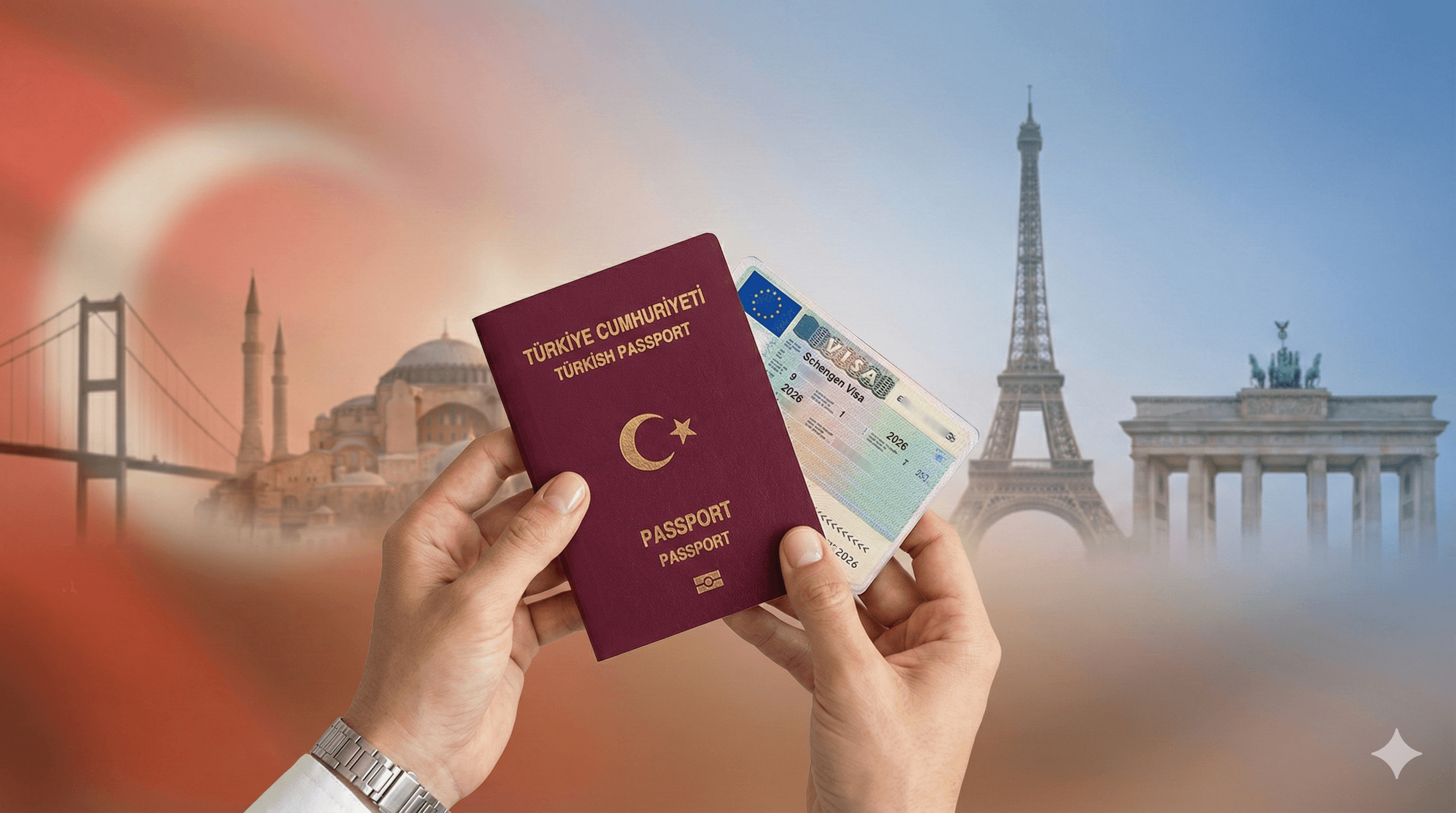
Romania became a full Schengen member on 1 January 2025, completing the land-border accession that started with airport and maritime borders in March 2024. From Turkish applicants' perspective, this changed the visa process meaningfully: Romania now issues uniform Schengen visas (Type C) that allow travel across the entire 27-country Schengen Area, not just Romania.
The application path itself is straightforward: Turkish residents apply directly at the Embassy of Romania in Ankara via the e-Visa portal at evisa.mae.ro. No outsourced VAC — the embassy handles applications and biometrics in person.
This guide covers documents, fees, processing times, the e-Visa portal flow, and how to actually secure a Romania visa appointment from Turkey in 2026.
Who Needs a Romania Schengen Visa from Turkey?
Turkish citizens holding ordinary (burgundy) passports need a Schengen visa to visit Romania for short stays up to 90 days within any 180-day period.
Holders of Turkish diplomatic, service, and special (green) passports are exempt from visa requirements for short-term stays.
Third-country nationals legally residing in Turkey can apply at the Romanian Embassy in Ankara if they hold a valid Turkish residence permit valid for at least 6 months from the application date.
What Changed in 2025: Romania's Full Schengen Accession
Romania (along with Bulgaria) joined the Schengen Area in two stages:
March 2024: Schengen rules applied at air and sea borders
January 2025: Schengen rules extended to land borders — full membership
As of 1 January 2025, Romania issues:
Uniform Schengen visas (Type C) — valid across all 27 Schengen member states
Visas with limited territorial validity (VLTV) — valid in one or more Schengen states, but not all
Airport transit visas
This means a Romania visa now gives you the same access as a visa from France, Italy, or Germany — not just access to Romania. Internal border checks between Romania and its Schengen neighbours have been removed.
Visa Types and Multiple-Entry Cascade
The most-issued visa for Turkish applicants is the short-stay (Type C) Schengen visa, available for:
Tourism
Business
Visit to relatives or friends
Cultural events
Sports
Official visit
Medical reasons
Studies (up to 90 days)
Airport transit
Multiple-entry visas follow the EU cascade rules:
1-year multiple-entry: if you've legally obtained and used 3 Schengen visas in the last 2 years
2-year multiple-entry: if you've held a 1-year multiple-entry visa in the last 2 years
5-year multiple-entry: if you've held a 2-year multiple-entry visa in the last 3 years
Required Documents for a Romania Visa from Turkey
The Embassy of Romania in Ankara requires the following for a short-stay (Type C) Schengen visa.
Harmonised Application Form
Schengen visa application form, completed online via evisa.mae.ro
Print, sign, and bring to your appointment
The 2024 harmonised EU application form is the current standard
Passport
Valid for at least 3 months beyond your intended departure from the Schengen Area
Issued within the last 10 years
At least 2 blank pages
Photograph
One recent biometric colour photo, white background
Civil Registry
Complete extract of the civil registry (Tam Tekmil Vukuatlı Nüfus Kayıt Örneği) from e-devlet
Turkish Residence (for non-Turkish nationals)
Valid Turkish residence permit, valid at least 6 months from the application date
Travel Medical Insurance
Minimum coverage EUR 30,000
Covers medical emergencies, hospitalisation, and repatriation
Valid for all 27 Schengen member states for the entire trip
Flight Itinerary
Round-trip flight reservation, or other proof of intended transport, or proof of travel itinerary
Accommodation
Hotel reservation, rental contract, or proof of property ownership in Romania
Private visit: invitation containing length of stay, relationship details, host's ID number and personal identification code, date and signature; proof of family ties; proof of sponsorship/accommodation
Financial Means
Bank account statement showing movements over the last 3 months
Proof of regular income: salary slips for the last 3 months
Pensioner booklet if relevant
Employment Documentation
Employed: letter from employer with leave approval, SGK (social security) statement and SGK history with QR code
Farmers: farmer certificate from a chamber of agriculture
Company owners: chamber of commerce registration, trade register bulletin, tax statement, company activity certificate (Faaliyet Belgesi)
Students: student certificate (higher education: from YÖK with QR code)
Minors (under 18)
Travelling alone or with one parent/legal guardian only: notarised written consent from the non-travelling parent(s) or proof of sole custody
Truck Drivers
Employer guarantee letter, company drivers list with Schengen visa data, SGK documents with QR code, chamber of commerce registration, C2 certificate (Yetki Belgesi), professional driving licence (SRC 3), last 3 CMR/T1 or T2 transport documents (not older than 6 months), invitation from destination company
Business Travellers
Invitation from the company in the Member State of destination with purpose and length of visit
Sending company's supporting letter with purpose and stay length
Information on who covers stay costs
For fairs: entry card or participation documents
Study or EU Programme Participation
Original invitation from the receiving university or research centre
Letter from Turkish National Agency or TÜBİTAK confirming EU programme support
Employer leave approval if applicable
🚨 Document requirements vary by purpose — confirm via the embassy's website before submission.
Visa Fees for Romania from Turkey
Romania follows the standard EU Schengen fee schedule. Fees are paid at the embassy on the day of submission.
Consular Fees
Adults (12+): EUR 90
Children 6–11: EUR 45
Children under 6: Free
Spouses and children under 18 of EU citizens: free
Fees are typically paid in EUR cash or TL equivalent — confirm with the embassy before your appointment.
All fees are non-refundable if the visa is refused.
Processing Time
Romania's standard processing time is 15 calendar days from receipt at the embassy. Complex cases requiring extra scrutiny can extend to 30 or 45 calendar days.
Submit at least 3–6 weeks before travel, and earlier during peak season (June–August).
The Real Problem: Getting an Appointment
Romania's profile has risen sharply since the full Schengen accession in January 2025 — the visa now gives access to all 27 Schengen states, and Romania is an increasingly popular destination in its own right (Bucharest, Transylvania, the Carpathians, Black Sea coast).
Direct submission at the Romanian embassy in Ankara means the appointment supply is limited by embassy staffing rather than by an outsourced VAC's capacity. Slots are released via the e-Visa portal with no advance notice and clear within hours.
Manual refreshing rarely succeeds. Visard's appointment monitoring service checks the Romanian e-Visa portal every 3 seconds — 28,800 checks per day. When a slot opens, you receive an instant Telegram alert.
The Schengen visa appointment bot for Turkey residents covers a 31-day monitoring period for a single country or all Schengen countries. No personal documents required — just appointment monitoring.
Step-by-Step Application Process
1. Register on the e-Visa portal. Create an account at evisa.mae.ro. Select the appropriate Diplomatic Mission/Consular Office (Bucharest → Ankara for Turkish residents).
2. Complete the application. Fill the harmonised application form, enter personal information and visa details, upload required documents.
3. Book an appointment. Schedule via the e-Visa portal, or use a Romania appointment bot in Turkey for instant alerts on slot openings.
4. Submit the application in the portal. Lock in your submission.
5. Attend the appointment. Report to the Romanian Embassy in Ankara at your scheduled time. The embassy locates your application in the internal portal, verifies and validates documents. Biometrics (fingerprints + photo) captured for first-time applicants.
6. Pay the fee. Collect your payment receipt.
7. Track and collect. Application processed in the SNIV (National Visa Information System). Status updated in the e-Visa portal. Collect your passport when notified.
Tips for a Stronger Application
Bookmark the official sources. e-Visa portal: evisa.mae.ro. Embassy: ankara.mae.ro. Don't apply through unofficial intermediaries.
Show strong ties to Turkey. Stable employment, family in Turkey, property, and previous Schengen travel record all strengthen your case — see common Schengen rejection reasons.
Apply at the right country. Romania must be your main destination (most days spent). If you'll spend more time in another Schengen country, apply at that country's consulate — the Schengen rules apply to Romania the same as everywhere else now.
Use the cascade strategy. Romania is a strong choice for building Schengen visa history because of its lower volume vs. France or Italy. A clean Romanian visa used properly can lead to longer multiple-entry visas on subsequent applications.
Don't book paid flights early. Reservations are sufficient. Only purchase confirmed tickets after visa approval.
Romania as a Schengen Destination
Romania joined full Schengen on 1 January 2025. With a Romanian Schengen visa (Type C), you can:
Stay up to 90 days within any 180-day period
Travel freely across all 27 Schengen member states
Enter and exit through any Schengen country — including via Romania's now-open land borders
Bucharest is increasingly visited as a city break, Transylvania (Sibiu, Braşov, Sighişoara) draws cultural and history-focused travellers, and the Carpathian Mountains offer hiking and skiing. Direct flights from Istanbul to Bucharest operate year-round.
What's New in 2026: EES and ETIAS
The EU Entry/Exit System (EES) went live on 10 April 2026 across all 27 Schengen states including Romania. First-time travellers entering Romania (or any Schengen country) register fingerprints and a facial scan at the border. Subsequent entries are faster.
The ETIAS travel authorisation launches in Q4 2026 for visa-exempt nationals. EUR 20 fee, valid 3 years. Schengen visa holders (Turkish ordinary passport holders) do not need ETIAS.
Frequently Asked Questions
Is a Romanian visa the same as a Schengen visa now?
Yes. Since 1 January 2025, Romania issues uniform Schengen visas (Type C) that allow travel across all 27 Schengen member states. The visa is functionally identical to one issued by France, Italy, or Germany.
Do I still need a separate visa for Bulgaria?
No. Bulgaria also joined full Schengen on 1 January 2025. Both Romanian and Bulgarian Schengen visas are valid for the entire Schengen Area.
Where do I apply?
The Embassy of Romania in Ankara via the e-Visa portal at evisa.mae.ro. There is no outsourced VAC — you submit at the embassy in person.
How long is a Romanian Schengen visa valid?
A standard single-entry tourist visa covers your trip dates (up to 90 days). Multiple-entry visas (1, 2, or 5 years) follow the EU cascade rules described above.
Do holders of green passports need a visa?
No. Turkish diplomatic, service, and special (green) passport holders are exempt from short-stay visa requirements for Romania.
🔴 Sources:
Updated: 21 May 2026
Romania became a full Schengen member on 1 January 2025, completing the land-border accession that started with airport and maritime borders in March 2024. From Turkish applicants' perspective, this changed the visa process meaningfully: Romania now issues uniform Schengen visas (Type C) that allow travel across the entire 27-country Schengen Area, not just Romania.
The application path itself is straightforward: Turkish residents apply directly at the Embassy of Romania in Ankara via the e-Visa portal at evisa.mae.ro. No outsourced VAC — the embassy handles applications and biometrics in person.
This guide covers documents, fees, processing times, the e-Visa portal flow, and how to actually secure a Romania visa appointment from Turkey in 2026.
Who Needs a Romania Schengen Visa from Turkey?
Turkish citizens holding ordinary (burgundy) passports need a Schengen visa to visit Romania for short stays up to 90 days within any 180-day period.
Holders of Turkish diplomatic, service, and special (green) passports are exempt from visa requirements for short-term stays.
Third-country nationals legally residing in Turkey can apply at the Romanian Embassy in Ankara if they hold a valid Turkish residence permit valid for at least 6 months from the application date.
What Changed in 2025: Romania's Full Schengen Accession
Romania (along with Bulgaria) joined the Schengen Area in two stages:
March 2024: Schengen rules applied at air and sea borders
January 2025: Schengen rules extended to land borders — full membership
As of 1 January 2025, Romania issues:
Uniform Schengen visas (Type C) — valid across all 27 Schengen member states
Visas with limited territorial validity (VLTV) — valid in one or more Schengen states, but not all
Airport transit visas
This means a Romania visa now gives you the same access as a visa from France, Italy, or Germany — not just access to Romania. Internal border checks between Romania and its Schengen neighbours have been removed.
Visa Types and Multiple-Entry Cascade
The most-issued visa for Turkish applicants is the short-stay (Type C) Schengen visa, available for:
Tourism
Business
Visit to relatives or friends
Cultural events
Sports
Official visit
Medical reasons
Studies (up to 90 days)
Airport transit
Multiple-entry visas follow the EU cascade rules:
1-year multiple-entry: if you've legally obtained and used 3 Schengen visas in the last 2 years
2-year multiple-entry: if you've held a 1-year multiple-entry visa in the last 2 years
5-year multiple-entry: if you've held a 2-year multiple-entry visa in the last 3 years
Required Documents for a Romania Visa from Turkey
The Embassy of Romania in Ankara requires the following for a short-stay (Type C) Schengen visa.
Harmonised Application Form
Schengen visa application form, completed online via evisa.mae.ro
Print, sign, and bring to your appointment
The 2024 harmonised EU application form is the current standard
Passport
Valid for at least 3 months beyond your intended departure from the Schengen Area
Issued within the last 10 years
At least 2 blank pages
Photograph
One recent biometric colour photo, white background
Civil Registry
Complete extract of the civil registry (Tam Tekmil Vukuatlı Nüfus Kayıt Örneği) from e-devlet
Turkish Residence (for non-Turkish nationals)
Valid Turkish residence permit, valid at least 6 months from the application date
Travel Medical Insurance
Minimum coverage EUR 30,000
Covers medical emergencies, hospitalisation, and repatriation
Valid for all 27 Schengen member states for the entire trip
Flight Itinerary
Round-trip flight reservation, or other proof of intended transport, or proof of travel itinerary
Accommodation
Hotel reservation, rental contract, or proof of property ownership in Romania
Private visit: invitation containing length of stay, relationship details, host's ID number and personal identification code, date and signature; proof of family ties; proof of sponsorship/accommodation
Financial Means
Bank account statement showing movements over the last 3 months
Proof of regular income: salary slips for the last 3 months
Pensioner booklet if relevant
Employment Documentation
Employed: letter from employer with leave approval, SGK (social security) statement and SGK history with QR code
Farmers: farmer certificate from a chamber of agriculture
Company owners: chamber of commerce registration, trade register bulletin, tax statement, company activity certificate (Faaliyet Belgesi)
Students: student certificate (higher education: from YÖK with QR code)
Minors (under 18)
Travelling alone or with one parent/legal guardian only: notarised written consent from the non-travelling parent(s) or proof of sole custody
Truck Drivers
Employer guarantee letter, company drivers list with Schengen visa data, SGK documents with QR code, chamber of commerce registration, C2 certificate (Yetki Belgesi), professional driving licence (SRC 3), last 3 CMR/T1 or T2 transport documents (not older than 6 months), invitation from destination company
Business Travellers
Invitation from the company in the Member State of destination with purpose and length of visit
Sending company's supporting letter with purpose and stay length
Information on who covers stay costs
For fairs: entry card or participation documents
Study or EU Programme Participation
Original invitation from the receiving university or research centre
Letter from Turkish National Agency or TÜBİTAK confirming EU programme support
Employer leave approval if applicable
🚨 Document requirements vary by purpose — confirm via the embassy's website before submission.
Visa Fees for Romania from Turkey
Romania follows the standard EU Schengen fee schedule. Fees are paid at the embassy on the day of submission.
Consular Fees
Adults (12+): EUR 90
Children 6–11: EUR 45
Children under 6: Free
Spouses and children under 18 of EU citizens: free
Fees are typically paid in EUR cash or TL equivalent — confirm with the embassy before your appointment.
All fees are non-refundable if the visa is refused.
Processing Time
Romania's standard processing time is 15 calendar days from receipt at the embassy. Complex cases requiring extra scrutiny can extend to 30 or 45 calendar days.
Submit at least 3–6 weeks before travel, and earlier during peak season (June–August).
The Real Problem: Getting an Appointment
Romania's profile has risen sharply since the full Schengen accession in January 2025 — the visa now gives access to all 27 Schengen states, and Romania is an increasingly popular destination in its own right (Bucharest, Transylvania, the Carpathians, Black Sea coast).
Direct submission at the Romanian embassy in Ankara means the appointment supply is limited by embassy staffing rather than by an outsourced VAC's capacity. Slots are released via the e-Visa portal with no advance notice and clear within hours.
Manual refreshing rarely succeeds. Visard's appointment monitoring service checks the Romanian e-Visa portal every 3 seconds — 28,800 checks per day. When a slot opens, you receive an instant Telegram alert.
The Schengen visa appointment bot for Turkey residents covers a 31-day monitoring period for a single country or all Schengen countries. No personal documents required — just appointment monitoring.
Step-by-Step Application Process
1. Register on the e-Visa portal. Create an account at evisa.mae.ro. Select the appropriate Diplomatic Mission/Consular Office (Bucharest → Ankara for Turkish residents).
2. Complete the application. Fill the harmonised application form, enter personal information and visa details, upload required documents.
3. Book an appointment. Schedule via the e-Visa portal, or use a Romania appointment bot in Turkey for instant alerts on slot openings.
4. Submit the application in the portal. Lock in your submission.
5. Attend the appointment. Report to the Romanian Embassy in Ankara at your scheduled time. The embassy locates your application in the internal portal, verifies and validates documents. Biometrics (fingerprints + photo) captured for first-time applicants.
6. Pay the fee. Collect your payment receipt.
7. Track and collect. Application processed in the SNIV (National Visa Information System). Status updated in the e-Visa portal. Collect your passport when notified.
Tips for a Stronger Application
Bookmark the official sources. e-Visa portal: evisa.mae.ro. Embassy: ankara.mae.ro. Don't apply through unofficial intermediaries.
Show strong ties to Turkey. Stable employment, family in Turkey, property, and previous Schengen travel record all strengthen your case — see common Schengen rejection reasons.
Apply at the right country. Romania must be your main destination (most days spent). If you'll spend more time in another Schengen country, apply at that country's consulate — the Schengen rules apply to Romania the same as everywhere else now.
Use the cascade strategy. Romania is a strong choice for building Schengen visa history because of its lower volume vs. France or Italy. A clean Romanian visa used properly can lead to longer multiple-entry visas on subsequent applications.
Don't book paid flights early. Reservations are sufficient. Only purchase confirmed tickets after visa approval.
Romania as a Schengen Destination
Romania joined full Schengen on 1 January 2025. With a Romanian Schengen visa (Type C), you can:
Stay up to 90 days within any 180-day period
Travel freely across all 27 Schengen member states
Enter and exit through any Schengen country — including via Romania's now-open land borders
Bucharest is increasingly visited as a city break, Transylvania (Sibiu, Braşov, Sighişoara) draws cultural and history-focused travellers, and the Carpathian Mountains offer hiking and skiing. Direct flights from Istanbul to Bucharest operate year-round.
What's New in 2026: EES and ETIAS
The EU Entry/Exit System (EES) went live on 10 April 2026 across all 27 Schengen states including Romania. First-time travellers entering Romania (or any Schengen country) register fingerprints and a facial scan at the border. Subsequent entries are faster.
The ETIAS travel authorisation launches in Q4 2026 for visa-exempt nationals. EUR 20 fee, valid 3 years. Schengen visa holders (Turkish ordinary passport holders) do not need ETIAS.
Frequently Asked Questions
Is a Romanian visa the same as a Schengen visa now?
Yes. Since 1 January 2025, Romania issues uniform Schengen visas (Type C) that allow travel across all 27 Schengen member states. The visa is functionally identical to one issued by France, Italy, or Germany.
Do I still need a separate visa for Bulgaria?
No. Bulgaria also joined full Schengen on 1 January 2025. Both Romanian and Bulgarian Schengen visas are valid for the entire Schengen Area.
Where do I apply?
The Embassy of Romania in Ankara via the e-Visa portal at evisa.mae.ro. There is no outsourced VAC — you submit at the embassy in person.
How long is a Romanian Schengen visa valid?
A standard single-entry tourist visa covers your trip dates (up to 90 days). Multiple-entry visas (1, 2, or 5 years) follow the EU cascade rules described above.
Do holders of green passports need a visa?
No. Turkish diplomatic, service, and special (green) passport holders are exempt from short-stay visa requirements for Romania.
🔴 Sources:
Related posts
Schengen Visa from Turkey 2026: Complete Guide

Iceland Schengen Visa from Turkey 2026: VFS Denmark Process & Documents

Schengen Visa to Denmark from Turkey | Book Danish Visa Appointment Online
Romania Schengen Visa from Turkey 2026: Full Schengen Member — Documents & Application Guide

Portugal Schengen Visa from Turkey 2026: As Visa Solutions Documents & Application Guide

Hungary Schengen Visa from Turkey 2026: AS Visa Documents & Booking

Greece Schengen Visa from Turkey 2026: Kosmos Vize Documents & Application Guide

Schengen Visa to Switzerland from Turkey | Book Swiss Visa Appointment Online

Schengen Visa to Spain from Turkey | Book Spanish Visa Appointment Online

Schengen Visa to Netherlands from Turkey | Book Dutch Visa Appointment Online
Related posts
Related posts