
Hungary Schengen Visa from Ireland 2026: Complete Requirements & Application Guide
Last updated: 7 August 2026. Requirements, fees, providers and representation arrangements can change; confirm the route-specific checklist linked in the official sources before submitting.
Applying for a Schengen visa to Hungary from Ireland can be a complex process, not because of the paperwork, but due to the extreme difficulty in securing a visa appointment in Dublin. This guide provides a complete walkthrough of the 2026 application process for non-EU nationals with an Irish Residence Permit (IRP), covering requirements, documents, and strategies to secure an appointment faster.
Since Ireland is not in the Schengen Area, most non-EU/EEA residents need a visa to visit Hungary. This guide is for IRP holders and will cover the entire application, including how automated tools like the Visard Schengen Visa Appointment Bot can help secure an appointment. Irish citizens do not need a visa.
Hungary Schengen Visa Requirements from Ireland
To apply for a Hungary Schengen visa from Ireland, you will need a valid passport, a completed application form, a recent passport photo, travel medical insurance, proof of accommodation and flights, evidence of sufficient funds, and your Irish Residence Permit (IRP). The application must be submitted in person at the VFS Global centre in Dublin after booking an appointment online.
Overview of Hungary Schengen Visa Types
The most common type of visa for tourists and short-term visitors is the Short-stay (Type C) visa. This visa allows for travel throughout the Schengen Area for up to 90 days within a 180-day period. The Type C visa is suitable for:
Tourism
Business trips
Visiting family or friends
This guide focuses exclusively on the short-stay visa. Applications for long-stay national visas (for work, study, or residence) follow a different process and are handled directly by the Embassy of Hungary.
Who Needs a Hungary Schengen Visa from Ireland?
Here's who needs a visa:
Irish Citizens: Irish passport holders do not need a visa to travel to Hungary or any other Schengen country.
Non-EU/EEA Nationals with an Irish Residence Permit (IRP): If you are a citizen of a country that does not have a visa-waiver agreement with the Schengen states, you must obtain a Schengen visa before travelling to Hungary. The IRP card is essential for your application.
EU Family Members (Stamp 4 EU FAM): Holders of a "Stamp 4 EU FAM" residence card issued by Ireland may be exempt from the visa requirement, as this card indicates they are a family member of an EU citizen. However, it is strongly recommended to confirm this with the Embassy of Hungary in Dublin before travelling, as rules can be subject to interpretation and change.
Common Nationalities Applying from Ireland: A significant number of applicants for Schengen visas in Ireland are from countries such as India, Pakistan, China, the Philippines, Nigeria, and Turkey, among others.
Where to Apply: VFS Global in Dublin
Visa applications for Hungary from Ireland are managed by VFS Global, an external service provider that acts on behalf of the Embassy of Hungary in Dublin. While the final visa decision is made by the embassy, all applications must be submitted through the VFS Global application centre.
You must book an appointment through the VFS Global website before you can submit your documents. Applicants should confirm the centre location during the appointment booking process.
Decision-Making Body: Embassy of Hungary, Dublin
Application Submission: VFS Global
Appointment Booking Portal: visa.vfsglobal.com/irl/en/hun
Required Documents Checklist for Hungary Visa from Ireland
Preparing a complete and accurate set of documents is the most critical part of your visa application. All submitted documents should be recent (issued within the last month), and you must present the original documents along with a photocopy for submission.
Mandatory Documents for All Applicants
Document | Details |
|---|---|
Valid Passport | Must have at least two blank pages and be valid for a minimum of three months beyond your intended departure from the Schengen Area. |
Application Form | The completed and signed Schengen visa application form. This is typically filled out online via the VFS Global portal. |
Passport Photo | One recent, colour passport-size photograph that meets ICAO standards (e.g., white background, no glasses, neutral expression). |
Travel Medical Insurance | The policy must provide a minimum coverage of €30,000 for emergency medical care, hospitalisation, and repatriation. It must be valid across the entire Schengen Area for the full duration of your trip. |
Irish Residence Permit (IRP) | Your valid IRP card is mandatory. You must present the original card and provide a photocopy of the front and back. The permit must be valid for at least three months after your planned return from the Schengen zone. |
Proof of Accommodation | Confirmed hotel reservations for your entire stay in Hungary and any other Schengen countries you plan to visit. If you are staying with a host, a formal letter of invitation is required. |
Flight Itinerary | A round-trip flight reservation showing your travel dates. Do not purchase the tickets until your visa is approved; a reservation is sufficient. |
Financial Proof | Evidence of sufficient funds to cover your trip. This typically involves providing your last three to six months of bank statements. A general guideline for the Schengen Area is to show access to approximately €60-€100 per day of your stay. |
Cover Letter | A signed letter explaining the purpose of your visit, your detailed travel itinerary (day-by-day plan), the dates of your trip, and a list of the documents you are submitting. |
Employment or Student Letter | If employed, a letter from your employer on company letterhead confirming your position, salary, start date, and approved leave. If a student, a letter from your university or college confirming your enrolment and attendance. |
Additional Documents by Visa Type
Depending on the specific purpose of your visit, you may need to provide additional supporting documents:
For Tourism: A detailed day-by-day travel plan, including any internal travel bookings (trains, buses) and tickets for attractions, if available.
For Business: An official invitation letter from the company in Hungary you will be visiting. This letter should detail the purpose of your visit, your intended activities, and the duration of your stay. Proof of the business relationship (e.g., contracts, correspondence) may also be required.
For Visiting Family or Friends: A formal letter of invitation from your host in Hungary. This should be accompanied by a copy of your host's passport or Hungarian ID card, and if they are not a Hungarian citizen, a copy of their Hungarian residence permit.
Common Document Mistakes to Avoid
Avoid these common mistakes:
Expired IRP Card: Submitting an IRP card that will expire too soon is a frequent reason for refusal.
Outdated Bank Statements: Your financial statements must be recent, typically from within the last month.
Insufficient Travel Insurance: Ensure your insurance policy explicitly covers the entire Schengen Area and meets the minimum coverage amount.
Missing Signatures: The application form and cover letter must be signed.
Incorrect Photo Specifications: A photo that does not meet the strict ICAO standards will be rejected.
Hungary Visa Application Process from Ireland: Step-by-Step
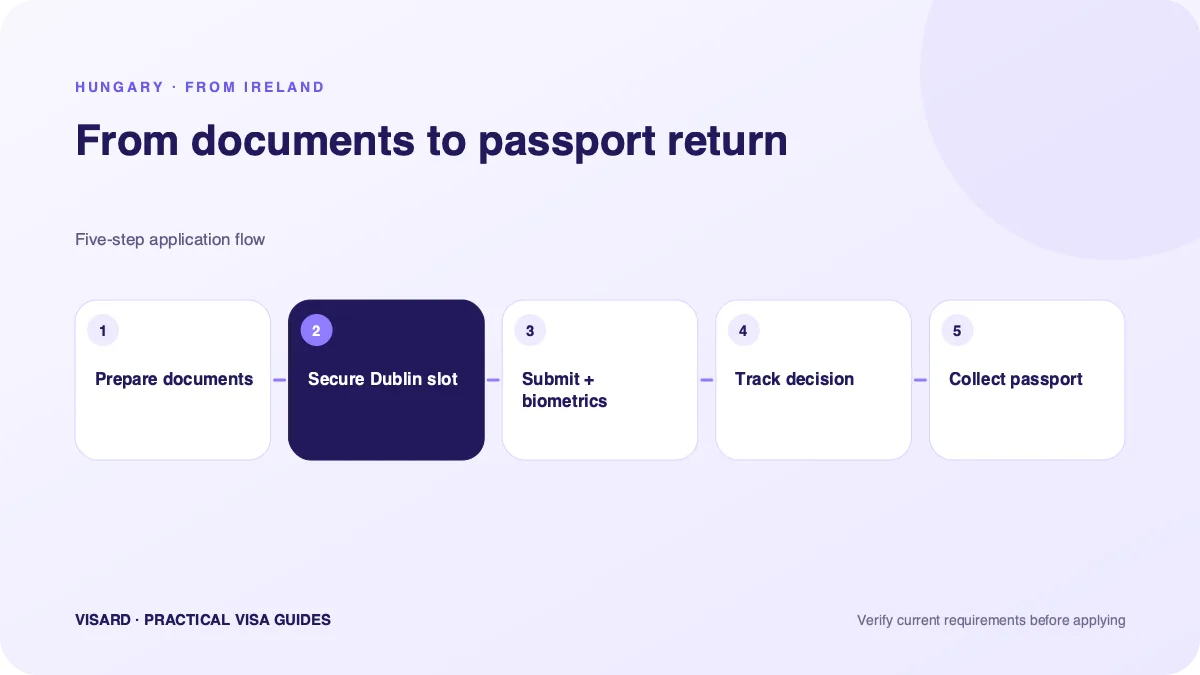
Step 1, Gather and Prepare All Documents
The first step is to meticulously gather and prepare all the required documents as per the checklist provided above. It is highly recommended to create a checklist and tick off each item as you prepare it. Make photocopies of all original documents, as the application centre will keep the copies. Ensure that all documents are up-to-date and meet the specified requirements.
Step 2, Book Your Visa Appointment in Dublin
Booking the appointment is the hardest part. Slots on the VFS Global portal for Hungary disappear in seconds, forcing applicants to spend weeks manually refreshing the page.
Automated services like Visard solve this problem. The service monitors the booking site every 3 seconds and provides instant Telegram alerts. For Hungary, Visard offers an Hungary visa appointment in Dublin for €100 (plus €50 for each additional family member), charged only after success. This pay-after-success model eliminates risk.
Step 3, Attend Your Appointment and Submit Biometrics
On the day of your appointment, you will need to visit the VFS Global centre in person. During the appointment, you will submit your application form and all supporting documents. Your biometric data, which includes fingerprints and a digital photograph, will also be collected. This data is stored in the Visa Information System (VIS) and is valid for 59 months. You will also pay the visa fee and the VFS service fee at the centre.
Step 4, Track Your Application
After submitting your application, you can track its status online through the VFS Global website. You will receive a tracking number at the time of submission. The processing time can vary, so it is advisable to track your application regularly for updates. If there are any delays, you may need to contact VFS Global for more information.
Step 5, Collect Your Passport
Once a decision has been made on your application, you will be notified to collect your passport from the VFS Global centre. Alternatively, you can opt for a courier service to have your passport delivered to your address. When you receive your passport, check the visa sticker immediately to ensure all the details are correct, including your name, passport number, and the visa validity dates. If your visa is refused, you will receive a letter explaining the reasons for the refusal and the process for an appeal.
Hungary Visa Fees and Processing Times from Ireland
Understanding the costs and timelines associated with your visa application is essential for proper planning. All fees are paid in Euros (€) at the VFS Global centre during your appointment.
Official Visa Fees
The fees for a Hungarian Schengen visa from Ireland are composed of the consulate fee and the VFS Global service fee.
Schengen Visa Fee: As of 2026, the standard fee is €90 for adults and €45 for children between the ages of 6 and 12. There is no fee for children under the age of 6.
VFS Global Service Charge: A mandatory service fee of €19 is charged by VFS Global for processing the application.
Optional Services: VFS Global offers additional services for a fee, such as SMS updates on your application status and courier services for passport return. These are optional and can be selected at the time of your appointment.
Processing Time for Hungary Visa from Ireland
There is some conflicting information regarding the processing time for Hungarian visa applications from Ireland. The VFS Global website for Hungary suggests a minimum processing time of 20 working days. However, the standard processing time under the Schengen Visa Code is 15 calendar days. This period can be extended up to 45 days in individual cases, for instance, when further scrutiny of the application is needed.
Given this discrepancy, it is highly recommended that you apply well in advance of your intended travel date. The Embassy of Hungary in Dublin advises applying at least 30 days before your trip. To be safe, you should aim to apply at least 4-6 weeks prior to your departure. The earliest you can submit your application is six months before your trip.
Total Cost Breakdown
Here is an estimated breakdown of the total cost for a single adult applicant:
Fee Type | Amount |
|---|---|
Consulate Visa Fee | €90 |
VFS Global Service Charge | €19 |
Travel Insurance | ~€15-€40 |
Total Estimated Cost | ~€124-€149 |
How to Get Your Hungary Visa Appointment Faster from Ireland
Securing a visa appointment is the biggest hurdle for applicants in Ireland. This section explains the problem and the solution.
The Dublin Appointment Bottleneck
Ireland's large and growing population of non-EU residents creates immense demand for visa services. However, the number of visa application centres in Dublin is limited. For popular destinations like Hungary, this creates a significant bottleneck. Appointment slots are released sporadically and are often booked within seconds by the thousands of applicants who are constantly refreshing the VFS Global website. This manual checking process is not only time-consuming and frustrating but also frequently unsuccessful.
Why Manual Booking Fails
Manual booking often fails for these reasons:
Extreme Competition: You are competing with thousands of other applicants for a very limited number of slots.
Unpredictable Schedule: There is no set schedule for when new appointments are released. They can appear at any time of day or night.
Speed of Booking: The slots are often taken by automated tools or faster users before you can even complete the booking form.
Constant Refreshing: The need to constantly refresh the browser page is exhausting and impractical for most people.
Automated Appointment Monitoring with Visard
Automated monitoring with Visard is the solution. It checks for appointments every 3 seconds and sends instant Telegram alerts. The auto-booking feature secures the slot for you automatically.
The pay-after-success model (€100 per primary applicant, €50 for additional) means you only pay after an appointment is booked, eliminating risk. With over 15,000 appointments secured and a 4.8/5 Trustpilot rating, it's a proven system. More details are on the Schengen visa appointment service for Ireland page.
Visard vs Traditional Visa Agents
Compared to traditional agents who charge €200-€400 upfront with no guarantee, Visard's €100 pay-after-success fee offers the same result at a fraction of the cost and with no risk.
Common Hungary Visa Rejection Reasons from Ireland
Knowing why applications are rejected helps you avoid the same fate.
Incomplete or Incorrect Documentation
This is one of the most common reasons for visa refusal. Ensure you have submitted all the required documents as per the checklist. Double-check that your IRP card is valid and that you have filled out the application form correctly and signed it.
Insufficient Financial Proof
You must demonstrate that you have sufficient funds to cover your travel expenses. A low bank balance, a lack of regular income, or bank statements that are too old can all lead to a rejection. It is important to provide recent bank statements that show a consistent and stable financial situation.
Unclear Purpose of Travel
Your application must clearly state the purpose of your visit. A vague or inconsistent itinerary, a lack of hotel bookings, or conflicting dates between your flight reservations and your accommodation bookings can raise red flags. Your cover letter should provide a clear and detailed explanation of your travel plans.
Weak Ties to Ireland
Consular officers need to be convinced that you will return to Ireland after your trip. A lack of strong ties to your country of residence is a common reason for refusal. You can demonstrate strong ties through a stable job, property ownership, family commitments, or ongoing studies.
How to Reduce Your Rejection Risk
Apply Early: Submitting your application well in advance shows that you are a well-prepared and serious applicant.
Provide More Than the Minimum: If you can provide additional supporting documents, such as property deeds, car ownership documents, or evidence of family ties, it can strengthen your application.
Write a Detailed Cover Letter: Use your cover letter to explain any potential ambiguities in your application and to present a clear and compelling case for your visit.
Ensure Consistency: Double-check that all the information in your documents is consistent, including dates, names, and addresses.
Hungary-Specific Visa Requirements and Tips
While the Schengen visa requirements are largely standardised, there can be some country-specific nuances. For Hungary, it is important to be aware of the following:
Invitation Letter Requirements: If you are visiting friends or family, the invitation letter should be a formal document. It is good practice to have a detailed and official-looking letter.
Best Time to Visit: Hungary is a year-round destination, but the best times to visit are during the spring (April to June) and autumn (September to October) when the weather is pleasant. The summer months (July and August) can be hot and crowded.
Popular Travel Routes: Most travellers from Ireland will fly into Budapest Ferenc Liszt International Airport (BUD), the country's main international gateway. There are direct flights from Dublin to Budapest on airlines like Ryanair.
Schengen Entry Rules: As your first port of entry into the Schengen Area, Hungarian immigration officials may ask to see your supporting documents, such as your hotel reservations and travel insurance. It is advisable to have copies of these documents in your hand luggage.
Frequently Asked Questions, Hungary Schengen Visa from Ireland
Do Irish passport holders need a visa for Hungary?
No, Irish citizens do not need a visa to travel to Hungary or any other country in the Schengen Area. As EU citizens, they enjoy the freedom of movement within the Schengen zone. This guide is intended for non-EU/EEA nationals who are residents of Ireland.
How long does a Hungary Schengen visa take from Ireland?
The official VFS Global website states a minimum processing time of 20 working days. However, the standard processing time under the Schengen Visa Code is 15 calendar days. To be safe, you should apply at least 30 to 45 days before your intended travel date, especially during peak seasons.
Can I apply for a Hungary visa online from Ireland?
The initial part of the application, including filling out the form and booking an appointment, is done online through the VFS Global portal. However, you must submit your application and provide your biometric data in person at the VFS Global centre in Dublin. Therefore, the entire process cannot be completed online.
How much does a Hungary Schengen visa cost from Ireland?
The total mandatory cost for a single adult applicant is €109. This consists of the €90 Schengen visa fee and the €19 VFS Global service fee. This does not include other potential costs like travel insurance, photos, or optional services like courier delivery.
Will using a visa appointment bot affect my Hungary visa application?
No. Using a service like Visard to book your appointment has absolutely no impact on the outcome of your visa application. The visa decision is made solely by the Embassy of Hungary based on the documents you submit. Visard is a tool that automates the booking process only; it is not involved in the visa decision itself. Over 15,000 applicants have successfully used Visard and attended their appointments without any issues.
Can I book a Hungary visa appointment for my family from Ireland?
Yes, you can. When booking through the VFS Global portal, you can typically add multiple applicants to a single appointment slot if they are available. Services like Visard are also family-friendly, allowing you to secure appointments for your entire family under a single subscription.
What happens if my Hungary visa is rejected?
If your visa application is rejected, you will receive a formal notification explaining the reasons for the refusal. You have the right to appeal this decision. The appeal process and deadline will be detailed in the refusal letter. Alternatively, you can address the reasons for the rejection and submit a new application.
Conclusion
Getting a Hungarian Schengen visa from Ireland is achievable with early and thorough preparation. A successful application depends on accurate documentation and a clear travel purpose. The main challenge is booking the appointment in Dublin.
Don't let the stress of booking an appointment delay your trip. watch Hungary Schengen visa appointment slots in Dublin in 60 seconds with Visard and secure your appointment with the pay-after-success auto-booking service.
Applying on the same route from another country? Our guide to Hungary visa checklist from the UK 2026 covers the steps.
Our full breakdown of Hungary visa appointment from the UK works through the same process in detail.
Official context: EU and Schengen consulates received more than 11.7 million short-stay visa applications in 2024 and refused 14.8% worldwide, down from 16% in 2023 and 17.9% in 2022. Rates vary by consulate and applicant profile. European Commission 2024 visa statistics.
If checking the portal every day is not realistic, you can use the Visard Schengen Visa Slot Tracker to follow appointment availability from Dublin instead.
Official sources checked for this update
Use these primary sources to verify the current rule or route before applying.
Embassy of Hungary in DublinVFS Global Ireland receives Hungary visa applications from November 2024; lodge at least 15 days before departure.
Hungary Schengen Visa from Ireland 2026: Complete Requirements & Application Guide
Last updated: 7 August 2026. Requirements, fees, providers and representation arrangements can change; confirm the route-specific checklist linked in the official sources before submitting.
Applying for a Schengen visa to Hungary from Ireland can be a complex process, not because of the paperwork, but due to the extreme difficulty in securing a visa appointment in Dublin. This guide provides a complete walkthrough of the 2026 application process for non-EU nationals with an Irish Residence Permit (IRP), covering requirements, documents, and strategies to secure an appointment faster.
Since Ireland is not in the Schengen Area, most non-EU/EEA residents need a visa to visit Hungary. This guide is for IRP holders and will cover the entire application, including how automated tools like the Visard Schengen Visa Appointment Bot can help secure an appointment. Irish citizens do not need a visa.
Hungary Schengen Visa Requirements from Ireland
To apply for a Hungary Schengen visa from Ireland, you will need a valid passport, a completed application form, a recent passport photo, travel medical insurance, proof of accommodation and flights, evidence of sufficient funds, and your Irish Residence Permit (IRP). The application must be submitted in person at the VFS Global centre in Dublin after booking an appointment online.
Overview of Hungary Schengen Visa Types
The most common type of visa for tourists and short-term visitors is the Short-stay (Type C) visa. This visa allows for travel throughout the Schengen Area for up to 90 days within a 180-day period. The Type C visa is suitable for:
Tourism
Business trips
Visiting family or friends
This guide focuses exclusively on the short-stay visa. Applications for long-stay national visas (for work, study, or residence) follow a different process and are handled directly by the Embassy of Hungary.
Who Needs a Hungary Schengen Visa from Ireland?
Here's who needs a visa:
Irish Citizens: Irish passport holders do not need a visa to travel to Hungary or any other Schengen country.
Non-EU/EEA Nationals with an Irish Residence Permit (IRP): If you are a citizen of a country that does not have a visa-waiver agreement with the Schengen states, you must obtain a Schengen visa before travelling to Hungary. The IRP card is essential for your application.
EU Family Members (Stamp 4 EU FAM): Holders of a "Stamp 4 EU FAM" residence card issued by Ireland may be exempt from the visa requirement, as this card indicates they are a family member of an EU citizen. However, it is strongly recommended to confirm this with the Embassy of Hungary in Dublin before travelling, as rules can be subject to interpretation and change.
Common Nationalities Applying from Ireland: A significant number of applicants for Schengen visas in Ireland are from countries such as India, Pakistan, China, the Philippines, Nigeria, and Turkey, among others.
Where to Apply: VFS Global in Dublin
Visa applications for Hungary from Ireland are managed by VFS Global, an external service provider that acts on behalf of the Embassy of Hungary in Dublin. While the final visa decision is made by the embassy, all applications must be submitted through the VFS Global application centre.
You must book an appointment through the VFS Global website before you can submit your documents. Applicants should confirm the centre location during the appointment booking process.
Decision-Making Body: Embassy of Hungary, Dublin
Application Submission: VFS Global
Appointment Booking Portal: visa.vfsglobal.com/irl/en/hun
Required Documents Checklist for Hungary Visa from Ireland
Preparing a complete and accurate set of documents is the most critical part of your visa application. All submitted documents should be recent (issued within the last month), and you must present the original documents along with a photocopy for submission.
Mandatory Documents for All Applicants
Document | Details |
|---|---|
Valid Passport | Must have at least two blank pages and be valid for a minimum of three months beyond your intended departure from the Schengen Area. |
Application Form | The completed and signed Schengen visa application form. This is typically filled out online via the VFS Global portal. |
Passport Photo | One recent, colour passport-size photograph that meets ICAO standards (e.g., white background, no glasses, neutral expression). |
Travel Medical Insurance | The policy must provide a minimum coverage of €30,000 for emergency medical care, hospitalisation, and repatriation. It must be valid across the entire Schengen Area for the full duration of your trip. |
Irish Residence Permit (IRP) | Your valid IRP card is mandatory. You must present the original card and provide a photocopy of the front and back. The permit must be valid for at least three months after your planned return from the Schengen zone. |
Proof of Accommodation | Confirmed hotel reservations for your entire stay in Hungary and any other Schengen countries you plan to visit. If you are staying with a host, a formal letter of invitation is required. |
Flight Itinerary | A round-trip flight reservation showing your travel dates. Do not purchase the tickets until your visa is approved; a reservation is sufficient. |
Financial Proof | Evidence of sufficient funds to cover your trip. This typically involves providing your last three to six months of bank statements. A general guideline for the Schengen Area is to show access to approximately €60-€100 per day of your stay. |
Cover Letter | A signed letter explaining the purpose of your visit, your detailed travel itinerary (day-by-day plan), the dates of your trip, and a list of the documents you are submitting. |
Employment or Student Letter | If employed, a letter from your employer on company letterhead confirming your position, salary, start date, and approved leave. If a student, a letter from your university or college confirming your enrolment and attendance. |
Additional Documents by Visa Type
Depending on the specific purpose of your visit, you may need to provide additional supporting documents:
For Tourism: A detailed day-by-day travel plan, including any internal travel bookings (trains, buses) and tickets for attractions, if available.
For Business: An official invitation letter from the company in Hungary you will be visiting. This letter should detail the purpose of your visit, your intended activities, and the duration of your stay. Proof of the business relationship (e.g., contracts, correspondence) may also be required.
For Visiting Family or Friends: A formal letter of invitation from your host in Hungary. This should be accompanied by a copy of your host's passport or Hungarian ID card, and if they are not a Hungarian citizen, a copy of their Hungarian residence permit.
Common Document Mistakes to Avoid
Avoid these common mistakes:
Expired IRP Card: Submitting an IRP card that will expire too soon is a frequent reason for refusal.
Outdated Bank Statements: Your financial statements must be recent, typically from within the last month.
Insufficient Travel Insurance: Ensure your insurance policy explicitly covers the entire Schengen Area and meets the minimum coverage amount.
Missing Signatures: The application form and cover letter must be signed.
Incorrect Photo Specifications: A photo that does not meet the strict ICAO standards will be rejected.
Hungary Visa Application Process from Ireland: Step-by-Step
Step 1, Gather and Prepare All Documents
The first step is to meticulously gather and prepare all the required documents as per the checklist provided above. It is highly recommended to create a checklist and tick off each item as you prepare it. Make photocopies of all original documents, as the application centre will keep the copies. Ensure that all documents are up-to-date and meet the specified requirements.
Step 2, Book Your Visa Appointment in Dublin
Booking the appointment is the hardest part. Slots on the VFS Global portal for Hungary disappear in seconds, forcing applicants to spend weeks manually refreshing the page.
Automated services like Visard solve this problem. The service monitors the booking site every 3 seconds and provides instant Telegram alerts. For Hungary, Visard offers an Hungary visa appointment in Dublin for €100 (plus €50 for each additional family member), charged only after success. This pay-after-success model eliminates risk.
Step 3, Attend Your Appointment and Submit Biometrics
On the day of your appointment, you will need to visit the VFS Global centre in person. During the appointment, you will submit your application form and all supporting documents. Your biometric data, which includes fingerprints and a digital photograph, will also be collected. This data is stored in the Visa Information System (VIS) and is valid for 59 months. You will also pay the visa fee and the VFS service fee at the centre.
Step 4, Track Your Application
After submitting your application, you can track its status online through the VFS Global website. You will receive a tracking number at the time of submission. The processing time can vary, so it is advisable to track your application regularly for updates. If there are any delays, you may need to contact VFS Global for more information.
Step 5, Collect Your Passport
Once a decision has been made on your application, you will be notified to collect your passport from the VFS Global centre. Alternatively, you can opt for a courier service to have your passport delivered to your address. When you receive your passport, check the visa sticker immediately to ensure all the details are correct, including your name, passport number, and the visa validity dates. If your visa is refused, you will receive a letter explaining the reasons for the refusal and the process for an appeal.
Hungary Visa Fees and Processing Times from Ireland
Understanding the costs and timelines associated with your visa application is essential for proper planning. All fees are paid in Euros (€) at the VFS Global centre during your appointment.
Official Visa Fees
The fees for a Hungarian Schengen visa from Ireland are composed of the consulate fee and the VFS Global service fee.
Schengen Visa Fee: As of 2026, the standard fee is €90 for adults and €45 for children between the ages of 6 and 12. There is no fee for children under the age of 6.
VFS Global Service Charge: A mandatory service fee of €19 is charged by VFS Global for processing the application.
Optional Services: VFS Global offers additional services for a fee, such as SMS updates on your application status and courier services for passport return. These are optional and can be selected at the time of your appointment.
Processing Time for Hungary Visa from Ireland
There is some conflicting information regarding the processing time for Hungarian visa applications from Ireland. The VFS Global website for Hungary suggests a minimum processing time of 20 working days. However, the standard processing time under the Schengen Visa Code is 15 calendar days. This period can be extended up to 45 days in individual cases, for instance, when further scrutiny of the application is needed.
Given this discrepancy, it is highly recommended that you apply well in advance of your intended travel date. The Embassy of Hungary in Dublin advises applying at least 30 days before your trip. To be safe, you should aim to apply at least 4-6 weeks prior to your departure. The earliest you can submit your application is six months before your trip.
Total Cost Breakdown
Here is an estimated breakdown of the total cost for a single adult applicant:
Fee Type | Amount |
|---|---|
Consulate Visa Fee | €90 |
VFS Global Service Charge | €19 |
Travel Insurance | ~€15-€40 |
Total Estimated Cost | ~€124-€149 |
How to Get Your Hungary Visa Appointment Faster from Ireland
Securing a visa appointment is the biggest hurdle for applicants in Ireland. This section explains the problem and the solution.
The Dublin Appointment Bottleneck
Ireland's large and growing population of non-EU residents creates immense demand for visa services. However, the number of visa application centres in Dublin is limited. For popular destinations like Hungary, this creates a significant bottleneck. Appointment slots are released sporadically and are often booked within seconds by the thousands of applicants who are constantly refreshing the VFS Global website. This manual checking process is not only time-consuming and frustrating but also frequently unsuccessful.
Why Manual Booking Fails
Manual booking often fails for these reasons:
Extreme Competition: You are competing with thousands of other applicants for a very limited number of slots.
Unpredictable Schedule: There is no set schedule for when new appointments are released. They can appear at any time of day or night.
Speed of Booking: The slots are often taken by automated tools or faster users before you can even complete the booking form.
Constant Refreshing: The need to constantly refresh the browser page is exhausting and impractical for most people.
Automated Appointment Monitoring with Visard
Automated monitoring with Visard is the solution. It checks for appointments every 3 seconds and sends instant Telegram alerts. The auto-booking feature secures the slot for you automatically.
The pay-after-success model (€100 per primary applicant, €50 for additional) means you only pay after an appointment is booked, eliminating risk. With over 15,000 appointments secured and a 4.8/5 Trustpilot rating, it's a proven system. More details are on the Schengen visa appointment service for Ireland page.
Visard vs Traditional Visa Agents
Compared to traditional agents who charge €200-€400 upfront with no guarantee, Visard's €100 pay-after-success fee offers the same result at a fraction of the cost and with no risk.
Common Hungary Visa Rejection Reasons from Ireland
Knowing why applications are rejected helps you avoid the same fate.
Incomplete or Incorrect Documentation
This is one of the most common reasons for visa refusal. Ensure you have submitted all the required documents as per the checklist. Double-check that your IRP card is valid and that you have filled out the application form correctly and signed it.
Insufficient Financial Proof
You must demonstrate that you have sufficient funds to cover your travel expenses. A low bank balance, a lack of regular income, or bank statements that are too old can all lead to a rejection. It is important to provide recent bank statements that show a consistent and stable financial situation.
Unclear Purpose of Travel
Your application must clearly state the purpose of your visit. A vague or inconsistent itinerary, a lack of hotel bookings, or conflicting dates between your flight reservations and your accommodation bookings can raise red flags. Your cover letter should provide a clear and detailed explanation of your travel plans.
Weak Ties to Ireland
Consular officers need to be convinced that you will return to Ireland after your trip. A lack of strong ties to your country of residence is a common reason for refusal. You can demonstrate strong ties through a stable job, property ownership, family commitments, or ongoing studies.
How to Reduce Your Rejection Risk
Apply Early: Submitting your application well in advance shows that you are a well-prepared and serious applicant.
Provide More Than the Minimum: If you can provide additional supporting documents, such as property deeds, car ownership documents, or evidence of family ties, it can strengthen your application.
Write a Detailed Cover Letter: Use your cover letter to explain any potential ambiguities in your application and to present a clear and compelling case for your visit.
Ensure Consistency: Double-check that all the information in your documents is consistent, including dates, names, and addresses.
Hungary-Specific Visa Requirements and Tips
While the Schengen visa requirements are largely standardised, there can be some country-specific nuances. For Hungary, it is important to be aware of the following:
Invitation Letter Requirements: If you are visiting friends or family, the invitation letter should be a formal document. It is good practice to have a detailed and official-looking letter.
Best Time to Visit: Hungary is a year-round destination, but the best times to visit are during the spring (April to June) and autumn (September to October) when the weather is pleasant. The summer months (July and August) can be hot and crowded.
Popular Travel Routes: Most travellers from Ireland will fly into Budapest Ferenc Liszt International Airport (BUD), the country's main international gateway. There are direct flights from Dublin to Budapest on airlines like Ryanair.
Schengen Entry Rules: As your first port of entry into the Schengen Area, Hungarian immigration officials may ask to see your supporting documents, such as your hotel reservations and travel insurance. It is advisable to have copies of these documents in your hand luggage.
Frequently Asked Questions, Hungary Schengen Visa from Ireland
Do Irish passport holders need a visa for Hungary?
No, Irish citizens do not need a visa to travel to Hungary or any other country in the Schengen Area. As EU citizens, they enjoy the freedom of movement within the Schengen zone. This guide is intended for non-EU/EEA nationals who are residents of Ireland.
How long does a Hungary Schengen visa take from Ireland?
The official VFS Global website states a minimum processing time of 20 working days. However, the standard processing time under the Schengen Visa Code is 15 calendar days. To be safe, you should apply at least 30 to 45 days before your intended travel date, especially during peak seasons.
Can I apply for a Hungary visa online from Ireland?
The initial part of the application, including filling out the form and booking an appointment, is done online through the VFS Global portal. However, you must submit your application and provide your biometric data in person at the VFS Global centre in Dublin. Therefore, the entire process cannot be completed online.
How much does a Hungary Schengen visa cost from Ireland?
The total mandatory cost for a single adult applicant is €109. This consists of the €90 Schengen visa fee and the €19 VFS Global service fee. This does not include other potential costs like travel insurance, photos, or optional services like courier delivery.
Will using a visa appointment bot affect my Hungary visa application?
No. Using a service like Visard to book your appointment has absolutely no impact on the outcome of your visa application. The visa decision is made solely by the Embassy of Hungary based on the documents you submit. Visard is a tool that automates the booking process only; it is not involved in the visa decision itself. Over 15,000 applicants have successfully used Visard and attended their appointments without any issues.
Can I book a Hungary visa appointment for my family from Ireland?
Yes, you can. When booking through the VFS Global portal, you can typically add multiple applicants to a single appointment slot if they are available. Services like Visard are also family-friendly, allowing you to secure appointments for your entire family under a single subscription.
What happens if my Hungary visa is rejected?
If your visa application is rejected, you will receive a formal notification explaining the reasons for the refusal. You have the right to appeal this decision. The appeal process and deadline will be detailed in the refusal letter. Alternatively, you can address the reasons for the rejection and submit a new application.
Conclusion
Getting a Hungarian Schengen visa from Ireland is achievable with early and thorough preparation. A successful application depends on accurate documentation and a clear travel purpose. The main challenge is booking the appointment in Dublin.
Don't let the stress of booking an appointment delay your trip. watch Hungary Schengen visa appointment slots in Dublin in 60 seconds with Visard and secure your appointment with the pay-after-success auto-booking service.
Applying on the same route from another country? Our guide to Hungary visa checklist from the UK 2026 covers the steps.
Our full breakdown of Hungary visa appointment from the UK works through the same process in detail.
Official context: EU and Schengen consulates received more than 11.7 million short-stay visa applications in 2024 and refused 14.8% worldwide, down from 16% in 2023 and 17.9% in 2022. Rates vary by consulate and applicant profile. European Commission 2024 visa statistics.
If checking the portal every day is not realistic, you can use the Visard Schengen Visa Slot Tracker to follow appointment availability from Dublin instead.
Official sources checked for this update
Use these primary sources to verify the current rule or route before applying.
Embassy of Hungary in DublinVFS Global Ireland receives Hungary visa applications from November 2024; lodge at least 15 days before departure.
Related posts
Hungary Visa Requirements from Ireland 2026

Spain Visa Appointment in Dublin 2026: BLS and Documents

Slovenia Visa Requirements from Ireland 2026

Liechtenstein Visa Documents from Ireland
Croatia Visa Requirements from Ireland 2026

Denmark Visa Appointment in Dublin 2026: VFS and Documents

Sweden Visa Requirements from Ireland 2026

Norway Visa Requirements from Ireland 2026

Iceland Visa from Ireland 2026: Dublin Appointments

Switzerland Visa Requirements from Ireland
Related posts
Related posts