Schengen Visa from India 2026: Complete Guide for Indian Residents
Every year, millions of Indians face the same nightmare: securing a Schengen visa appointment at VFS Global. You've tried for weeks. The Delhi centre shows no slots. Mumbai is fully booked. Bangalore appointments vanish in seconds.
The cruel irony? Getting your visa approved isn't the problem. The real bottleneck is getting an appointment to even submit your application.
As of 2026, Indian passport holders need a Schengen visa to visit any of the 29 Schengen countries for tourism, business, or family visits. This applies to all Indian nationals worldwide, as well as non-Indian nationals legally residing in India for over one year. The good news: a new cascade visa regime introduced in April 2024 now offers 2-year and 5-year multi-entry visas for repeat travelers, essentially giving you visa-free-equivalent travel rights once you've established a clean track record.
But there's a catch. None of these benefits matter if you can't book an appointment in the first place.
This guide covers everything from VFS Global centres across India to document requirements, processing times, and the new cascade visa regime. You'll learn which countries are easiest to get visas from India, how much the process actually costs in rupees, and why a cover letter isn't legally mandatory but could make or break your application.
At Visard, we've helped secure 25,000+ visa appointments globally with a 4-7 day average. We understand the VFS appointment crisis better than anyone. Let's solve it together.
If the calendar keeps coming back empty, Visard watches it and messages you when Schengen visa appointment slots in India open.
Who Needs a Schengen Visa from India?
Indian passport holders need a Schengen visa to visit any of the 29 Schengen countries for tourism, business, or family visits. This applies to all Indian nationals regardless of where they live, as well as non-Indian nationals legally residing in India for over one year.
Indian Passport Holders Worldwide
If you hold an Indian passport, you need a Schengen visa even if you live outside India. Whether you're a student in the UK, a professional in Dubai, or a permanent resident in Canada, your Indian nationality requires you to obtain a visa before traveling to the Schengen zone.
Non-Indian Nationals Residing in India
Foreign nationals who have lived in India for more than one year can apply for Schengen visas from India. You'll need proof of legal residence (employment visa, residence permit, or PIO/OCI card) along with standard documentation.
Green Card Holders and Permanent Residents Abroad
Indian nationals with US green cards or Canadian permanent residency still need Schengen visas. Your residence status abroad doesn't exempt you from visa requirements based on your passport nationality.
Who Doesn't Need a Visa
EU and Schengen nationals don't need visas. If you hold dual citizenship with an EU country, use that passport for travel. British citizens also don't need Schengen visas despite Brexit, though they're limited to 90 days in 180 days like other visa-free nationals.
Understanding Schengen Visa Categories for Indians
Official 2025 context: EU and Schengen-associated consulates received more than 12 million short-stay visa applications in 2025. The worldwide refusal rate was 14.6%, down from 14.8% in 2024; 51.7% of issued visas allowed multiple entries. These are global figures, not a prediction for an individual application. European Commission 2025 visa statistics.
Type C (Short-Stay Visa) - The Standard Option
The Type C visa is what 95% of Indian applicants need. It allows you to stay in the Schengen area for up to 90 days within any 180-day period. This covers tourism and leisure (visiting Paris, Rome, or Barcelona), business meetings and conferences, family and friend visits, and cultural or sporting events.
The 90/180 rule is critical. You can't just stay 90 days, leave for a week, and come back for another 90 days. The system tracks your total days in the Schengen zone over a rolling 180-day window.
Multiple-Entry Visa Eligibility: The 2024 Cascade Regime
This is the game-changer for 2026. In April 2024, the European Commission adopted special rules specifically for Indian nationals residing in India. Here's how the cascade system works: obtain and lawfully use two Schengen visas within the previous three years, and your third application automatically qualifies you for a 2-year multi-entry visa. Use that 2-year visa responsibly, and your next application grants a 5-year multi-entry visa.
The benefits are massive. Once you have a 2-year or 5-year visa, you enjoy travel rights equivalent to visa-free nationals. No more applying for every trip. No more gathering bank statements every six months. You simply book your flights and go, as long as you respect the 90/180 rule.
The only requirement is sufficient passport validity. For a 5-year visa, your passport must be valid for at least 5 years plus 3 months beyond.
Type A (Airport Transit Visa)
If you're transiting through a Schengen airport (changing flights without entering the country), some nationalities need an airport transit visa. Indian nationals generally don't need this unless you're changing airports within the same city (like Paris Orly to Charles de Gaulle) or leaving the international transit area.
Long-Stay Visas (Work, Study)
Type D visas (national visas) are for stays exceeding 90 days. These are issued by individual Schengen countries for work, study, or family reunification. The application process is entirely different and goes through the specific country's embassy or consulate, not VFS Global in most cases.
Selecting the Correct Country for Your Application
Single Destination Rule (Most Straightforward)
If you're only visiting one Schengen country, apply for that country's visa. Going to Switzerland for a conference? Apply for a Swiss visa. Honeymoon in France? French visa. This is the simplest scenario.
Multiple Destinations Rule (Country with Most Days)
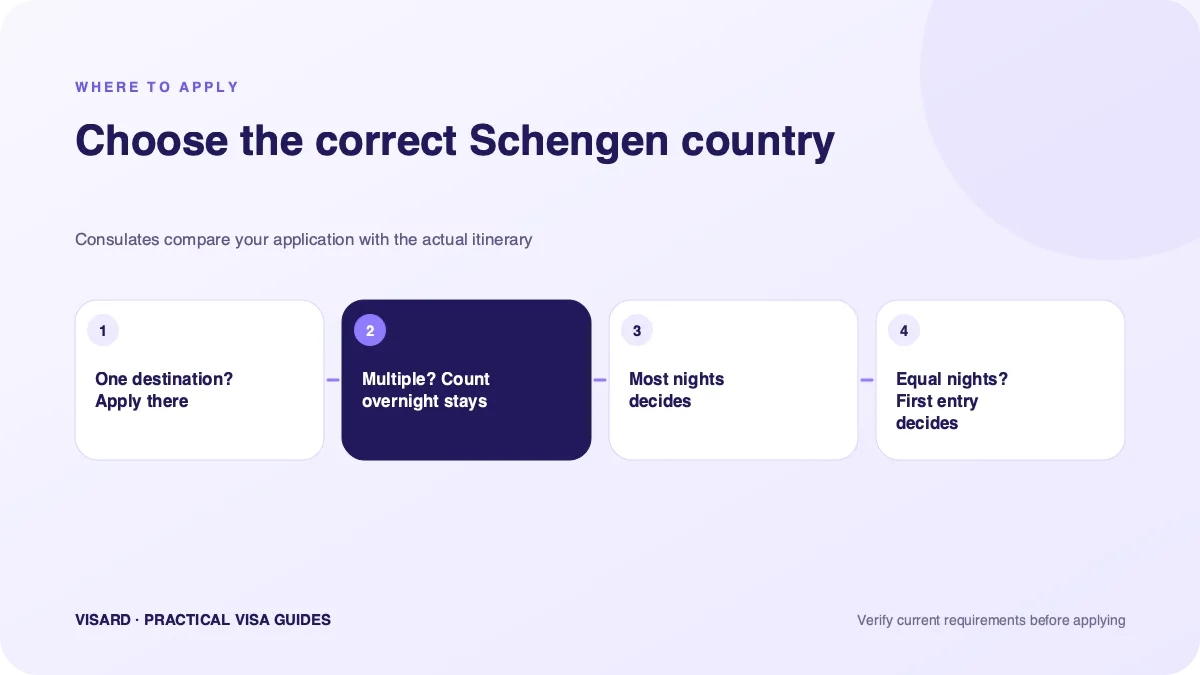
Visiting multiple countries? Apply to the country where you'll spend the most days. If you're spending 5 days in France, 3 days in Switzerland, and 2 days in Belgium, apply for a French visa. Count overnight stays, not arrival/departure days.
Equal Time Rule (First Entry Point)
If you're spending equal time in multiple countries (4 days in Netherlands, 4 days in Belgium), apply to the country where you'll first enter the Schengen zone. If you're flying into Amsterdam before heading to Brussels, apply for a Netherlands visa.
Why This Matters for Indian Applicants (Rejection Risk)
Getting this wrong is a common rejection reason for Indian applicants. Consulates verify your travel itinerary against your flight bookings and hotel confirmations. If you apply for a French visa but your itinerary shows 8 days in another country and 2 days in France, you're likely to be rejected for applying to the wrong mission.
Countries to Avoid vs. Easier Countries
Based on 2025-2026 data, some countries have significantly lower rejection rates for Indian applicants. Lithuania, Estonia, Latvia, and Slovakia are known as "easier" countries with rejection rates around 5-8%. Switzerland, Greece, and Czech Republic are also relatively straightforward, with rejection rates around 10-15%.
France, Sweden, and Norway have higher rejection rates (20-25%) for Indian applicants, often due to stricter scrutiny of financial documents and return intention proof. This doesn't mean you shouldn't apply to these countries if that's your genuine destination, but it does mean your documentation needs to be absolutely flawless.
VFS Global Application Centres Across India
VFS Global: India's Primary Service Provider
As of 2026, VFS Global operates 12 application centres across India, making it the largest visa service provider in the country. The major centres are Delhi (relocating some operations to K.G. Marg for select missions in January 2026), Mumbai (Urmi Axis Building, Mahalaxmi West), Bangalore (Global Tech Park, Langford Road), and Chennai (Fagun Towers, Ethiraj Salai).
Additional centres include Hyderabad (Punjagutta Metro Station), Kolkata (Rene Tower, Rajdanga Main Road), Pune (93 Avenue Mall, Wanowrie), Ahmedabad (GC Road, Navrangpura), Cochin (Coastal Chambers, M G Road), Chandigarh (Elante Offices, Industrial Area), Jalandhar (Aman Plaza, Lajpat Nagar), and Lucknow (Golden High Way, Alambagh, servicing select countries like France and Switzerland).
Which Countries Use VFS vs. Other Providers vs. Direct Embassy
Most Schengen countries use VFS Global in India, including France, Switzerland, Austria, Netherlands, Belgium, and Croatia. However, there are critical exceptions in 2026.
Spain uses BLS International, not VFS Global. All Spanish visa applications must go through BLS centres, not VFS. This is a common mistake that costs Indian applicants time and money.
Greece underwent a major change in January 2026. GVC World (GVCW), which previously handled Greek visa applications, ceased operations in India on January 1, 2026. Until a new provider is announced, applicants must contact the Embassy of Greece in New Delhi directly. Check the embassy website for the latest instructions.
Slovakia is the opposite story. VFS Global won the contract to open 87 new centres effective January 2026, making Slovakia one of the most accessible Schengen countries for Indian applicants in terms of appointment availability.
Choosing the Right Centre Based on Residence
For most countries, you're required to apply at the VFS centre closest to your residence. You'll need to prove residency (Aadhaar card, utility bill, or rental agreement) matching the centre's jurisdiction. Delhi serves North India, Mumbai serves West India, Bangalore serves South India, and Kolkata serves East India, but specific boundaries vary by country.
The 2026 Documentation Checklist for Indian Applicants
Valid Passport Requirements
Your passport must have at least 3 months validity beyond your planned return date from the Schengen zone. If you're traveling August 1-15, 2026, your passport must be valid until at least November 15, 2026. The passport must also have at least two blank pages for visa stamps.
India-Specific Mandatory Requirement: You must submit all old passports. If you've had previous passports (expired or cancelled), you must bring them to your VFS appointment. If an old passport is lost, you need to provide a police FIR (First Information Report) or proof of cancellation from the passport office. This requirement catches many first-time Indian applicants off guard.
Financial Evidence for Indians
Financial documentation for Indian applicants typically requires bank statements for the last 3-6 months, stamped and signed by your bank. Unstamped online printouts are often rejected. You also need Income Tax Returns (ITR-V acknowledgment) for the past 3 years. Unlike other countries where pay slips might suffice, ITR is the gold standard in India for proving financial credibility.
If you're employed, include an employment letter on company letterhead showing your salary, designation, joining date, and approved leave. For business owners, provide business registration documents and GST returns. If someone else is sponsoring your trip (parents, spouse, or friend in Europe), you need a sponsor letter explaining the relationship, their financial capacity, and their commitment to cover your expenses.
Avoid last-minute large deposits. Consular officers are trained to spot suspicious financial activity. If you suddenly deposit ₹5 lakh two weeks before your application, you'll likely be questioned during the interview or asked for an explanation letter.
Cover Letter (Critical for Indian Applications)
The cover letter isn't legally mandatory under Schengen visa regulations, but it's effectively required for Indian applicants. Embassies and VFS centres consistently list it on their "recommended documents" checklists, and weak or missing cover letters are a common reason for rejection.
Your cover letter should explain the purpose of your visit in detail. A generic "I want to visit France for tourism" won't cut it. Specify why France, which cities, which monuments, why those dates. Include a detailed day-by-day itinerary showing where you'll be each day.
Demonstrate employment or education ties to India. Explain why you will return (job commitment, family obligations, property ownership, ongoing education). Address the elephant in the room: consular officers assume every applicant might overstay. Your cover letter must proactively prove return intention.
Show financial capacity clearly. Don't just attach bank statements. Write: "As evidenced by my attached bank statements showing a balance of ₹4.5 lakh and my ITR showing annual income of ₹8 lakh, I have sufficient funds to cover my 10-day trip estimated at ₹1.5 lakh."
Travel Insurance Requirements
You must purchase travel insurance covering a minimum of €30,000 for medical emergencies and repatriation. The insurance must be valid for all 29 Schengen countries and cover your entire period of stay plus a few extra days as buffer.
Not all insurance companies are accepted. Missions maintain lists of "approved Indian insurance companies." Commonly accepted providers include Tata AIG, Reliance General, ICICI Lombard, Bajaj Allianz, and HDFC Ergo. Purchase from the approved list to avoid complications. Budget ₹1,500-₹3,000 for a 15-day policy depending on your age and coverage.
Accommodation and Travel Bookings
You need proof of accommodation for your entire stay. This can be hotel confirmations, an invitation letter from a host in Europe (with their residence proof and passport copy), or hostel bookings. For flight reservations, official guidance says you only need a "reservation" or "itinerary," not a fully paid ticket.
Critical advice: Do not buy non-refundable flight tickets before visa approval. If your visa is rejected, you lose the money. Most travel agents can provide a "confirmed reservation" that holds a seat for 72 hours to a week without full payment. Use this for your application. Only buy the actual ticket after your visa is approved.
Biometric Photograph (India Standards)
Your photograph must be exactly 35mm x 40mm (not the standard Indian passport photo size of 35mm x 45mm). It must have a white background (preferably) or light-colored background. The photo must be taken within the last 6 months, show 70-80% face coverage, and have no software corrections (no airbrushing, no red-eye removal, no filters).
Professional photo studios near VFS centres know the exact specifications. Budget ₹100-₹200 for a set of 4-6 photos meeting Schengen standards.
Additional Supporting Documents
Include a detailed travel itinerary showing flights, hotels, and activities for each day. If you're employed, bring your employment letter with leave approval. If you're a student, bring a bonafide certificate from your college and a no-objection certificate.
For business visas, include an invitation letter from the European company you're visiting, showing the purpose of the meeting, duration, and who's covering expenses. Self-employed applicants should bring business registration, GST certificates, and recent bank statements showing business income.
Visa Fees for Indian Applicants in 2026
Consular Fees (Standard EU Rates)
The base Schengen visa fee is set by the European Union and applies to all Schengen countries. As of 2026, adults pay €90 (approximately ₹8,200-₹9,100 depending on the consular exchange rate). Children aged 6-12 pay €45 (approximately ₹4,100-₹4,600). Children under 6 are exempt from the consular fee.
Fee waivers exist for students and researchers under 25 participating in specific educational programs, but this requires official invitation letters from recognized institutions.
VFS Global and BLS Service Charges
The consular fee is just the beginning. Every application also incurs a service fee charged by VFS Global, BLS International, or the respective service provider. These fees vary by country and are charged per applicant.
Destination Country | Service Provider | Service Fee (₹) | Total Cost Per Adult (₹) |
|---|---|---|---|
France | VFS Global | 2,234 | ~11,334 |
Switzerland | VFS Global | 2,690 | ~11,790 |
Netherlands | VFS Global | ~2,000 | ~11,100 |
Austria | VFS Global | ~2,000 | ~11,100 |
Belgium | VFS Global | ~2,000 | ~11,100 |
Sweden | VFS Global | ~2,200 | ~11,300 |
Norway | VFS Global | ~2,200 | ~11,300 |
Hungary | VFS Global | ~2,000 | ~11,100 |
Spain | BLS International | 1,802 | ~10,900 |
Slovakia | VFS Global | ~2,700 (€30) | ~11,800 |
Croatia | VFS Global | 2,392 | ~11,492 |
Total Cost Breakdown Example (Family of 4)
For a family of 4 (2 adults, 2 children aged 8 and 10) applying for France visas through VFS Global:
Adult 1: ₹9,100 (consular) + ₹2,234 (VFS) = ₹11,334
Adult 2: ₹9,100 + ₹2,234 = ₹11,334
Child 1 (age 8): ₹4,600 + ₹2,234 = ₹6,834
Child 2 (age 10): ₹4,600 + ₹2,234 = ₹6,834
Travel insurance (4 people): ₹6,000-₹10,000
Optional courier return: ₹3,720 (₹930 × 4)
Total: ₹46,056-₹50,056 before you've even bought your flight tickets.
This is why the VFS appointment itself becomes so valuable. When you've budgeted ₹50,000 for visa fees alone, losing that because you couldn't get an appointment is genuinely devastating.
Processing Times - What Indian Applicants Should Expect
Standard Processing Time
The official standard processing time across all Schengen countries is 15 calendar days from the date you submit your biometrics and documents at VFS. This is mandated by EU regulation and applies whether you're applying in Delhi or Mumbai, for France or Switzerland.
France processes most applications within 15 days but explicitly states that processing can extend to 45 days during peak travel months (April-July).
Switzerland is often faster than other countries, with applications processed in 7-10 calendar days for straightforward cases. However, the official guidance still states to expect 15 days.
Extended Processing Scenarios
Some applications require consultation between Schengen countries or additional document verification. In these cases, processing can extend to 45 calendar days. If inter-Schengen consultation is needed (rare for tourist visas, more common for business or family visas), an additional 14 days may be added, bringing the total to 59 calendar days.
Peak Season Reality for India
The official 15-day processing time is accurate for the processing phase, but it doesn't account for the appointment wait. During peak season (April-August for summer travel, November-January for Christmas travel), the bottleneck isn't visa processing. It's getting an appointment slot at VFS.
Indian applicants routinely wait 4-8 weeks just to get an appointment during peak months. By the time you get your appointment, submit your documents, and wait 15 days for processing, you're looking at 6-12 weeks from start to finish, assuming no complications.
The Real Bottleneck: Appointment Availability
Let's be blunt. If you're reading this guide in 2026, processing time is predictable. Getting the appointment is the crisis. India generated 1.15 million short-stay Schengen visa applications in 2025, the third-highest volume after China and Türkiye. The EU-wide total across all applicant countries exceeded 12 million.
This is where the real anxiety lives. Not in waiting for the consular officer's decision, but in refreshing the VFS website 50 times a day hoping for a cancellation slot.
The Appointment Booking Crisis in India
Why Indian Applicants Face the Longest Waits
India was the third-largest source market for Schengen visa applications in 2025, with 1.15 million applications. Appointment availability remains uneven across cities and travel seasons, so applicants should check the relevant official booking portal before committing to non-refundable travel.
Scalper bots and black market agents compound the problem. Automated scripts monitor the VFS booking system 24/7, grabbing slots the moment they appear. These slots are then sold to desperate applicants at inflated prices (₹15,000-₹25,000 per person).
During peak season (summer and winter holidays), VFS websites experience crashes during slot releases. Multiple applicants competing for the same slot means whoever clicks fastest wins. If you're 3 seconds late, the slot is gone.
Manual Booking Reality
If you're trying to book manually, here's what you're facing: 4-8 weeks of checking the website multiple times daily. Slots that appear and disappear in 2-3 seconds before you can even complete the form. Racing against hundreds of other applicants for each slot release. VFS websites that crash during peak slot release times, forcing you to start over.
The psychological toll is real. You've booked ₹1.2 lakh in flights. Your annual leave is approved. Your kids are asking every day, "Dad, are we really going to Paris?" And you're stuck refreshing a website that shows "No appointments available" for the 43rd day in a row.
The Black Market Reality
The frustration creates a black market. Agents promise to "get you an appointment" for ₹15,000-₹25,000 per person, on top of the actual visa fees. Some are legitimate (using their own bots or insider connections). Many are scams who take your money and disappear.
VFS and embassies have plastered warnings about these touts, but the warnings don't solve the underlying scarcity problem. When the official system doesn't work, desperate people turn to unofficial solutions.
How Visard Solves the India Appointment Crisis
Why Indian Applicants Choose Visard
Over 25,000 travelers globally have used our Schengen Visa Telegram Bot to bypass the VFS appointment chaos. We built Visard specifically for markets like India where appointment scarcity is the primary barrier to travel.
Rather than spending weeks refreshing, a visa appointment bot can monitor all 12 VFS centres simultaneously. Our system checks VFS availability every 3 seconds (28,800 times per day). When an appointment opens for any of the supported countries in Mumbai, Delhi, Bangalore, or any other VFS centre, you're alerted instantly via Telegram. No more manual checking. No more missed slots because you were in a meeting.
Two Service Options for Indians
We offer our notification service designed for the Indian market and budget.
Notifications Service costs ₹2,500 for one country or ₹4,600 for all supported countries. You receive instant Telegram alerts when appointments appear for your selected country and city. You still need to book manually, but you're competing with milliseconds of advantage instead of discovering the slot 5 hours later when it's long gone. Think of it as having a 24/7 assistant watching the VFS website so you don't have to.
Visard monitors VFS Global appointments for these 6 countries from India:
🇳🇱 Netherlands
🇦🇹 Austria
🇨🇭 Switzerland
🇸🇪 Sweden
🇳🇴 Norway
🇭🇺 Hungary
Note on Auto-Booking: Auto-booking is not currently available for India. Our notification service gives you the speed advantage you need—when a slot appears, you're alerted within seconds, giving you a massive head start over manual checkers. For markets where auto-booking is available (such as UK and Ireland for select countries), we offer a pay-after-success model.
Family Coverage (Critical for Indian Families)
Here's where Visard becomes genuinely affordable for Indian families. One subscription covers your entire family. Whether you're booking for yourself or for 6 people, the price is the same: ₹2,500 for one country or ₹4,600 for all supported countries.
Compare this to the agent alternative. Traditional agents charge per person. A family of 4 would pay ₹60,000-₹100,000 (₹15,000-₹25,000 per person). With Visard, that same family pays ₹4,600 total. That's ₹1,150 per person. The math isn't even close.
How It Works for Indian Users
Sign up via Telegram (most Indians already use Telegram)
Select your VFS centre: Delhi, Mumbai, Bangalore, Chennai, Hyderabad, or whichever is closest
Select your destination countries from the 6 supported: Netherlands, Austria, Switzerland, Sweden, Norway, or Hungary
Receive instant notifications when slots appear—then book manually with your speed advantage
Our average time to secure an appointment is 4-7 days. During peak season, it might extend to 10-14 days for the most competitive routes, but you're still looking at 2 weeks instead of 2 months.
Success Stories from India
"Got Netherlands appointment from Delhi VFS in 3 days using Visard. I had been trying manually for 6 weeks. The bot found a cancellation slot I would have never seen." — Priya K., New Delhi
"Family of 5, needed appointments for Austria from Mumbai. Visard alerted us to same-day slots in less than a week. Would have cost us ₹1.25 lakh with an agent. We paid ₹4,600." — Rohan M., Mumbai
"Switzerland appointment from Bangalore in 5 days. University semester starts September 1. I was panicking. Visard saved my education." — Arjun S., Bangalore
Step-by-Step Application Process from India
Step 1 - Determine Your Destination & First Entry
Review your travel itinerary carefully. Count overnight stays in each country. If visiting multiple countries, identify which one you'll stay in longest. That's your visa application country. If equal time in multiple countries, identify your first point of entry into the Schengen zone.
Double-check this. Applying to the wrong country is a leading cause of rejection for Indian applicants.
Step 2 - Gather All Required Documents
Download the country-specific checklist from VFS Global's website. Each Schengen country has slightly different requirements. Don't use a generic checklist. Use the official one for your destination country.
Prepare your cover letter explaining your trip purpose, itinerary, ties to India, and financial capacity. Secure travel insurance from an approved Indian provider (Tata AIG, ICICI Lombard, Reliance, Bajaj Allianz). Get the correct photo size (35mm x 40mm, not standard Indian passport size).
Gather financial documents: last 6 months bank statements (stamped by bank), ITR-V for past 3 years, employment letter with salary details. Don't forget your old passports or FIR if lost.
Step 3 - Book VFS Global Appointment
This is where most Indian applicants get stuck. You have three options.
Option A: Manual booking on VFS website. Check daily (or hourly during peak season). When a slot appears, grab it immediately. Success rate: 20-30% within 4-8 weeks during peak season.
Option B: Pay an agent ₹15,000-₹25,000 per person to "get you an appointment." No guarantees. Risk of scams.
Option C: Use an automated monitoring service like Visard. ₹2,500-₹4,600 for entire family. Average 4-7 days to appointment. Notification alerts for Netherlands, Austria, Switzerland, Sweden, Norway, and Hungary.
Once you have an appointment (however you get it), you'll receive a confirmation email with your appointment date, time, VFS centre location, and checklist of required documents.
Step 4 - Attend Your VFS Appointment
Arrive 15 minutes before your appointment time. Bring original documents plus one photocopy set of everything. Your biometric data (fingerprints from all 10 fingers) will be collected. This takes 5-10 minutes.
A VFS officer will verify your documents against the checklist. They don't make visa decisions. They just ensure everything required is present. Payment is submitted at the VFS centre (cash, card, or online depending on location).
The entire appointment typically takes 30-45 minutes unless there's a long queue. Your passport and documents will be forwarded to the embassy/consulate for the actual decision.
Step 5 - Track Your Application
VFS provides a tracking portal where you can check your application status using your reference number. You'll receive SMS updates when your passport is processed and ready for collection.
Email notifications are also sent at key stages: documents received, under processing, decision made, ready for pickup.
Step 6 - Collect Your Passport
You can collect your passport from the VFS centre where you submitted it, or pay extra (₹930-₹960) for courier delivery to your address. Most Indian applicants choose pickup to avoid courier delays and ensure safe handling.
If your visa is approved, it will be stamped in your passport showing validity dates, number of entries allowed, and duration of each stay. If rejected, you'll receive a letter explaining the reasons.
The New Cascade Visa Regime: Multi-Year Visas for Indians
What Changed in April 2024
In a significant diplomatic breakthrough, the European Union adopted special rules specifically for Indian nationals residing in India on April 18, 2024. This decision was part of the EU-India Common Agenda on Migration and Mobility, and it fundamentally changes the landscape for repeat Indian travelers.
Previously, there was no guaranteed path to multi-year visas. Consular officers had discretion to grant longer validity based on your travel history, but there was no formal entitlement. The cascade regime changes this by creating a rules-based system.
How the Cascade System Works
Here's the step-by-step progression:
Step 1: Apply for your first Schengen visa. If approved and you use it lawfully (enter and exit within the validity period, no overstays, no violations), that's Step 1 complete.
Step 2: Apply for your second Schengen visa within the next 3 years. Use it lawfully. That's Step 2 complete.
Step 3 (Automatic Upgrade): When you apply for your third visa, you're automatically entitled to a 2-year multi-entry visa. Not "might get" or "at the discretion of." Entitled. This is a legal right under the cascade regime, assuming you haven't violated any rules.
Step 4 (Automatic Upgrade): Use the 2-year visa lawfully. When you apply for your fourth visa, you're automatically entitled to a 5-year multi-entry visa, provided your passport has sufficient remaining validity.
Benefits for Indian Travelers
The cascade regime gives you travel rights equivalent to visa-free nationals. Once you have a 2-year or 5-year multi-entry visa, you don't need to apply for a new visa before every trip. Book your flights to Paris, Amsterdam, or Vienna and go. No more gathering documents every six months.
The 90/180 rule still applies (maximum 90 days in any 180-day period), but you don't need permission for each entry. This is transformative for business travelers who might visit Europe quarterly, or families who want to visit relatives multiple times a year.
Reduced documentation burden is another major benefit. While you'll still need to maintain travel insurance and sufficient funds, the application process for renewal is streamlined compared to fresh applications.
Eligibility Requirements and Limitations
To qualify for the cascade progression, you must lawfully use each previous visa. This means entering and exiting within the validity dates, respecting the 90/180 day limits, and not engaging in any unauthorized activities (like working on a tourist visa).
No overstays or violations on record. Even a single day overstay can disqualify you from the cascade benefits. Your passport must have sufficient validity. For a 5-year visa, your passport should ideally be valid for at least 5 years plus 3 months.
The benefits are specific to Indian nationals residing in India. If you move abroad permanently, the standard rules of your new residence country apply.
Common Mistakes That Lead to Rejection for Indians
Passport Issues
Insufficient validity (less than 3 months beyond return date) is the most basic error but still catches many applicants. Missing old passports when required is specifically problematic for Indian applicants since it's mandatory. Damaged or altered passports (torn pages, water damage, unauthorized markings) will result in automatic rejection.
Cover Letter Failures
Generic template-style letters copied from the internet are immediately recognizable to consular officers who read hundreds daily. Unclear purpose of visit ("I want to see Europe" without specific cities, dates, or attractions) suggests you haven't actually planned the trip. Weak ties to India demonstration (failing to explain job security, family obligations, property ownership) makes overstay risk seem high.
No return intention proof is fatal. You must proactively address why you will come back to India. "Because I love my country" isn't enough. "I have a permanent job as Senior Manager at XYZ Company, my parents are dependent on me, and I own property in Bangalore" is evidence.
Financial Documentation Errors
Insufficient bank balance for your stated trip is an obvious red flag. Last-minute large deposits (suddenly depositing ₹5 lakh two weeks before application) looks like borrowed money you'll pay back later. No income proof or inconsistent income story (bank balance doesn't match stated salary) raises fraud concerns.
Insurance Not Covering All Schengen States
Some cheaper insurance policies only cover specific countries or have territorial limits. If your insurance excludes even one Schengen country, it's invalid. Coverage below €30,000 doesn't meet the minimum requirement. Policies without repatriation coverage are rejected.
Applying to Wrong Country
Not respecting the main destination rule (applying to France when spending 8 days in Switzerland and 2 in France) is grounds for rejection. Visa shopping (applying to Lithuania because it's "easier" when your actual destination is France) is detected through itinerary inconsistencies and will result in rejection. If you genuinely plan to spend most time in Lithuania, apply to Lithuania. If France is your main destination, apply to France even if it's harder.
Inconsistent Travel Itinerary
Hotel bookings that don't match your stated itinerary raise immediate questions. Flight dates that conflict with your application (saying you're traveling June 1-15 but showing flights for July 5-20) suggests you're not sure of your plans. Unrealistic travel plans (10 countries in 12 days) make consular officers doubt the trip's legitimacy.
Biometric Requirements at VFS India
What is VIS (Visa Information System)?
The Visa Information System is an EU-wide database that stores biometric data (fingerprints and photographs) of all visa applicants. This data is shared across all Schengen countries, which is why your French visa shows you've also applied to Switzerland before.
59-Month Fingerprint Validity
Good news for repeat applicants: once your fingerprints are collected, they're valid for 59 months (approximately 5 years). If you applied in January 2022 and gave fingerprints, you won't need to give them again until August 2027 for any Schengen visa application.
This means if you're applying for a new visa within the 59-month window, you can submit your documents by courier without visiting VFS in person. The courier option saves time and is why many repeat travelers prefer it.
Who is Exempt from Biometrics?
Children under 12 are exempt from fingerprint collection (though photos are still required). Heads of state, government officials with diplomatic passports, and specific accredited diplomats are exempt. Physical impossibility (missing fingers, severe injuries) exempts you, but you'll need medical documentation.
The Biometric Collection Process
The process takes 5-10 minutes. A VFS officer will scan all 10 fingerprints (both hands) using a digital scanner. A digital photograph is taken (this is different from the photo you submit with your documents—this one goes into VIS). The data is encrypted and sent to the central Schengen database.
If you've given biometrics before, the system will flag this and may waive the requirement depending on how long ago it was.
EES and ETIAS: What Changes for Indian Travellers in 2026?
Indian passport holders travelling on a short-stay Schengen visa are registered in the Entry/Exit System (EES), but they do not need ETIAS while travelling with a valid uniform visa. EES became fully operational across Schengen external borders on 10 April 2026. It records travel-document data, facial images, fingerprints and entry and exit dates, replacing routine passport stamps and enabling automatic detection of overstays. On a first crossing, allow extra time for registration and follow the instructions at the border. ETIAS is a separate authorisation for visa-exempt travellers and is not currently operational; the official EU portal states that holders of a uniform visa do not need ETIAS. Sources: European Commission: EES fully operational and official ETIAS eligibility guidance.
Watch the official eu-LISA explainer: how the Entry/Exit System works at Schengen external borders.
Frequently Asked Questions (India-Specific)
How long does it take to get a Schengen visa from India?
Processing time is officially 15 calendar days from document submission, but can extend to 45 days for complex cases. However, the total timeline is longer. You first need to secure a VFS appointment (4-8 weeks during peak season if booking manually, 4-7 days average with automated monitoring). Then you submit documents and wait 15 days for processing. Total: 3-8 weeks from start to passport in hand, assuming no complications.
Can I apply without a confirmed flight ticket?
Yes. Official guidance states you only need a flight "reservation" or "itinerary," not a fully paid non-refundable ticket. Most travel agents can provide a confirmed seat reservation that holds your booking for 72 hours to a week without full payment. Use this for your visa application. Only purchase the actual ticket after visa approval. Buying a non-refundable ticket before approval is risky—if rejected, you lose that money.
What is the Schengen visa success rate from India?
Overall approval rate for Indian applicants is approximately 85-90%, but this varies significantly by destination country. Lithuania, Estonia, and Latvia have approval rates above 92-95%. Switzerland, Greece, and Czech Republic are around 85-90%. France, Sweden, and Norway have higher rejection rates (75-80% approval), often due to stricter financial scrutiny. These are aggregate statistics—your individual approval depends on your documentation quality, financial evidence, and demonstrated ties to India.
Is cover letter mandatory for Indian applicants?
Legally, no. Under EU regulations, there's no requirement for a cover letter. However, in practice, it's highly recommended and almost mandatory for Indian applicants. VFS checklists include it under "supporting documents." Weak or missing cover letters are frequently cited in rejection letters. Think of it this way: the cover letter is your chance to tell your story before the consular officer makes assumptions. Use it.
Which Schengen country is easiest from India?
Based on 2025-2026 rejection data: Lithuania, Estonia, Latvia, and Slovakia have the lowest rejection rates (5-8%) for Indian applicants. Switzerland, Greece, and Czech Republic are moderately easier (10-15% rejection). Portugal and Italy are middle-ground (15-20%). France, Sweden, and Norway have higher rejection rates (20-25%) due to stricter scrutiny. However, "easiest" doesn't mean "apply here regardless of your actual destination." If you're genuinely going to France, apply to France. The cascade visa system rewards lawful use of visas to your actual stated destinations.
Can I apply for multiple Schengen countries in one application?
No. Each visa application is to a specific country. However, once your visa is approved by one Schengen country, it's valid for travel to all 29 Schengen countries (subject to the main destination rule for that trip). You don't need separate visas for each country you plan to visit.
What happens if my visa is rejected?
You have the right to appeal within 30 days of the rejection decision. The rejection letter will explain the specific reasons. You can address those reasons and reapply with stronger documentation. Common rejection reasons include insufficient financial proof (submit more bank statements, ITR documents, or sponsor letters), unclear travel purpose (provide detailed itinerary, hotel bookings, and cover letter), or weak ties to India (add employment contract, property ownership documents, family dependency proof).
Some applicants choose to apply to a different Schengen country if rejected, but this carries risk. The rejection is visible in the VIS system. Be prepared to explain what changed since the rejection.
Will using a visa bot affect my visa decision?
No. The visa decision is based 100% on your documents, financial evidence, and interview (if conducted). The appointment booking method is irrelevant to the consular officer reviewing your file. Over 25,000 Visard users have attended VFS appointments secured via our notification alerts and received normal visa decisions—approvals and rejections based solely on their documentation. VFS and embassies care about document authenticity and travel legitimacy, not how you secured the appointment slot.
Country-Specific Visa Guides for Indian Residents
While this general guide covers the fundamentals, each Schengen country has specific nuances in their application process, documentation requirements, and processing times. Below are detailed guides for Indian residents applying to individual Schengen destinations:
Automated Appointment Services by Destination
Struggling to book your visa appointment at VFS Global centres across India? Visard's automated monitoring eliminates the manual search. Our system checks VFS Global booking systems every 3 seconds, 24/7.
Notification service available (instant alerts when slots appear):
Note: Auto-booking is not currently available from India. The notification service alerts you within seconds of slots appearing, giving you a massive head start over manual checkers competing for the same slot.
How it works:
Choose your destination country from the 6 supported
Enable 24/7 monitoring (checks every 3 seconds)
Receive instant Telegram alerts when slots appear
Book manually with your speed advantage
Planning to Apply from Another Country?
If you're exploring visa application options from different locations or planning to apply with family members residing elsewhere, check our complete guides for other application countries:
Schengen Visa from USA: Guide for US Residents
Schengen Visa from Morocco: 2026 Process
Schengen Visa from UAE: Dubai & Abu Dhabi Guide
Schengen Visa from Ireland: 2026 Requirements
Schengen Visa from UK: Complete 2026 Guide
Schengen Visa from Turkey: Complete Guide
Schengen Visa from Morocco: 2026 Process
Each guide covers country-specific requirements, local visa centres, and appointment booking strategies for that region.
Conclusion
The Schengen visa process from India in 2026 is straightforward in theory—gather documents, book appointment, attend VFS, wait 15 days, collect passport. In practice, the system breaks down at step two: booking the appointment.
The new cascade visa regime is a game-changer for repeat travelers. After two successful visas, you're entitled to a 2-year multi-entry visa. After that, a 5-year visa. This essentially gives you visa-free travel rights once you've proven you're a responsible traveler.
But none of these benefits matter if you can't get an appointment in the first place. The VFS appointment crisis in India is real. With 1.15 million applications recorded from India in 2025, appointment demand is substantial, but waiting times vary by destination, city and season. Treat any fixed booking-time estimate as indicative rather than guaranteed.
This is exactly why Visard exists. Our notification service has helped secure 15,000+ appointments globally, with an average 4-7 day turnaround for Indian users. For Indian families facing ₹60,000-₹100,000 agent fees, our ₹4,600 family coverage option represents a 90% cost savings for the same outcome: your appointments secured, your trip protected.
The visa application itself—the documents, the process, the requirements—you can handle that with this guide. The appointment? That's where you need help. Stop refreshing the VFS website manually. Start monitoring VFS centres smartly.
If you would rather be told than keep checking, you can track Schengen appointment availability from India.
Schengen Visa from India 2026: Complete Guide for Indian Residents
Every year, millions of Indians face the same nightmare: securing a Schengen visa appointment at VFS Global. You've tried for weeks. The Delhi centre shows no slots. Mumbai is fully booked. Bangalore appointments vanish in seconds.
The cruel irony? Getting your visa approved isn't the problem. The real bottleneck is getting an appointment to even submit your application.
As of 2026, Indian passport holders need a Schengen visa to visit any of the 29 Schengen countries for tourism, business, or family visits. This applies to all Indian nationals worldwide, as well as non-Indian nationals legally residing in India for over one year. The good news: a new cascade visa regime introduced in April 2024 now offers 2-year and 5-year multi-entry visas for repeat travelers, essentially giving you visa-free-equivalent travel rights once you've established a clean track record.
But there's a catch. None of these benefits matter if you can't book an appointment in the first place.
This guide covers everything from VFS Global centres across India to document requirements, processing times, and the new cascade visa regime. You'll learn which countries are easiest to get visas from India, how much the process actually costs in rupees, and why a cover letter isn't legally mandatory but could make or break your application.
At Visard, we've helped secure 25,000+ visa appointments globally with a 4-7 day average. We understand the VFS appointment crisis better than anyone. Let's solve it together.
If the calendar keeps coming back empty, Visard watches it and messages you when Schengen visa appointment slots in India open.
Who Needs a Schengen Visa from India?
Indian passport holders need a Schengen visa to visit any of the 29 Schengen countries for tourism, business, or family visits. This applies to all Indian nationals regardless of where they live, as well as non-Indian nationals legally residing in India for over one year.
Indian Passport Holders Worldwide
If you hold an Indian passport, you need a Schengen visa even if you live outside India. Whether you're a student in the UK, a professional in Dubai, or a permanent resident in Canada, your Indian nationality requires you to obtain a visa before traveling to the Schengen zone.
Non-Indian Nationals Residing in India
Foreign nationals who have lived in India for more than one year can apply for Schengen visas from India. You'll need proof of legal residence (employment visa, residence permit, or PIO/OCI card) along with standard documentation.
Green Card Holders and Permanent Residents Abroad
Indian nationals with US green cards or Canadian permanent residency still need Schengen visas. Your residence status abroad doesn't exempt you from visa requirements based on your passport nationality.
Who Doesn't Need a Visa
EU and Schengen nationals don't need visas. If you hold dual citizenship with an EU country, use that passport for travel. British citizens also don't need Schengen visas despite Brexit, though they're limited to 90 days in 180 days like other visa-free nationals.
Understanding Schengen Visa Categories for Indians
Official 2025 context: EU and Schengen-associated consulates received more than 12 million short-stay visa applications in 2025. The worldwide refusal rate was 14.6%, down from 14.8% in 2024; 51.7% of issued visas allowed multiple entries. These are global figures, not a prediction for an individual application. European Commission 2025 visa statistics.
Type C (Short-Stay Visa) - The Standard Option
The Type C visa is what 95% of Indian applicants need. It allows you to stay in the Schengen area for up to 90 days within any 180-day period. This covers tourism and leisure (visiting Paris, Rome, or Barcelona), business meetings and conferences, family and friend visits, and cultural or sporting events.
The 90/180 rule is critical. You can't just stay 90 days, leave for a week, and come back for another 90 days. The system tracks your total days in the Schengen zone over a rolling 180-day window.
Multiple-Entry Visa Eligibility: The 2024 Cascade Regime
This is the game-changer for 2026. In April 2024, the European Commission adopted special rules specifically for Indian nationals residing in India. Here's how the cascade system works: obtain and lawfully use two Schengen visas within the previous three years, and your third application automatically qualifies you for a 2-year multi-entry visa. Use that 2-year visa responsibly, and your next application grants a 5-year multi-entry visa.
The benefits are massive. Once you have a 2-year or 5-year visa, you enjoy travel rights equivalent to visa-free nationals. No more applying for every trip. No more gathering bank statements every six months. You simply book your flights and go, as long as you respect the 90/180 rule.
The only requirement is sufficient passport validity. For a 5-year visa, your passport must be valid for at least 5 years plus 3 months beyond.
Type A (Airport Transit Visa)
If you're transiting through a Schengen airport (changing flights without entering the country), some nationalities need an airport transit visa. Indian nationals generally don't need this unless you're changing airports within the same city (like Paris Orly to Charles de Gaulle) or leaving the international transit area.
Long-Stay Visas (Work, Study)
Type D visas (national visas) are for stays exceeding 90 days. These are issued by individual Schengen countries for work, study, or family reunification. The application process is entirely different and goes through the specific country's embassy or consulate, not VFS Global in most cases.
Selecting the Correct Country for Your Application
Single Destination Rule (Most Straightforward)
If you're only visiting one Schengen country, apply for that country's visa. Going to Switzerland for a conference? Apply for a Swiss visa. Honeymoon in France? French visa. This is the simplest scenario.
Multiple Destinations Rule (Country with Most Days)
Visiting multiple countries? Apply to the country where you'll spend the most days. If you're spending 5 days in France, 3 days in Switzerland, and 2 days in Belgium, apply for a French visa. Count overnight stays, not arrival/departure days.
Equal Time Rule (First Entry Point)
If you're spending equal time in multiple countries (4 days in Netherlands, 4 days in Belgium), apply to the country where you'll first enter the Schengen zone. If you're flying into Amsterdam before heading to Brussels, apply for a Netherlands visa.
Why This Matters for Indian Applicants (Rejection Risk)
Getting this wrong is a common rejection reason for Indian applicants. Consulates verify your travel itinerary against your flight bookings and hotel confirmations. If you apply for a French visa but your itinerary shows 8 days in another country and 2 days in France, you're likely to be rejected for applying to the wrong mission.
Countries to Avoid vs. Easier Countries
Based on 2025-2026 data, some countries have significantly lower rejection rates for Indian applicants. Lithuania, Estonia, Latvia, and Slovakia are known as "easier" countries with rejection rates around 5-8%. Switzerland, Greece, and Czech Republic are also relatively straightforward, with rejection rates around 10-15%.
France, Sweden, and Norway have higher rejection rates (20-25%) for Indian applicants, often due to stricter scrutiny of financial documents and return intention proof. This doesn't mean you shouldn't apply to these countries if that's your genuine destination, but it does mean your documentation needs to be absolutely flawless.
VFS Global Application Centres Across India
VFS Global: India's Primary Service Provider
As of 2026, VFS Global operates 12 application centres across India, making it the largest visa service provider in the country. The major centres are Delhi (relocating some operations to K.G. Marg for select missions in January 2026), Mumbai (Urmi Axis Building, Mahalaxmi West), Bangalore (Global Tech Park, Langford Road), and Chennai (Fagun Towers, Ethiraj Salai).
Additional centres include Hyderabad (Punjagutta Metro Station), Kolkata (Rene Tower, Rajdanga Main Road), Pune (93 Avenue Mall, Wanowrie), Ahmedabad (GC Road, Navrangpura), Cochin (Coastal Chambers, M G Road), Chandigarh (Elante Offices, Industrial Area), Jalandhar (Aman Plaza, Lajpat Nagar), and Lucknow (Golden High Way, Alambagh, servicing select countries like France and Switzerland).
Which Countries Use VFS vs. Other Providers vs. Direct Embassy
Most Schengen countries use VFS Global in India, including France, Switzerland, Austria, Netherlands, Belgium, and Croatia. However, there are critical exceptions in 2026.
Spain uses BLS International, not VFS Global. All Spanish visa applications must go through BLS centres, not VFS. This is a common mistake that costs Indian applicants time and money.
Greece underwent a major change in January 2026. GVC World (GVCW), which previously handled Greek visa applications, ceased operations in India on January 1, 2026. Until a new provider is announced, applicants must contact the Embassy of Greece in New Delhi directly. Check the embassy website for the latest instructions.
Slovakia is the opposite story. VFS Global won the contract to open 87 new centres effective January 2026, making Slovakia one of the most accessible Schengen countries for Indian applicants in terms of appointment availability.
Choosing the Right Centre Based on Residence
For most countries, you're required to apply at the VFS centre closest to your residence. You'll need to prove residency (Aadhaar card, utility bill, or rental agreement) matching the centre's jurisdiction. Delhi serves North India, Mumbai serves West India, Bangalore serves South India, and Kolkata serves East India, but specific boundaries vary by country.
The 2026 Documentation Checklist for Indian Applicants
Valid Passport Requirements
Your passport must have at least 3 months validity beyond your planned return date from the Schengen zone. If you're traveling August 1-15, 2026, your passport must be valid until at least November 15, 2026. The passport must also have at least two blank pages for visa stamps.
India-Specific Mandatory Requirement: You must submit all old passports. If you've had previous passports (expired or cancelled), you must bring them to your VFS appointment. If an old passport is lost, you need to provide a police FIR (First Information Report) or proof of cancellation from the passport office. This requirement catches many first-time Indian applicants off guard.
Financial Evidence for Indians
Financial documentation for Indian applicants typically requires bank statements for the last 3-6 months, stamped and signed by your bank. Unstamped online printouts are often rejected. You also need Income Tax Returns (ITR-V acknowledgment) for the past 3 years. Unlike other countries where pay slips might suffice, ITR is the gold standard in India for proving financial credibility.
If you're employed, include an employment letter on company letterhead showing your salary, designation, joining date, and approved leave. For business owners, provide business registration documents and GST returns. If someone else is sponsoring your trip (parents, spouse, or friend in Europe), you need a sponsor letter explaining the relationship, their financial capacity, and their commitment to cover your expenses.
Avoid last-minute large deposits. Consular officers are trained to spot suspicious financial activity. If you suddenly deposit ₹5 lakh two weeks before your application, you'll likely be questioned during the interview or asked for an explanation letter.
Cover Letter (Critical for Indian Applications)
The cover letter isn't legally mandatory under Schengen visa regulations, but it's effectively required for Indian applicants. Embassies and VFS centres consistently list it on their "recommended documents" checklists, and weak or missing cover letters are a common reason for rejection.
Your cover letter should explain the purpose of your visit in detail. A generic "I want to visit France for tourism" won't cut it. Specify why France, which cities, which monuments, why those dates. Include a detailed day-by-day itinerary showing where you'll be each day.
Demonstrate employment or education ties to India. Explain why you will return (job commitment, family obligations, property ownership, ongoing education). Address the elephant in the room: consular officers assume every applicant might overstay. Your cover letter must proactively prove return intention.
Show financial capacity clearly. Don't just attach bank statements. Write: "As evidenced by my attached bank statements showing a balance of ₹4.5 lakh and my ITR showing annual income of ₹8 lakh, I have sufficient funds to cover my 10-day trip estimated at ₹1.5 lakh."
Travel Insurance Requirements
You must purchase travel insurance covering a minimum of €30,000 for medical emergencies and repatriation. The insurance must be valid for all 29 Schengen countries and cover your entire period of stay plus a few extra days as buffer.
Not all insurance companies are accepted. Missions maintain lists of "approved Indian insurance companies." Commonly accepted providers include Tata AIG, Reliance General, ICICI Lombard, Bajaj Allianz, and HDFC Ergo. Purchase from the approved list to avoid complications. Budget ₹1,500-₹3,000 for a 15-day policy depending on your age and coverage.
Accommodation and Travel Bookings
You need proof of accommodation for your entire stay. This can be hotel confirmations, an invitation letter from a host in Europe (with their residence proof and passport copy), or hostel bookings. For flight reservations, official guidance says you only need a "reservation" or "itinerary," not a fully paid ticket.
Critical advice: Do not buy non-refundable flight tickets before visa approval. If your visa is rejected, you lose the money. Most travel agents can provide a "confirmed reservation" that holds a seat for 72 hours to a week without full payment. Use this for your application. Only buy the actual ticket after your visa is approved.
Biometric Photograph (India Standards)
Your photograph must be exactly 35mm x 40mm (not the standard Indian passport photo size of 35mm x 45mm). It must have a white background (preferably) or light-colored background. The photo must be taken within the last 6 months, show 70-80% face coverage, and have no software corrections (no airbrushing, no red-eye removal, no filters).
Professional photo studios near VFS centres know the exact specifications. Budget ₹100-₹200 for a set of 4-6 photos meeting Schengen standards.
Additional Supporting Documents
Include a detailed travel itinerary showing flights, hotels, and activities for each day. If you're employed, bring your employment letter with leave approval. If you're a student, bring a bonafide certificate from your college and a no-objection certificate.
For business visas, include an invitation letter from the European company you're visiting, showing the purpose of the meeting, duration, and who's covering expenses. Self-employed applicants should bring business registration, GST certificates, and recent bank statements showing business income.
Visa Fees for Indian Applicants in 2026
Consular Fees (Standard EU Rates)
The base Schengen visa fee is set by the European Union and applies to all Schengen countries. As of 2026, adults pay €90 (approximately ₹8,200-₹9,100 depending on the consular exchange rate). Children aged 6-12 pay €45 (approximately ₹4,100-₹4,600). Children under 6 are exempt from the consular fee.
Fee waivers exist for students and researchers under 25 participating in specific educational programs, but this requires official invitation letters from recognized institutions.
VFS Global and BLS Service Charges
The consular fee is just the beginning. Every application also incurs a service fee charged by VFS Global, BLS International, or the respective service provider. These fees vary by country and are charged per applicant.
Destination Country | Service Provider | Service Fee (₹) | Total Cost Per Adult (₹) |
|---|---|---|---|
France | VFS Global | 2,234 | ~11,334 |
Switzerland | VFS Global | 2,690 | ~11,790 |
Netherlands | VFS Global | ~2,000 | ~11,100 |
Austria | VFS Global | ~2,000 | ~11,100 |
Belgium | VFS Global | ~2,000 | ~11,100 |
Sweden | VFS Global | ~2,200 | ~11,300 |
Norway | VFS Global | ~2,200 | ~11,300 |
Hungary | VFS Global | ~2,000 | ~11,100 |
Spain | BLS International | 1,802 | ~10,900 |
Slovakia | VFS Global | ~2,700 (€30) | ~11,800 |
Croatia | VFS Global | 2,392 | ~11,492 |
Total Cost Breakdown Example (Family of 4)
For a family of 4 (2 adults, 2 children aged 8 and 10) applying for France visas through VFS Global:
Adult 1: ₹9,100 (consular) + ₹2,234 (VFS) = ₹11,334
Adult 2: ₹9,100 + ₹2,234 = ₹11,334
Child 1 (age 8): ₹4,600 + ₹2,234 = ₹6,834
Child 2 (age 10): ₹4,600 + ₹2,234 = ₹6,834
Travel insurance (4 people): ₹6,000-₹10,000
Optional courier return: ₹3,720 (₹930 × 4)
Total: ₹46,056-₹50,056 before you've even bought your flight tickets.
This is why the VFS appointment itself becomes so valuable. When you've budgeted ₹50,000 for visa fees alone, losing that because you couldn't get an appointment is genuinely devastating.
Processing Times - What Indian Applicants Should Expect
Standard Processing Time
The official standard processing time across all Schengen countries is 15 calendar days from the date you submit your biometrics and documents at VFS. This is mandated by EU regulation and applies whether you're applying in Delhi or Mumbai, for France or Switzerland.
France processes most applications within 15 days but explicitly states that processing can extend to 45 days during peak travel months (April-July).
Switzerland is often faster than other countries, with applications processed in 7-10 calendar days for straightforward cases. However, the official guidance still states to expect 15 days.
Extended Processing Scenarios
Some applications require consultation between Schengen countries or additional document verification. In these cases, processing can extend to 45 calendar days. If inter-Schengen consultation is needed (rare for tourist visas, more common for business or family visas), an additional 14 days may be added, bringing the total to 59 calendar days.
Peak Season Reality for India
The official 15-day processing time is accurate for the processing phase, but it doesn't account for the appointment wait. During peak season (April-August for summer travel, November-January for Christmas travel), the bottleneck isn't visa processing. It's getting an appointment slot at VFS.
Indian applicants routinely wait 4-8 weeks just to get an appointment during peak months. By the time you get your appointment, submit your documents, and wait 15 days for processing, you're looking at 6-12 weeks from start to finish, assuming no complications.
The Real Bottleneck: Appointment Availability
Let's be blunt. If you're reading this guide in 2026, processing time is predictable. Getting the appointment is the crisis. India generated 1.15 million short-stay Schengen visa applications in 2025, the third-highest volume after China and Türkiye. The EU-wide total across all applicant countries exceeded 12 million.
This is where the real anxiety lives. Not in waiting for the consular officer's decision, but in refreshing the VFS website 50 times a day hoping for a cancellation slot.
The Appointment Booking Crisis in India
Why Indian Applicants Face the Longest Waits
India was the third-largest source market for Schengen visa applications in 2025, with 1.15 million applications. Appointment availability remains uneven across cities and travel seasons, so applicants should check the relevant official booking portal before committing to non-refundable travel.
Scalper bots and black market agents compound the problem. Automated scripts monitor the VFS booking system 24/7, grabbing slots the moment they appear. These slots are then sold to desperate applicants at inflated prices (₹15,000-₹25,000 per person).
During peak season (summer and winter holidays), VFS websites experience crashes during slot releases. Multiple applicants competing for the same slot means whoever clicks fastest wins. If you're 3 seconds late, the slot is gone.
Manual Booking Reality
If you're trying to book manually, here's what you're facing: 4-8 weeks of checking the website multiple times daily. Slots that appear and disappear in 2-3 seconds before you can even complete the form. Racing against hundreds of other applicants for each slot release. VFS websites that crash during peak slot release times, forcing you to start over.
The psychological toll is real. You've booked ₹1.2 lakh in flights. Your annual leave is approved. Your kids are asking every day, "Dad, are we really going to Paris?" And you're stuck refreshing a website that shows "No appointments available" for the 43rd day in a row.
The Black Market Reality
The frustration creates a black market. Agents promise to "get you an appointment" for ₹15,000-₹25,000 per person, on top of the actual visa fees. Some are legitimate (using their own bots or insider connections). Many are scams who take your money and disappear.
VFS and embassies have plastered warnings about these touts, but the warnings don't solve the underlying scarcity problem. When the official system doesn't work, desperate people turn to unofficial solutions.
How Visard Solves the India Appointment Crisis
Why Indian Applicants Choose Visard
Over 25,000 travelers globally have used our Schengen Visa Telegram Bot to bypass the VFS appointment chaos. We built Visard specifically for markets like India where appointment scarcity is the primary barrier to travel.
Rather than spending weeks refreshing, a visa appointment bot can monitor all 12 VFS centres simultaneously. Our system checks VFS availability every 3 seconds (28,800 times per day). When an appointment opens for any of the supported countries in Mumbai, Delhi, Bangalore, or any other VFS centre, you're alerted instantly via Telegram. No more manual checking. No more missed slots because you were in a meeting.
Two Service Options for Indians
We offer our notification service designed for the Indian market and budget.
Notifications Service costs ₹2,500 for one country or ₹4,600 for all supported countries. You receive instant Telegram alerts when appointments appear for your selected country and city. You still need to book manually, but you're competing with milliseconds of advantage instead of discovering the slot 5 hours later when it's long gone. Think of it as having a 24/7 assistant watching the VFS website so you don't have to.
Visard monitors VFS Global appointments for these 6 countries from India:
🇳🇱 Netherlands
🇦🇹 Austria
🇨🇭 Switzerland
🇸🇪 Sweden
🇳🇴 Norway
🇭🇺 Hungary
Note on Auto-Booking: Auto-booking is not currently available for India. Our notification service gives you the speed advantage you need—when a slot appears, you're alerted within seconds, giving you a massive head start over manual checkers. For markets where auto-booking is available (such as UK and Ireland for select countries), we offer a pay-after-success model.
Family Coverage (Critical for Indian Families)
Here's where Visard becomes genuinely affordable for Indian families. One subscription covers your entire family. Whether you're booking for yourself or for 6 people, the price is the same: ₹2,500 for one country or ₹4,600 for all supported countries.
Compare this to the agent alternative. Traditional agents charge per person. A family of 4 would pay ₹60,000-₹100,000 (₹15,000-₹25,000 per person). With Visard, that same family pays ₹4,600 total. That's ₹1,150 per person. The math isn't even close.
How It Works for Indian Users
Sign up via Telegram (most Indians already use Telegram)
Select your VFS centre: Delhi, Mumbai, Bangalore, Chennai, Hyderabad, or whichever is closest
Select your destination countries from the 6 supported: Netherlands, Austria, Switzerland, Sweden, Norway, or Hungary
Receive instant notifications when slots appear—then book manually with your speed advantage
Our average time to secure an appointment is 4-7 days. During peak season, it might extend to 10-14 days for the most competitive routes, but you're still looking at 2 weeks instead of 2 months.
Success Stories from India
"Got Netherlands appointment from Delhi VFS in 3 days using Visard. I had been trying manually for 6 weeks. The bot found a cancellation slot I would have never seen." — Priya K., New Delhi
"Family of 5, needed appointments for Austria from Mumbai. Visard alerted us to same-day slots in less than a week. Would have cost us ₹1.25 lakh with an agent. We paid ₹4,600." — Rohan M., Mumbai
"Switzerland appointment from Bangalore in 5 days. University semester starts September 1. I was panicking. Visard saved my education." — Arjun S., Bangalore
Step-by-Step Application Process from India
Step 1 - Determine Your Destination & First Entry
Review your travel itinerary carefully. Count overnight stays in each country. If visiting multiple countries, identify which one you'll stay in longest. That's your visa application country. If equal time in multiple countries, identify your first point of entry into the Schengen zone.
Double-check this. Applying to the wrong country is a leading cause of rejection for Indian applicants.
Step 2 - Gather All Required Documents
Download the country-specific checklist from VFS Global's website. Each Schengen country has slightly different requirements. Don't use a generic checklist. Use the official one for your destination country.
Prepare your cover letter explaining your trip purpose, itinerary, ties to India, and financial capacity. Secure travel insurance from an approved Indian provider (Tata AIG, ICICI Lombard, Reliance, Bajaj Allianz). Get the correct photo size (35mm x 40mm, not standard Indian passport size).
Gather financial documents: last 6 months bank statements (stamped by bank), ITR-V for past 3 years, employment letter with salary details. Don't forget your old passports or FIR if lost.
Step 3 - Book VFS Global Appointment
This is where most Indian applicants get stuck. You have three options.
Option A: Manual booking on VFS website. Check daily (or hourly during peak season). When a slot appears, grab it immediately. Success rate: 20-30% within 4-8 weeks during peak season.
Option B: Pay an agent ₹15,000-₹25,000 per person to "get you an appointment." No guarantees. Risk of scams.
Option C: Use an automated monitoring service like Visard. ₹2,500-₹4,600 for entire family. Average 4-7 days to appointment. Notification alerts for Netherlands, Austria, Switzerland, Sweden, Norway, and Hungary.
Once you have an appointment (however you get it), you'll receive a confirmation email with your appointment date, time, VFS centre location, and checklist of required documents.
Step 4 - Attend Your VFS Appointment
Arrive 15 minutes before your appointment time. Bring original documents plus one photocopy set of everything. Your biometric data (fingerprints from all 10 fingers) will be collected. This takes 5-10 minutes.
A VFS officer will verify your documents against the checklist. They don't make visa decisions. They just ensure everything required is present. Payment is submitted at the VFS centre (cash, card, or online depending on location).
The entire appointment typically takes 30-45 minutes unless there's a long queue. Your passport and documents will be forwarded to the embassy/consulate for the actual decision.
Step 5 - Track Your Application
VFS provides a tracking portal where you can check your application status using your reference number. You'll receive SMS updates when your passport is processed and ready for collection.
Email notifications are also sent at key stages: documents received, under processing, decision made, ready for pickup.
Step 6 - Collect Your Passport
You can collect your passport from the VFS centre where you submitted it, or pay extra (₹930-₹960) for courier delivery to your address. Most Indian applicants choose pickup to avoid courier delays and ensure safe handling.
If your visa is approved, it will be stamped in your passport showing validity dates, number of entries allowed, and duration of each stay. If rejected, you'll receive a letter explaining the reasons.
The New Cascade Visa Regime: Multi-Year Visas for Indians
What Changed in April 2024
In a significant diplomatic breakthrough, the European Union adopted special rules specifically for Indian nationals residing in India on April 18, 2024. This decision was part of the EU-India Common Agenda on Migration and Mobility, and it fundamentally changes the landscape for repeat Indian travelers.
Previously, there was no guaranteed path to multi-year visas. Consular officers had discretion to grant longer validity based on your travel history, but there was no formal entitlement. The cascade regime changes this by creating a rules-based system.
How the Cascade System Works
Here's the step-by-step progression:
Step 1: Apply for your first Schengen visa. If approved and you use it lawfully (enter and exit within the validity period, no overstays, no violations), that's Step 1 complete.
Step 2: Apply for your second Schengen visa within the next 3 years. Use it lawfully. That's Step 2 complete.
Step 3 (Automatic Upgrade): When you apply for your third visa, you're automatically entitled to a 2-year multi-entry visa. Not "might get" or "at the discretion of." Entitled. This is a legal right under the cascade regime, assuming you haven't violated any rules.
Step 4 (Automatic Upgrade): Use the 2-year visa lawfully. When you apply for your fourth visa, you're automatically entitled to a 5-year multi-entry visa, provided your passport has sufficient remaining validity.
Benefits for Indian Travelers
The cascade regime gives you travel rights equivalent to visa-free nationals. Once you have a 2-year or 5-year multi-entry visa, you don't need to apply for a new visa before every trip. Book your flights to Paris, Amsterdam, or Vienna and go. No more gathering documents every six months.
The 90/180 rule still applies (maximum 90 days in any 180-day period), but you don't need permission for each entry. This is transformative for business travelers who might visit Europe quarterly, or families who want to visit relatives multiple times a year.
Reduced documentation burden is another major benefit. While you'll still need to maintain travel insurance and sufficient funds, the application process for renewal is streamlined compared to fresh applications.
Eligibility Requirements and Limitations
To qualify for the cascade progression, you must lawfully use each previous visa. This means entering and exiting within the validity dates, respecting the 90/180 day limits, and not engaging in any unauthorized activities (like working on a tourist visa).
No overstays or violations on record. Even a single day overstay can disqualify you from the cascade benefits. Your passport must have sufficient validity. For a 5-year visa, your passport should ideally be valid for at least 5 years plus 3 months.
The benefits are specific to Indian nationals residing in India. If you move abroad permanently, the standard rules of your new residence country apply.
Common Mistakes That Lead to Rejection for Indians
Passport Issues
Insufficient validity (less than 3 months beyond return date) is the most basic error but still catches many applicants. Missing old passports when required is specifically problematic for Indian applicants since it's mandatory. Damaged or altered passports (torn pages, water damage, unauthorized markings) will result in automatic rejection.
Cover Letter Failures
Generic template-style letters copied from the internet are immediately recognizable to consular officers who read hundreds daily. Unclear purpose of visit ("I want to see Europe" without specific cities, dates, or attractions) suggests you haven't actually planned the trip. Weak ties to India demonstration (failing to explain job security, family obligations, property ownership) makes overstay risk seem high.
No return intention proof is fatal. You must proactively address why you will come back to India. "Because I love my country" isn't enough. "I have a permanent job as Senior Manager at XYZ Company, my parents are dependent on me, and I own property in Bangalore" is evidence.
Financial Documentation Errors
Insufficient bank balance for your stated trip is an obvious red flag. Last-minute large deposits (suddenly depositing ₹5 lakh two weeks before application) looks like borrowed money you'll pay back later. No income proof or inconsistent income story (bank balance doesn't match stated salary) raises fraud concerns.
Insurance Not Covering All Schengen States
Some cheaper insurance policies only cover specific countries or have territorial limits. If your insurance excludes even one Schengen country, it's invalid. Coverage below €30,000 doesn't meet the minimum requirement. Policies without repatriation coverage are rejected.
Applying to Wrong Country
Not respecting the main destination rule (applying to France when spending 8 days in Switzerland and 2 in France) is grounds for rejection. Visa shopping (applying to Lithuania because it's "easier" when your actual destination is France) is detected through itinerary inconsistencies and will result in rejection. If you genuinely plan to spend most time in Lithuania, apply to Lithuania. If France is your main destination, apply to France even if it's harder.
Inconsistent Travel Itinerary
Hotel bookings that don't match your stated itinerary raise immediate questions. Flight dates that conflict with your application (saying you're traveling June 1-15 but showing flights for July 5-20) suggests you're not sure of your plans. Unrealistic travel plans (10 countries in 12 days) make consular officers doubt the trip's legitimacy.
Biometric Requirements at VFS India
What is VIS (Visa Information System)?
The Visa Information System is an EU-wide database that stores biometric data (fingerprints and photographs) of all visa applicants. This data is shared across all Schengen countries, which is why your French visa shows you've also applied to Switzerland before.
59-Month Fingerprint Validity
Good news for repeat applicants: once your fingerprints are collected, they're valid for 59 months (approximately 5 years). If you applied in January 2022 and gave fingerprints, you won't need to give them again until August 2027 for any Schengen visa application.
This means if you're applying for a new visa within the 59-month window, you can submit your documents by courier without visiting VFS in person. The courier option saves time and is why many repeat travelers prefer it.
Who is Exempt from Biometrics?
Children under 12 are exempt from fingerprint collection (though photos are still required). Heads of state, government officials with diplomatic passports, and specific accredited diplomats are exempt. Physical impossibility (missing fingers, severe injuries) exempts you, but you'll need medical documentation.
The Biometric Collection Process
The process takes 5-10 minutes. A VFS officer will scan all 10 fingerprints (both hands) using a digital scanner. A digital photograph is taken (this is different from the photo you submit with your documents—this one goes into VIS). The data is encrypted and sent to the central Schengen database.
If you've given biometrics before, the system will flag this and may waive the requirement depending on how long ago it was.
EES and ETIAS: What Changes for Indian Travellers in 2026?
Indian passport holders travelling on a short-stay Schengen visa are registered in the Entry/Exit System (EES), but they do not need ETIAS while travelling with a valid uniform visa. EES became fully operational across Schengen external borders on 10 April 2026. It records travel-document data, facial images, fingerprints and entry and exit dates, replacing routine passport stamps and enabling automatic detection of overstays. On a first crossing, allow extra time for registration and follow the instructions at the border. ETIAS is a separate authorisation for visa-exempt travellers and is not currently operational; the official EU portal states that holders of a uniform visa do not need ETIAS. Sources: European Commission: EES fully operational and official ETIAS eligibility guidance.
Watch the official eu-LISA explainer: how the Entry/Exit System works at Schengen external borders.
Frequently Asked Questions (India-Specific)
How long does it take to get a Schengen visa from India?
Processing time is officially 15 calendar days from document submission, but can extend to 45 days for complex cases. However, the total timeline is longer. You first need to secure a VFS appointment (4-8 weeks during peak season if booking manually, 4-7 days average with automated monitoring). Then you submit documents and wait 15 days for processing. Total: 3-8 weeks from start to passport in hand, assuming no complications.
Can I apply without a confirmed flight ticket?
Yes. Official guidance states you only need a flight "reservation" or "itinerary," not a fully paid non-refundable ticket. Most travel agents can provide a confirmed seat reservation that holds your booking for 72 hours to a week without full payment. Use this for your visa application. Only purchase the actual ticket after visa approval. Buying a non-refundable ticket before approval is risky—if rejected, you lose that money.
What is the Schengen visa success rate from India?
Overall approval rate for Indian applicants is approximately 85-90%, but this varies significantly by destination country. Lithuania, Estonia, and Latvia have approval rates above 92-95%. Switzerland, Greece, and Czech Republic are around 85-90%. France, Sweden, and Norway have higher rejection rates (75-80% approval), often due to stricter financial scrutiny. These are aggregate statistics—your individual approval depends on your documentation quality, financial evidence, and demonstrated ties to India.
Is cover letter mandatory for Indian applicants?
Legally, no. Under EU regulations, there's no requirement for a cover letter. However, in practice, it's highly recommended and almost mandatory for Indian applicants. VFS checklists include it under "supporting documents." Weak or missing cover letters are frequently cited in rejection letters. Think of it this way: the cover letter is your chance to tell your story before the consular officer makes assumptions. Use it.
Which Schengen country is easiest from India?
Based on 2025-2026 rejection data: Lithuania, Estonia, Latvia, and Slovakia have the lowest rejection rates (5-8%) for Indian applicants. Switzerland, Greece, and Czech Republic are moderately easier (10-15% rejection). Portugal and Italy are middle-ground (15-20%). France, Sweden, and Norway have higher rejection rates (20-25%) due to stricter scrutiny. However, "easiest" doesn't mean "apply here regardless of your actual destination." If you're genuinely going to France, apply to France. The cascade visa system rewards lawful use of visas to your actual stated destinations.
Can I apply for multiple Schengen countries in one application?
No. Each visa application is to a specific country. However, once your visa is approved by one Schengen country, it's valid for travel to all 29 Schengen countries (subject to the main destination rule for that trip). You don't need separate visas for each country you plan to visit.
What happens if my visa is rejected?
You have the right to appeal within 30 days of the rejection decision. The rejection letter will explain the specific reasons. You can address those reasons and reapply with stronger documentation. Common rejection reasons include insufficient financial proof (submit more bank statements, ITR documents, or sponsor letters), unclear travel purpose (provide detailed itinerary, hotel bookings, and cover letter), or weak ties to India (add employment contract, property ownership documents, family dependency proof).
Some applicants choose to apply to a different Schengen country if rejected, but this carries risk. The rejection is visible in the VIS system. Be prepared to explain what changed since the rejection.
Will using a visa bot affect my visa decision?
No. The visa decision is based 100% on your documents, financial evidence, and interview (if conducted). The appointment booking method is irrelevant to the consular officer reviewing your file. Over 25,000 Visard users have attended VFS appointments secured via our notification alerts and received normal visa decisions—approvals and rejections based solely on their documentation. VFS and embassies care about document authenticity and travel legitimacy, not how you secured the appointment slot.
Country-Specific Visa Guides for Indian Residents
While this general guide covers the fundamentals, each Schengen country has specific nuances in their application process, documentation requirements, and processing times. Below are detailed guides for Indian residents applying to individual Schengen destinations:
Automated Appointment Services by Destination
Struggling to book your visa appointment at VFS Global centres across India? Visard's automated monitoring eliminates the manual search. Our system checks VFS Global booking systems every 3 seconds, 24/7.
Notification service available (instant alerts when slots appear):
Note: Auto-booking is not currently available from India. The notification service alerts you within seconds of slots appearing, giving you a massive head start over manual checkers competing for the same slot.
How it works:
Choose your destination country from the 6 supported
Enable 24/7 monitoring (checks every 3 seconds)
Receive instant Telegram alerts when slots appear
Book manually with your speed advantage
Planning to Apply from Another Country?
If you're exploring visa application options from different locations or planning to apply with family members residing elsewhere, check our complete guides for other application countries:
Schengen Visa from USA: Guide for US Residents
Schengen Visa from Morocco: 2026 Process
Schengen Visa from UAE: Dubai & Abu Dhabi Guide
Schengen Visa from Ireland: 2026 Requirements
Schengen Visa from UK: Complete 2026 Guide
Schengen Visa from Turkey: Complete Guide
Schengen Visa from Morocco: 2026 Process
Each guide covers country-specific requirements, local visa centres, and appointment booking strategies for that region.
Conclusion
The Schengen visa process from India in 2026 is straightforward in theory—gather documents, book appointment, attend VFS, wait 15 days, collect passport. In practice, the system breaks down at step two: booking the appointment.
The new cascade visa regime is a game-changer for repeat travelers. After two successful visas, you're entitled to a 2-year multi-entry visa. After that, a 5-year visa. This essentially gives you visa-free travel rights once you've proven you're a responsible traveler.
But none of these benefits matter if you can't get an appointment in the first place. The VFS appointment crisis in India is real. With 1.15 million applications recorded from India in 2025, appointment demand is substantial, but waiting times vary by destination, city and season. Treat any fixed booking-time estimate as indicative rather than guaranteed.
This is exactly why Visard exists. Our notification service has helped secure 15,000+ appointments globally, with an average 4-7 day turnaround for Indian users. For Indian families facing ₹60,000-₹100,000 agent fees, our ₹4,600 family coverage option represents a 90% cost savings for the same outcome: your appointments secured, your trip protected.
The visa application itself—the documents, the process, the requirements—you can handle that with this guide. The appointment? That's where you need help. Stop refreshing the VFS website manually. Start monitoring VFS centres smartly.
If you would rather be told than keep checking, you can track Schengen appointment availability from India.
Related posts

Switzerland Visa for Indians 2026: VFS Fees and Documents

Sweden Visa Requirements from India 2026

Norway Visa Requirements from India 2026
Netherlands Visa Requirements from India 2026

Hungary Visa Requirements from India 2026

Austria Visa for Indians 2026: VFS Fees and Documents
Schengen Visa Requirements for Indian Citizens 2026
Related posts
Related posts