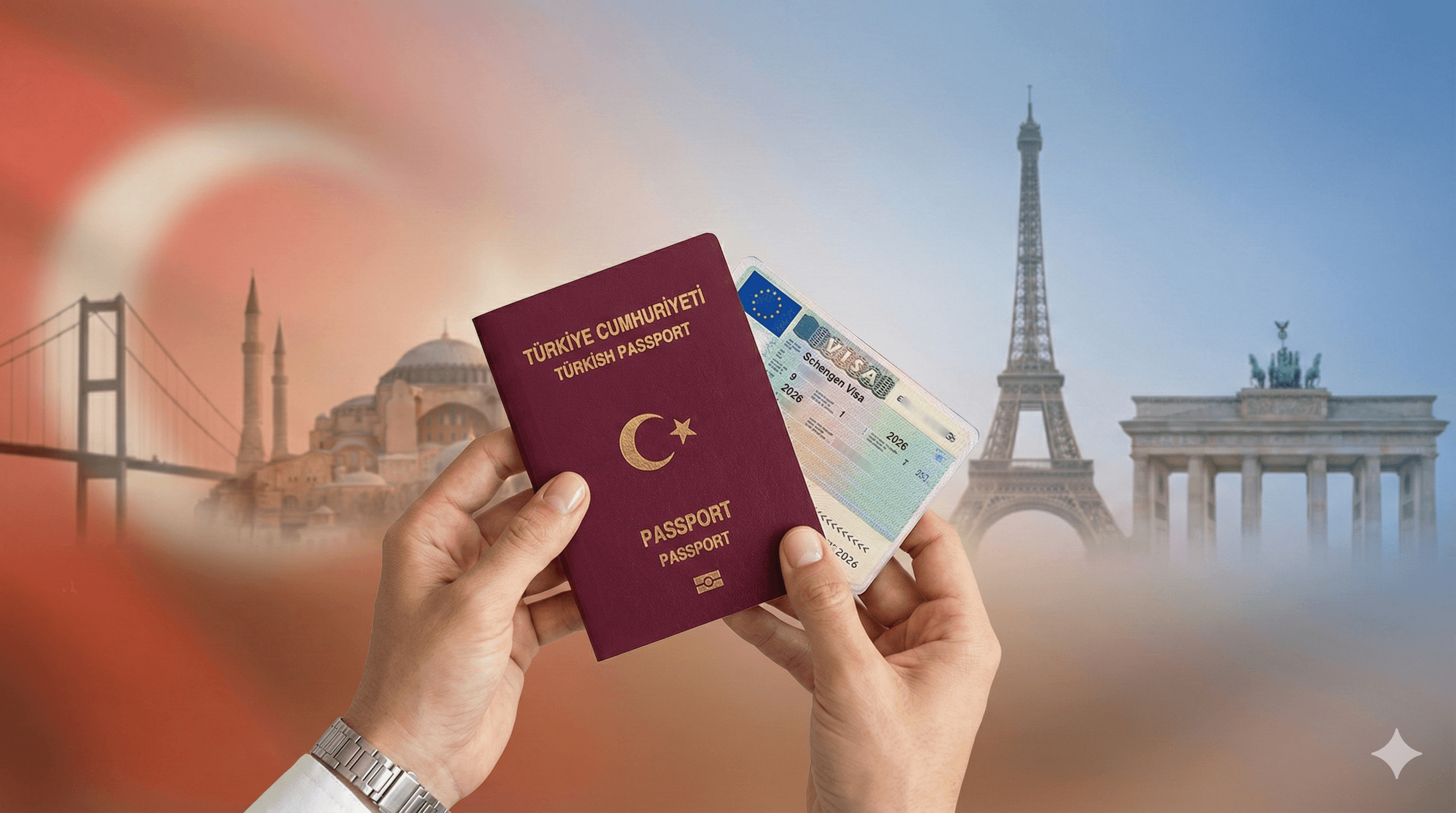
Schengen Visa from Turkey 2026: Complete Guide for Turkey Residents
Last updated: 7 August 2026. Requirements, fees, providers and representation arrangements can change; confirm the route-specific checklist linked in the official sources before submitting.
Getting a Schengen visa as a Turkey resident in 2026 isn't just about planning a holiday—for many, it's about university acceptance deadlines, job opportunities abroad, or reuniting with family in Europe. With Turkey processing over 1.17 million Schengen applications annually as the world's second-largest applicant country, the competition for appointment slots at visa centres in Istanbul, Ankara, and Izmir has reached critical levels. This guide provides everything Turkey residents need to know about securing a Schengen visa in 2026, from document requirements to navigating the appointment crisis.
Whether you're applying for your first visa or your fifth, understanding Turkey's unique position in the Schengen system—including the fragmented service provider landscape and heightened scrutiny on Turkish applications—can mean the difference between approval and rejection. We'll cover the complete process, country-specific fees in Turkish Lira, realistic processing timelines, and proven strategies for securing that elusive appointment slot.

If refreshing the booking page is not realistic, you can book a Schengen visa appointment in Turkey instead and be told the moment a slot opens.
Who Needs a Schengen Visa from Turkey?
Turkish passport holders require Schengen visas for all travel to the 29-country Schengen Area, whether for tourism, business, family visits, or educational purposes. Despite ongoing visa liberalization discussions between Turkey and the EU, Turkey remains outside the visa-free travel agreement as of 2026, with no exemptions for short trips.
Turkish Passport Holders
All Turkish citizens need a visa to enter the Schengen zone, regardless of trip purpose or duration. The long-discussed visa liberalization roadmap between Turkey and the EU remains stalled as of 2026, meaning Turkish passport holders face the same application requirements they've faced for years. There are no shortcuts—even for business travelers making quick day trips or tourists visiting for a weekend.
The emotional and financial toll of this requirement weighs heavily on Turkish citizens. University students miss acceptance deadlines waiting for visas. Families postpone reunions. Job seekers lose opportunities. For many Turkish residents, securing a Schengen visa has become a life-defining challenge rather than a simple travel formality.
Foreign Residents in Turkey
If you hold a Turkish residence permit but carry a passport from a third country, your visa requirement depends entirely on your passport nationality, not your residence status in Turkey. A Nigerian citizen living in Istanbul with a valid Turkish residence permit still needs a Schengen visa. Conversely, an American or Canadian residing in Turkey may benefit from their passport's visa-free access to Schengen countries (though they still face Turkey's appointment availability challenges when applying from Turkey).
Turkey residency provides no special exemptions or priority processing for Schengen applications. However, having strong ties to Turkey—demonstrated through residence permits, employment, and property ownership—can strengthen your application by showing clear intention to return.
Dual Citizenship Holders
If you hold both a Turkish passport and an EU or Schengen country passport, use your EU passport for travel to avoid the visa requirement entirely. Dual Turkish-US or Turkish-Canadian citizens can benefit from their second passport's visa-free access. However, if your second passport is from another visa-required country, you'll still need to apply based on that passport's requirements. The key factor is always passport nationality, not Turkish citizenship status.
Understanding Schengen Visa Categories
Official 2025 context: EU and Schengen-associated consulates received more than 12 million short-stay visa applications in 2025. The worldwide refusal rate was 14.6%, down from 14.8% in 2024; 51.7% of issued visas allowed multiple entries. These are global figures, not a prediction for an individual application. European Commission 2025 visa statistics.
Type C (Short-Stay Visa) - Most Common
The vast majority of Turkish applicants seek Type C short-stay visas, which allow stays of up to 90 days within any 180-day period in the Schengen Area. This category covers tourism and leisure trips, business meetings and conferences, family visits, participation in cultural or sporting events, and medical treatment. The 90-day limit is cumulative across all Schengen countries during the 180-day reference period.
For Turkish families planning summer holidays in Europe or professionals attending industry conferences, the Type C visa is your standard requirement. Processing times and appointment availability remain challenging, but this is the most straightforward category with the clearest requirements.
Type A (Airport Transit Visa)
Turkish passport holders are generally exempt from airport transit visa requirements when connecting through Schengen airports. However, if you're transiting through specific airports in France or other countries with restricted nationality lists, verify whether you need a Type A visa. This visa allows you to remain in the international transit area without entering the Schengen zone.
Multiple-Entry Visa Eligibility
While your first Schengen visa from Turkey will likely be single-entry, building a positive travel history can lead to multiple-entry visas valid for one, two, or even five years. The EU introduced a "cascade" system specifically affecting Turkish applicants in 2025-2026: if you correctly use your first single-entry visa (entering and exiting on schedule), your second application may receive a one-year multiple-entry visa. Consistent compliance can escalate to two-year, then five-year visas.
This escalation system rewards Turkish applicants who demonstrate reliability, but violations—overstaying, working on a tourist visa, or misusing a visa—reset your status and make future applications significantly harder. For Turkey residents, this makes proper visa usage crucial for long-term travel flexibility.

Selecting the Correct Country for Your Application
Single Destination Rule
If you're visiting only one Schengen country, apply to that country's consulate—there are no alternatives. Whether you're attending a wedding in Germany, studying a summer course in France, or visiting relatives in the Netherlands, you must apply through that country's designated visa application centre in Turkey. Attempting to apply to a different country because slots are more available will result in immediate rejection.
Turkish applicants face particular scrutiny on this point. Consulates actively check for "country shopping"—applying to countries with easier processes while planning to visit a different destination. Your hotel bookings, flight reservations, and stated itinerary must align perfectly with your chosen application country.
Multiple Destinations Rule
When visiting multiple Schengen countries, apply to the country where you'll spend the most nights. If you're planning a two-week trip with 7 nights in Italy, 4 nights in France, and 3 nights in Spain, you must apply through Italy's visa application centre in Turkey. Document your day-by-day itinerary clearly, showing hotel reservations for each night to prove which country is your main destination.
Calculate carefully and honestly. Consulates cross-reference hotel bookings and may contact hotels to verify reservations. Turkish applicants have faced rejections when consulates discovered their "main destination" was misrepresented to game the system.
Equal Time Rule
If you're spending equal time in multiple countries (example: 5 nights in Germany, 5 nights in Austria), apply to the country of first entry according to your flight booking. Your initial entry point into the Schengen Area determines which consulate handles your application. This rule exists specifically to prevent applicants from choosing countries with higher approval rates when time spent is identical.
Why This Matters for Turkish Applicants
Turkey's 14.5% rejection rate (down from 16.1% in 2023, but still above the global average) means choosing the correct country isn't just bureaucratic compliance—it's essential for approval. Getting rejected for applying to the wrong country not only wastes your visa fee (approximately 6,000-6,500 TRY total) but also creates a rejection record that complicates future applications.
Different consulates also have varying processing speeds and scrutiny levels for Turkish applicants. Germany processes over 215,000 Turkish applications annually with established procedures. Greece handles 296,000+ applications but faces severe capacity constraints. Selecting your destination based on actual travel plans rather than perceived ease protects your application's integrity.
Visa Application Centres Across Turkey
Turkey's visa application landscape is uniquely fragmented compared to other countries. Unlike the UK where VFS Global handles most Schengen countries, Turkey distributes visa processing across five different service providers based on destination country. Understanding which provider handles which country is critical—using the wrong provider is the number one preventable error Turkish applicants make.
iDATA Centres (Germany & Italy)
Countries: Germany, Italy
Locations: Istanbul (Altunizade, Gayrettepe), Ankara, Izmir, Bursa, Gaziantep, Antalya, Trabzon
Service Fee: 1,993 TRY (as of January 2026)
Website: idata.com.tr
iDATA operates Germany and Italy visa applications across Turkey's major cities. The service requires full prepayment (approximately 2,000 TRY) before you can even view the appointment calendar. Turkey residents applying for German visas—the second most popular destination with 215,000+ annual applications—must use iDATA exclusively. The Istanbul centres handle the highest volume, with Altunizade and Gayrettepe locations both offering similar services.
Kosmos Vize Centres (Greece Only)
Country: Greece
Locations: Istanbul, Izmir, Ankara, Bursa, Edirne, Bodrum, Marmaris, Antalya
Service Fee: Approximately 1,475 TRY (€30)
Website: kosmosvize.com.tr
Kosmos Vize Services is the exclusive authorized provider for Greece Schengen visas in Turkey as of 2026, replacing VFS Global in most regions. This is critically important because Greece receives more Turkish applications than any other Schengen country (296,000+ annually), yet Kosmos faces the most severe appointment scarcity. Their official website regularly posts alerts stating "Appointments in Istanbul, Izmir, and Edirne regions are full," with new slots opening monthly and filling within minutes.
VFS Global Centres
Countries: France, Netherlands, Austria, Czech Republic, Belgium, Norway, Denmark, Sweden, Malta, Estonia, Finland, Latvia, Slovenia, Luxembourg
Locations: Istanbul, Ankara, Izmir, Antalya (Austria, Czech), Edirne (France only)
Service Fee: Approximately 1,960 TRY (€40) for France
Website: vfsglobal.com
VFS Global handles multiple Schengen countries but not Germany, Italy, or Greece. If you're applying for a French visa—France being a top destination for Turkish travelers—you'll use VFS centres. Note that different countries under VFS may have slightly different procedures and fees despite using the same provider.
TLScontact Centres
Country: Switzerland
Locations: Istanbul, Ankara
Website: tlscontact.com
Switzerland visa applications route through TLScontact's limited Turkey network. With only Istanbul and Ankara centres, Turkey residents in other regions may need to travel significant distances for appointments.
BLS International Centres
Country: Spain
Locations: Istanbul, Ankara, Izmir, Antalya, Gaziantep
Service Fee: Approximately 780 TRY ($22 USD)
Website: turkey.blsspainvisa.com
Spain visa applications use BLS International, which offers lower service fees than most providers. However, availability remains challenging during peak summer season when Turkish families plan Mediterranean holidays.
Regional Jurisdiction Requirements
Unlike some countries where you can apply at any visa centre, Turkey enforces strict regional jurisdictions. Izmir residents cannot simply book appointments in Istanbul because slots appear faster there. Centres require proof of residence in their service area. Attempting to circumvent this rule by using a relative's address can lead to rejection and potential fraud allegations.
Appointment Booking Systems
All providers in Turkey operate mandatory online appointment systems. Walk-ins are strictly forbidden. Each provider uses different booking platforms:
iDATA: Prepayment required before calendar access
Kosmos: "Prepaid Appointment System" with immediate payment upon slot selection
VFS/TLS/BLS: Appointment booking with payment at application submission
The common thread: appointments must be secured online in advance, and availability in Istanbul, Ankara, and Izmir centres has reached crisis levels in 2026, with typical wait times of 4-8 weeks.
Important Note About Visard Monitoring: While Turkey has multiple visa service providers handling different Schengen countries, Visard's monitoring service currently supports VFS Global appointments for: Czech Republic, Netherlands, Belgium, Norway, Denmark, Sweden, Malta, Estonia, Finland, Latvia, Slovenia, and Luxembourg. For other destinations like France, Germany, Greece, Spain, Italy, Switzerland, and Austria, you will need to monitor appointments manually through their respective service providers.
The 2026 Documentation Checklist
Passport Requirements
Your passport must be valid for at least three months beyond your intended departure date from the Schengen Area. If you're planning a two-week trip ending September 15, your passport must remain valid until at least December 15. Additionally, your passport must contain at least two completely blank visa pages and have been issued within the last 10 years. Older passports, even if still within their validity period, may not meet the 10-year issuance requirement.
Check your passport's issue date immediately. Many Turkish citizens carry passports issued 10+ years ago that remain "valid" for a few more years but fail the issuance requirement. This is a common technical rejection for Turkish applicants who otherwise have strong applications.
Financial Evidence - Critical for Turkish Applicants
Bank statements showing the last three months of account activity are mandatory and must be physically signed and stamped by bank officials. E-signed PDF statements downloaded from online banking are frequently rejected for Turkish applicants. Visit your bank branch to obtain official, stamped copies. The minimum recommended balance is approximately 30,000-50,000 TRY per person for a one-week trip, though this varies by destination country.
Employment Documentation Package:
For employed Turkish residents, provide an employment letter on company letterhead stating your salary, position, leave approval, and employment duration. However, unlike applicants from other countries, Turkish citizens must also submit:
İmza Sirküleri: Signature circulars of the company official who signed your employment letter
Vergi Levhası: Company tax plate document
Faaliyet Belgesi: Chamber of Commerce activity certificate (must be less than 6 months old)
Ticaret Sicil Gazetesi: Trade registry gazette copy
These additional documents verify your employer's legitimacy and your employment's authenticity—a requirement specific to Turkey due to high rates of fraudulent employment letters discovered by consulates.
If You Have a Sponsor:
Family members in EU countries can sponsor your trip through notarized invitation letters. However, the sponsor must also provide their residence permit copies, employment verification, and financial evidence showing they can support your visit. The sponsor's documents require translation into the destination country's language or English.
Travel Insurance - Non-Negotiable Requirement
All Schengen visa applications require travel insurance with minimum €30,000 medical coverage valid across all Schengen states for your entire trip duration. Turkish insurance companies like Anadolu Sigorta, Aksigorta, and Allianz Turkey offer Schengen-compliant policies starting around 800-1,200 TRY for a two-week trip.
Do not purchase insurance until your trip dates are finalized, but do purchase it before your visa appointment. Consulates verify insurance validity and frequently reject applications with insufficient coverage or incorrect dates. The insurance must specifically state "valid for all Schengen countries" and cover medical evacuation and repatriation.
Accommodation Proof - The "Cancelled Hotel" Trap
Provide hotel reservations, Airbnb confirmations, or host invitation letters for every night of your stay. Turkish applicants frequently encounter a specific rejection reason: "Hotel booking cancelled." Consulates actively check reservation validity 2-3 days before issuing visas. If you booked refundable hotels and cancelled them to avoid charges while waiting for visa approval, your visa will be rejected instantly even if everything else was perfect.
The solution: either book non-refundable hotels (risky if visa is rejected) or maintain refundable bookings until after visa approval. Many Turkish applicants use specialized "visa reservation services" that provide verifiable booking confirmations without full payment, though consulates increasingly scrutinize these.
Flight Reservations - Don't Purchase Until Approved
Submit round-trip flight reservations showing confirmed itinerary and dates. However, do not purchase actual tickets until your visa is approved. Airlines and travel agencies offer "reservation services" providing valid booking references without full payment. If your visa is rejected, you're not left with non-refundable tickets.
Ensure your flight dates align perfectly with your accommodation bookings and stated itinerary. Inconsistencies—like hotel check-out on September 15 but flight departure on September 14—trigger immediate scrutiny and potential rejection.
Biometric Photograph Requirements
Provide two recent (within 6 months) biometric photographs sized 35mm x 45mm with white background. Turkish photo studios are familiar with Schengen requirements, but verify specifications before ordering. Rejected photos are a frustrating administrative delay that can postpone appointments.
Turkey-Specific Mandatory Documents
These documents separate Turkish applications from other nationalities and represent the most common missing items causing rejections:
Tam Tekmil Vukuatlı Nüfus Kayıt Örneği (Complete Family Registry):
Obtain this certified copy through e-Devlet showing your parents, spouse, and children—even if they're not traveling with you. The document must include the QR code for verification. Consulates use this to verify family ties and assess return intention. Cost: Free via e-Devlet.
Yerleşim Yeri Belgesi (Proof of Residence):
Generate this through e-Devlet to confirm your current registered address in Turkey. This document establishes which visa centre jurisdiction you fall under and proves residential stability.
SGK Tescil ve Hizmet Dökümü (Social Security Registration and Service History):
This is arguably the single most important document for Turkish applicants. The SGK record, obtained via e-Devlet with QR code verification, proves your legitimate employment history and ties to Turkey. Applications without verifiable SGK records face significantly higher rejection rates because consulates cannot verify employment legitimacy.
For self-employed applicants, provide your SGK registration as a self-employed person along with tax returns and business registration documents. Unemployed or retired applicants should provide pension documents or investment income statements plus proof of assets in Turkey.
Marriage Certificate:
If traveling with your spouse or if your sponsor is your spouse, provide your Turkish marriage certificate with certified translation. Unmarried couples traveling together should provide separate applications and clearly explain their relationship in cover letters.
Birth Certificates for Children:
Children under 18 must submit birth certificates with certified translations. If one parent is not traveling, the non-traveling parent must provide a notarized consent letter authorizing the child to travel.
Translation Requirements
All documents in Turkish require certified translations into English or the destination country's official language. In Turkey, "certified translation" means sworn translators (Yeminli Tercüman) authorized by notaries. Regular translations, even if accurate, will be rejected. Budget approximately 500-800 TRY per document for certified translations.
The translation must include the translator's signature, stamp, and license number. Both the original Turkish document and certified translation must be submitted together.
Visa Fees for 2026
Standard Consular Fees
The EU-mandated Schengen visa fee is €90 for adults (approximately 4,424 TRY based on January 2026 exchange rates). Children aged 6-12 pay €45 (approximately 2,212 TRY), while children under 6 are exempt from consular fees. These fees apply regardless of which Schengen country you're applying to—they're set by EU regulation, not individual countries.
However, the exchange rate used by consulates may differ from market rates. Consulates typically update their Turkish Lira equivalents monthly or weekly based on official exchange rates. The actual TRY amount you pay can vary by 100-200 TRY from the estimates here depending on when you apply.
Service Centre Fees by Country
Beyond the consular fee, each visa application centre charges service fees for processing your application. These fees vary significantly by provider:
Destination Country | Service Provider | Service Fee | Consular Fee | Total Cost (Approx.) | Payment Method |
|---|---|---|---|---|---|
Germany / Italy | iDATA | 1,993 TRY | 4,424 TRY | ~6,417 TRY | Credit Card/Cash |
Greece | Kosmos Vize | ~1,475 TRY (€30) | 4,424 TRY | ~5,900 TRY | Cash Only (TRY) |
France | VFS Global | ~1,960 TRY (€40) | 4,424 TRY | ~6,384 TRY | Cash or Card |
Spain | BLS International | ~780 TRY ($22) | 4,424 TRY | ~5,200 TRY | TRY Cash |
Netherlands | VFS Global | ~1,960 TRY | 4,424 TRY | ~6,384 TRY | Cash or Card |
Austria | VFS Global | ~1,960 TRY | 4,424 TRY | ~6,384 TRY | Cash or Card |
Note: Service fees are subject to change. These are January 2026 rates.
Hidden Costs and Optional Services
The mandatory fees above are just the starting point. Most centres add "optional" services that are difficult to decline:
SMS Tracking: 50-100 TRY
Courier Delivery: 200-300 TRY (vs. collecting passport in person)
VIP/Premium Lounge: 500-1,500 TRY (faster appointment slot, not faster processing)
Photo Service: 150-200 TRY (if your photos don't meet requirements)
Photocopy Service: 50-100 TRY
Expect to pay 6,500-7,500 TRY total for a single adult application including all fees and services.
Total Cost Examples
Individual Tourist Application (1 week Netherlands trip):
Consular fee: 4,424 TRY
VFS service fee: 1,960 TRY
Travel insurance: 800 TRY
Certified translations (3 documents): 1,800 TRY
Photos: 150 TRY
Courier: 250 TRY
Total: ~9,384 TRY
Family of Four (Parents + 2 children aged 8 and 10, Belgium trip):
Adults: 2 × 6,384 TRY = 12,768 TRY
Children: 2 × 4,384 TRY (€45 + fees) = 8,768 TRY
Insurance (family): 2,500 TRY
Translations: 3,600 TRY
Photos: 600 TRY
Courier (4 passports): 800 TRY
Total: ~29,036 TRY
These costs represent significant financial commitments for Turkish families, especially given current economic conditions. Factor these into your travel budget planning early.
Processing Times - What to Expect from Turkey
Standard Processing Timeline
The official Schengen Visa Code mandates 15 calendar days processing time from your appointment date. This is not working days—it's total days including weekends and holidays. For straightforward applications with complete documentation and clear travel purpose, Turkish applicants sometimes receive decisions within this timeframe.
However, "15 days" assumes everything goes perfectly. The reality for Turkish applicants in 2026 is more complex.
Extended Processing (Up to 45 Days)
Consulates reserve the right to extend processing to 30 calendar days for complex cases, or up to 45 days in exceptional circumstances. Turkish applications frequently encounter extended processing due to:
Additional document requests: Missing translations or unclear financial evidence
Security checks: Enhanced screening for certain applicant profiles
Administrative processing: High application volumes during peak season
Consular workload: Turkey submitted 1.17 million Schengen applications in 2024, creating capacity constraints
When iDATA and other providers warn that "timely issuance is not guaranteed if applied less than 15 days before travel," they're acknowledging this reality. Turkish applicants should never book non-refundable travel within 30 days of their visa appointment.
Peak Season Reality in Turkey
Summer Season (May-September):
Processing times extend to 30-45 days during peak summer travel season. Greek islands, French Riviera, and Italian coastal destinations see massive demand from Turkish tourists. Combine this with reduced consular staffing during European holiday periods (July-August), and processing slows significantly.
Religious Holidays (Eid al-Fitr, Eid al-Adha):
Kurban Bayramı and Ramazan Bayramı create twin challenges: increased Turkish application volumes as families plan holiday travel, and reduced processing capacity as both Turkish visa centres and European consulates operate with holiday staffing levels.
Winter Holiday Season (December-January):
Christmas and New Year processing faces similar delays, though less severe than summer peaks.
Turkey-Specific Delay Factors
Turkish citizens applying from Turkey face unique processing challenges:
Enhanced Scrutiny:
Turkey's 14.5% rejection rate reflects stricter evaluation compared to some other nationalities. Consulates spend more time verifying employment, financial capacity, and return intention for Turkish applicants, extending average processing times.
SGK Verification:
The mandatory SGK (Social Security) records require consulates to cross-reference Turkish government databases. When systems are slow or require manual verification, processing extends.
Political Factors:
While rarely officially acknowledged, the frozen visa liberalization process and EU-Turkey relationship tensions create an environment where Turkish applications receive heightened attention.
Realistic Timeline Planning
Conservative Timeline for Turkish Applicants:
Appointment booking wait: 4-8 weeks (Istanbul/Ankara)
Application to decision: 15-45 days
Total from starting process to visa: 8-14 weeks
Plan your trips with this extended timeline in mind. University students with September enrollment should begin the visa process in May or June, not July. Families planning August holidays should apply in April or May.
The Appointment Booking Crisis in Turkey
Why Turkey Faces Severe Appointment Scarcity
Turkey's appointment availability crisis stems from a perfect storm of factors unique to the country's position in 2026:
Massive Application Volume:
As the world's second-largest source of Schengen applications (1.17 million annually), Turkey generates enormous demand. Istanbul alone processes more visa applications than many entire countries. The appointment infrastructure—even with multiple providers across seven cities—cannot accommodate this volume.
Economic Migration Pressure:
Turkey's ongoing economic challenges drive increased application rates. Young professionals seeking work opportunities, students pursuing European education, and families exploring relocation options all contribute to unprecedented demand. This isn't tourism—for many Turkish applicants, Schengen visas represent potential life-changing opportunities.
Limited Appointment Capacity:
EU-Turkey political tensions have not led to increased visa processing capacity despite rising demand. Consulates and visa centres operate with the same appointment quotas they've maintained for years, while applications continue growing. The math doesn't work.
Fragmented Service Providers:
Unlike countries where one provider (VFS Global) handles most appointments, Turkey's split across five providers creates inefficiencies. You cannot switch from booked-out Kosmos (Greece) to available slots at iDATA (Germany) unless you genuinely change your travel destination.
The Istanbul/Ankara/Izmir Reality
Istanbul Centres - Critical Scarcity:
Istanbul, home to 15+ million residents and Turkey's economic center, faces the worst appointment scarcity. Kosmos regularly posts official alerts: "Appointments in Istanbul region are full." When slots do open (typically monthly), they're claimed within minutes—sometimes seconds. iDATA's Istanbul centres (Altunizade and Gayrettepe) require prepayment before you even view the appointment calendar, creating financial risk if slots aren't available.
Ankara Centres - Slightly Better:
As Turkey's capital with lower population density than Istanbul, Ankara centres experience 3-6 week wait times compared to Istanbul's 4-8 weeks. However, "better" is relative—Ankara applicants still face significant delays and fierce competition for slots.
Izmir Centres - Limited Capacity:
Izmir, Turkey's third-largest city, operates fewer visa centres than Istanbul. While individual wait times may be similar, the total appointment capacity is lower, creating regional bottlenecks for Aegean region residents.
Manual Booking Experience - The Refresh Addiction Loop
Turkish applicants attempting manual booking describe a psychological trap similar to gambling addiction:
Initial Optimism: "I'll check every morning before work."
Escalating Frequency: Checking becomes hourly, then constant throughout the day.
The Tease: Occasionally, "Available: 1" appears for 2-3 seconds.
The Crash: Clicking immediately shows "No appointments available."
Obsessive Checking: Can't stop checking despite knowing it's futile.
The Toll: Missing work meetings, disrupted sleep, constant phone-checking.
This isn't theoretical. Turkish applicants report 4-8 weeks of daily manual checking, setting midnight alarms for rumored "slot release times," refreshing during family dinners. The intermittent reward psychology—occasionally seeing slots appear briefly—creates the same compulsive behavior patterns studied in behavioral addiction research.
The Emotional and Life Toll
For Students:
University acceptance letters have deadlines. Dorm registration closes. Scholarships lapse. Missing a visa appointment can mean missing an entire academic year, potentially derailing educational and career paths. The stakes aren't "missing a holiday"—they're "losing my future."
For Families:
Parents watch their children ask daily: "Did you get the appointment yet?" The guilt of promising a holiday or family reunion, then failing to secure appointments, weighs heavily. Some families have spent €500-1000 on flights before realizing they cannot get visa appointments, losing money to change fees or cancellations.
For Professionals:
Job offers abroad have expiration dates. Conference presentations can't be rescheduled. Business opportunities disappear when Turkish executives can't attend crucial meetings. The professional cost extends beyond individual inconvenience to economic impact on Turkish businesses.
For Family Reunification:
Adult children in Europe wanting to visit parents in Turkey, or vice versa, face heartbreaking delays. Elderly parents unable to see grandchildren. Siblings unable to attend weddings or funerals. These aren't administrative inconveniences—they're life moments missed permanently.
This is the reality the schengen visa telegram bot was built to address.
How Visard Solves the Appointment Problem
24/7 Automated Monitoring for Turkish Centres
While you're sleeping, working, or living your life, Visard monitors VFS Global centres in Istanbul, Ankara, and Izmir every 3 seconds—that's 28,800 appointment checks per day. The system monitors appointment availability for the following destinations from Turkey:
Czech Republic, Netherlands, Belgium, Norway, Denmark, Sweden, Malta, Estonia, Finland, Latvia, Slovenia, and Luxembourg.
When a slot appears at any monitored centre, you receive instant notification via Telegram in Turkish or English—whichever you prefer. The average notification-to-booking time is under 30 seconds, compared to manual checking where you might not see a slot for days or weeks.
Two Service Options for Turkey Residents
Notifications Service:
1 country package: $25 (one-time payment)
All countries package: $50 (one-time payment)
This service sends you instant Telegram alerts when appointments appear at your selected centres. You receive the notification, click through to the visa centre's booking page, and complete your booking manually. Best for applicants with flexible schedules who can act immediately when notified.
Auto-Booking Service:
Currently, auto-booking is not yet available for Turkey centres. Turkish residents have access to notification services only, with auto-booking on the waitlist for future development. We're transparent about this limitation—we only offer services we can actually deliver.
How It Works for Turkish Users
Sign up via Telegram bot (available in Turkish)
Select your destination countries - Choose from Czech Republic, Netherlands, Belgium, Norway, Denmark, Sweden, Malta, Estonia, Finland, Latvia, Slovenia, Luxembourg, or all countries
Receive instant alerts when slots appear at Istanbul, Ankara, or Izmir VFS Global centres
Book appointment immediately using the direct link in the notification
Average success: 4-7 days from signup to secured appointment, compared to 4-8 weeks manual checking
The system includes Turkish-language support throughout the process. Our Telegram bot interface, notifications, and customer support are available in Turkish—"Türkçe destek mevcut."
Family Coverage - Critical for Turkish Users
One subscription covers your entire family—no per-person charges. This is particularly valuable for Turkish families where multi-person applications are common:
Example:
A family of four planning a summer holiday to the Netherlands would pay just $50 total for the "all countries" package, receiving notifications for all family members simultaneously. When appointments appear, you book all four slots together for the same date and time. Compare this to paying separately or, worse, attempting to coordinate four separate manual booking attempts.
Traditional visa agencies in Turkey charge per person—often 5,000-10,000 TRY per person for "appointment securing services." For a family of four, that's 20,000-40,000 TRY. Visard's family coverage at $50 (approximately 1,850 TRY) represents 90-95% savings while providing faster, more transparent service.
Why Turkish Users Trust Visard
UK-Registered Company:
Visard is a UK-registered company verifiable through Companies House. This provides legal accountability and protection absent from anonymous "appointment agents" operating through WhatsApp. The UK registration also positions the service outside Turkey's domestic skepticism around local service providers.
Stripe Payment with Chargeback Protection:
All payments process through Stripe, an internationally recognized payment processor with standard consumer protections. Unlike bank transfers or cryptocurrency payments common with scam services, Stripe transactions offer chargeback options if service isn't delivered. This financial safety net is critical for Turkish users who've experienced visa service scams.
Transparent Pricing:
No hidden fees, no "contact us for pricing," no negotiation. The price is the price: $25 or $50. This transparency contrasts sharply with traditional Turkish visa agents who quote different prices to different customers and add unexpected charges throughout the process.
Turkish Language Support:
Full Turkish language support throughout the platform demonstrates genuine commitment to Turkish users rather than treating them as an afterthought market. Visard monitors VFS Global centres in Turkey for 12 Schengen destinations: Czech Republic, Netherlands, Belgium, Norway, Denmark, Sweden, Malta, Estonia, Finland, Latvia, Slovenia, and Luxembourg.
Pay Upfront, But Affordable:
While the notifications service requires upfront payment (unlike our auto-booking service in other countries which is pay-after-success), the $25-50 price point is minimal compared to the value of securing appointments. We're transparent about this payment structure rather than hiding it.
Proven Track Record:
Visard has secured 25,000+ appointments globally with a 4.8/5 Trustpilot rating. While these statistics include all markets (not Turkey exclusively), they demonstrate the service's legitimate operational history.
Important Clarification: What Visard Does and Doesn't Do
Visard ONLY helps you secure an appointment slot at VFS Global centres in Istanbul, Ankara, or Izmir for supported countries (Czech Republic, Netherlands, Belgium, Norway, Denmark, Sweden, Malta, Estonia, Finland, Latvia, Slovenia, Luxembourg). The visa appointment bot monitors availability and alerts you when slots appear.
Visard does NOT:
Guarantee visa approval (that's 100% based on your documents and eligibility)
Fill out your application
Provide document preparation services
Have any influence on consular decisions
"Get you a visa faster" - we get you the appointment faster; processing time remains standard
Monitor other providers like iDATA (Germany/Italy), Kosmos (Greece), TLScontact (Switzerland), or BLS (Spain)
The visa decision is entirely independent of how you booked your appointment. Using Visard's monitoring service has zero impact on whether your visa is approved or rejected.
Application Process Step-by-Step
Step 1 - Gather All Documents
Use the complete checklist from the documentation section above. For Turkish applicants, this means:
Valid passport (3+ months beyond trip, 10-year issuance rule)
Bank statements (3 months, physically stamped by bank)
Employment documentation package (letter + İmza Sirküleri + Vergi Levhası + Faaliyet Belgesi + Ticaret Sicil Gazetesi)
SGK Tescil ve Hizmet Dökümü (critical for proving employment and ties to Turkey)
Tam Tekmil Vukuatlı Nüfus Kayıt Örneği (complete family registry via e-Devlet)
Yerleşim Yeri Belgesi (proof of residence via e-Devlet)
Travel insurance (€30,000 minimum, valid all Schengen states)
Hotel reservations (maintain until visa approved—don't cancel early)
Flight reservations (not purchased tickets)
Marriage certificate (if applicable, with certified translation)
Children's birth certificates (if applicable, with certified translation)
Obtain certified translations (Yeminli Tercüman) for all Turkish documents. Budget 500-800 TRY per document and 2-3 weeks for translation completion.
Step 2 - Book Appointment
This is where most Turkish applicants face the biggest challenge. You have two options:
Manual Booking (Frustrating Reality):
Visit your destination country's visa centre website (Kosmos for Greece, iDATA for Germany/Italy, VFS for France/Netherlands/Austria/Czech Republic/Belgium/Nordic countries, TLS for Switzerland, BLS for Spain). Create an account, fill preliminary information, and attempt to find available appointment slots. Expect to check daily for 4-8 weeks, competing with thousands of other applicants for the same slots.
Automated Monitoring (Visard Solution):
For VFS Global destinations (Czech Republic, Netherlands, Belgium, Norway, Denmark, Sweden, Malta, Estonia, Finland, Latvia, Slovenia, Luxembourg), sign up for Visard's notification service targeting your specific visa centre (Istanbul, Ankara, or Izmir). Receive instant alerts when slots appear, typically securing appointments within 4-7 days. The $25-50 fee is a fraction of the time cost and stress of manual checking, and significantly cheaper than traditional agents charging 5,000-10,000 TRY.
Once you secure an appointment slot, pay the service centre fee online (ranging from 780 TRY for Spain/BLS to 1,993 TRY for Germany/Italy/iDATA). Some centres like iDATA require prepayment before viewing the calendar; others allow payment after appointment selection.
Step 3 - Attend Appointment in Person
Arrive at the visa centre 15 minutes before your scheduled time. Bring all original documents plus one complete set of photocopies. Some centres offer photocopying services but charge 50-100 TRY—save money by arriving with copies already made.
At the appointment:
Present your appointment confirmation and passport
Submit all documents (the visa officer will review and verify)
Provide biometric data (fingerprints captured via digital scanner, photograph taken)
Pay consular fees if not already paid online (approximately 4,424 TRY)
Receive a tracking number for your application
The entire appointment typically takes 30-60 minutes depending on centre volume. The visa officer may ask clarifying questions about your trip purpose, accommodation, or employment—answer honestly and directly.
Step 4 - Track Application
After submission, use the tracking number provided to monitor your application status on the visa centre's website. Most centres also offer SMS tracking services (additional 50-100 TRY) sending updates when your passport is ready.
Typical status progression:
"Application received at visa centre"
"Application forwarded to embassy/consulate"
"Application under process at embassy"
"Passport ready for collection" or "Decision made"
Check the tracking portal every 2-3 days. Avoid obsessive checking—there's nothing you can do during processing, and status updates are infrequent. The wait time is 15-45 days as detailed in the processing times section.
Step 5 - Collect Passport
When tracking shows "passport ready for collection," visit the visa centre to retrieve your passport in person or receive it via courier if you selected that service (200-300 TRY). Operating hours for collection are typically narrower than submission hours—verify your centre's specific collection schedule.
Upon receiving your passport:
Open it immediately and check the visa sticker details while still at the counter
Verify dates match your application (entry validity dates, duration)
Check number of entries (single/multiple)
Confirm visa type is correct
Verify your name spelling is exactly as on passport
If you spot any errors, bring them to visa centre staff attention immediately. Errors caught after leaving the centre require formal correction processes that can delay travel.
Common Mistakes That Lead to Rejection (Turkey-Specific)
Insufficient Financial Proof
Turkish salaries, when converted to Euros, often appear low to European consular officers—a mid-level manager earning 50,000 TRY monthly translates to approximately €1,015 EUR, which seems modest for European standards. This conversion creates the false impression that Turkish applicants lack financial capacity.
Solution: Don't rely on salary alone. Show accumulated savings accounts, investment accounts, property ownership, and if applicable, sponsor support from family members in Europe. Demonstrating 30,000-50,000 TRY in readily available funds plus steady income creates a stronger financial picture than high salary without savings.
Unclear Travel Purpose
Vague itineraries raise immediate suspicion for Turkish applicants who already face higher scrutiny. "Tourism in Europe" is insufficient—consulates need day-by-day plans showing specific destinations, confirmed hotel bookings, and logical travel routes.
Solution: Create a detailed itinerary document listing:
Day 1: Arrive Amsterdam, Hotel X (booking reference #123)
Day 2: Visit Rijksmuseum, Anne Frank House
Day 3: Day trip to Keukenhof Gardens
Day 4: Depart Amsterdam
The more specific and verifiable your plan, the stronger your application. Include museum tickets, train reservations, restaurant bookings—anything demonstrating genuine tourism purpose.
Previous Overstays or Violations
Any Schengen violation in your travel history—overstaying previous visas, working on tourist visas, misrepresenting travel purpose—dramatically increases rejection risk. Turkish applicants with violation histories receive heightened scrutiny, and consulates share violation information across all Schengen countries.
If you have a previous violation, address it directly in a cover letter explaining circumstances and demonstrating changed situation. Hiding violations never works—consulates access shared databases.
Inconsistent Information
Employment letters stating 50,000 TRY salary while bank statements show 30,000 TRY monthly deposits create immediate red flags. Hotel bookings in Paris while your stated "main destination" is Berlin trigger rejection. Flight departures not matching hotel checkout dates cause suspicion.
Solution: Cross-check every document for consistency before submission:
Do bank deposits match employment letter salary?
Do hotel dates align with flight dates?
Does travel insurance cover all trip dates?
Does the "main destination" calculation actually support your chosen country?
Applying to Wrong Country
Turkish applicants sometimes attempt to "game the system" by applying to countries with perceived easier approval rates while actually planning to visit different destinations. Example: Applying to Slovakia because appointment slots are available, but planning to spend most time in France.
This is country shopping, and consulates actively check for it. They verify hotel bookings and may contact hotels directly. If your application doesn't match your actual planned itinerary, rejection is almost guaranteed, plus you've now created a rejection record affecting future applications.
Missing Translations
All Turkish documents require certified translations—not just "recommended," but mandatory. Submitting your nüfus kaydı, employment letter, or bank statements in Turkish without certified English translations results in automatic rejection.
Turkish applicants sometimes assume consulates will accept Turkish documents given the volume of Turkish applications. This assumption is wrong. Budget for certified translations and obtain them from Yeminli Tercüman (sworn translators) authorized by Turkish notaries.
Turkey-Specific Red Flags
Consular officers evaluating Turkish applications pay particular attention to:
Young, Single Males:
Perceived as higher migration risk, especially if unemployed or in entry-level positions. Strengthen applications by demonstrating strong ties: property ownership in Turkey, established career progression, family responsibilities.
Unemployed or Unstable Employment:
Gaps in SGK records, frequent job changes, or self-employment without substantial tax history weaken applications. If unemployed, demonstrate alternate income sources and assets sufficient to cover travel.
First-Time Travelers:
Turkish applicants with clean (empty) passports and no prior international travel history face higher scrutiny. If this describes you, start with shorter trips to less popular destinations to build travel history before applying for prime summer season travel.
Low Ties to Turkey:
No property ownership, no children, no spouse, limited employment history—all signal weak ties. While you cannot fabricate ties, emphasize whatever connections you have: elderly parents you support, family business obligations, academic enrollment requiring return.
Understanding Rejection Rates for Turkish Applicants
Why Turkish Applicants Face Higher Rejection
Turkey's Schengen visa rejection rate of 14.5% in 2024 (down from 16.1% in 2023) remains above the 2024 worldwide rate of 14.8%. Given that Turkey submitted the second-highest number of applications globally (1.17 million), this translates to approximately 169,000 Turkish applicants rejected annually.
Political Context:
EU-Turkey visa liberalization has been frozen since 2016 despite Turkey meeting most requirements. This political stalemate creates an environment where Turkish applicants receive heightened scrutiny as a category, regardless of individual application merit.
Economic Crisis Perception:
Turkey's ongoing economic challenges and currency devaluation create consular perception that Turkish applicants face stronger "push factors" to remain in Europe rather than return home. Even applicants with strong ties must overcome this baseline assumption.
High Application Volume:
The sheer number of Turkish applications (over 1 million annually) means consular staff process applications under time pressure. Close-call applications are more likely to be rejected than approved when officers face heavy workloads.
What to Do If Rejected
Right to Appeal:
You have the right to appeal rejections, but success rates for appeals are very low. Appeals must be filed within the timeframe specified in your rejection letter (typically 15-30 days) and submitted to the consulate that rejected your application.
Reapply with Stronger Evidence:
For most Turkish applicants, reapplying with improved documentation is more effective than appealing. The rejection letter should specify reasons—address each reason directly in your new application:
"Insufficient financial means" → Add savings accounts, property ownership proof, sponsor letters
"Doubts about intention to return" → Add SGK history, property ties, family obligations documentation
"Travel purpose unclear" → Create detailed day-by-day itinerary with all reservations
Consider Different Destination Country:
If rejected by France, consider applying to Netherlands or Belgium for your next trip. Different consulates have varying approval thresholds, and starting fresh with a different country (while maintaining honest travel purpose) can yield different results.
How to Strengthen Your Application
Build Progressive Travel History:
Apply for shorter trips to less popular destinations first. A successful 5-day Netherlands business trip creates positive history. A successful 1-week Denmark family holiday demonstrates you return as promised. Build to longer, more complex trips over time.
Document Strong Financial Position:
Don't rely solely on employment income. Show:
Multiple bank accounts with steady balances
Investment accounts or retirement funds
Property ownership (title deeds)
Vehicle ownership
Regular savings patterns over months
Prove Employment Stability:
The SGK record is critical. Ensure it shows:
Continuous employment (minimize gaps)
Progressive career growth (promotions, increased responsibilities)
Current employer stability (company history, legitimate business)
Demonstrate Family and Property Ties:
If married with children, emphasize this. Children attending school in Turkey, elderly parents you support financially, property you own and live in—these create presumption of return.
Obtain Strong Sponsor Support (If Applicable):
EU-based family members can sponsor visits with notarized invitation letters. Strong sponsor applications include:
Sponsor's employment verification and salary statements
Sponsor's residence permit or EU citizenship proof
Sponsor's bank statements showing capacity to support visit
Detailed explanation of relationship and visit purpose
Biometric Data Requirements
VIS System (Visa Information System)
All first-time Schengen visa applicants and those whose previous fingerprints are older than 59 months must provide biometric data. This requires in-person attendance at the visa application centre—you cannot submit applications by mail or through representatives.
The Visa Information System stores your fingerprints for 59 months. If you apply again within this window, you may be exempt from providing new biometrics, though you must still attend the appointment in person for document submission and verification.
59-Month Fingerprint Validity
If you provided biometric data for a previous Schengen visa within the last 59 months (just under 5 years), inform the visa centre during your appointment. They will verify your VIS records and may waive the biometric collection, though this is at consular discretion.
Turkish applicants building travel history can benefit from this: your first application requires biometrics, but subsequent applications within 5 years streamline the process slightly.
Exemptions from Biometric Requirements
The following categories are exempt from providing fingerprints:
Children under 12 years old (though photographs are still required)
Persons for whom fingerprinting is physically impossible (permanent injury, temporary bandages—provide medical documentation)
Heads of state and government members (not applicable to most Turkish applicants)
If you have a temporary injury preventing fingerprinting (bandaged fingers, broken hand), provide medical documentation and reschedule your appointment for after healing. Attempting to proceed without complete biometrics will delay your application.
Turkey-Specific Visa Nuances
Multiple-Entry Visa Strategy
The "cascade" system introduced for Turkish applicants in 2025-2026 means your first Schengen visa will almost certainly be single-entry, valid only for your specific trip dates. However, correctly using this first visa opens the path to better visas:
The Cascade Progression:
First application: Single-entry visa (valid for trip dates only)
Second application (after correct use of first): Potential one-year multiple-entry visa
Third application (after correct use of one-year): Potential two-year multiple-entry visa
Fourth application (after correct use of two-year): Potential five-year multiple-entry visa
"Correct use" means:
Entering and exiting on the dates specified in your visa
Not overstaying even by one day
Not working or studying on tourist visas
Not violating any Schengen Area laws during your stay
This cascade system rewards Turkish applicants who demonstrate reliability, but violations reset your status completely. A single overstay or misuse violation means your next application starts over at single-entry status with heightened scrutiny.
Schengen Visa vs Turkey E-Visa Confusion
A common source of frustration for Turkish citizens: EU and many other nationals obtain Turkey e-visas online instantly for €30-50. The process is simple, approval is nearly guaranteed, and the visa is valid for multiple entries over 180 days.
Meanwhile, Turkish citizens seeking Schengen visas face weeks of waiting, complex documentation requirements, 6,000+ TRY costs, and 14.5% rejection rates. This asymmetry creates understandable frustration, but the two systems are not comparable—Turkey's e-visa for foreigners and the Schengen visa requirement for Turks exist in different frameworks.
The frozen visa liberalization process means this disparity continues indefinitely as of 2026.
Political Factors
The 2016 Freeze:
EU-Turkey visa liberalization negotiations froze in 2016 over disagreements regarding Turkey's anti-terrorism laws and other criteria. While Turkey met many requirements, the overall process stalled. As of 2026, there is no indication visa liberalization will resume in the near future.
Impact on Applications:
This political context doesn't directly affect individual application evaluation—consular officers review applications based on documentation and eligibility criteria. However, it contributes to the broader environment of scrutiny applied to Turkish applicants as a category.
2026 Outlook:
No significant changes are expected in 2026 regarding visa requirements for Turkish citizens. The status quo of mandatory visas, elevated scrutiny, and appointment scarcity will continue until high-level political changes occur.
Frequently Asked Questions
How long does it take to get a Schengen visa from Turkey?
The official processing time is 15 calendar days from your appointment date, though this frequently extends to 30-45 days for Turkish applicants, especially during peak season (May-September) or around religious holidays. However, the complete timeline from starting your application to receiving your visa is 8-14 weeks when you factor in securing an appointment slot.
Realistic Timeline Breakdown:
Gathering documents and translations: 2-3 weeks
Securing appointment at Istanbul/Ankara/Izmir centre: 4-8 weeks
Processing time: 15-45 days
Total: 8-14 weeks minimum
Plan trips well in advance. Students with September university enrollment should begin in May. Summer holiday planners should apply in April or earlier.
Can Turkish citizens travel to Schengen without a visa?
No, Turkish passport holders require Schengen visas for all travel to the 29-country Schengen Area as of 2026. The visa liberalization process between Turkey and the EU has been frozen since 2016 with no implementation timeline. There are no exemptions for short trips, business travel, or any other purpose—all Turkish citizens need visas.
The only exception: Turkish citizens who also hold EU country citizenship or another passport from a visa-exempt country can use that passport for visa-free travel.
What is the success rate for Schengen visas from Turkey?
Turkey's approval rate is approximately 85.5% based on the 14.5% rejection rate in 2024. This means roughly 8-9 out of 10 Turkish applications are approved. While this is lower than some nationalities, it's not dramatically different from the global average of approximately 84%.
The rejection rate varies by destination country and individual applicant profile. Strong financial documentation, clear travel purpose, verified employment through SGK records, and property/family ties in Turkey significantly increase approval chances.
How much does a Schengen visa cost from Turkey?
Total costs range from 5,900 TRY to 7,500 TRY for a single adult application, depending on destination country:
Consular fee: 4,424 TRY (€90)
Service centre fee: 780-1,993 TRY depending on provider
Travel insurance: 800-1,200 TRY
Certified translations: 1,500-2,500 TRY (3-5 documents)
Photos: 150-200 TRY
Optional courier/SMS: 250-350 TRY
Budget approximately 8,000-10,000 TRY including all costs and services. Family applications multiply these costs by the number of applicants, though children under 6 pay no consular fee and children 6-12 pay half.
Do I need travel insurance for Schengen visa?
Yes, travel insurance is mandatory for all Schengen visa applications. The insurance must provide minimum €30,000 medical coverage, be valid for the entire duration of your trip, and cover all Schengen member states. Turkish insurance companies including Anadolu Sigorta, Aksigorta, and Allianz Turkey offer Schengen-compliant policies starting around 800-1,200 TRY for two-week trips.
Purchase insurance only after finalizing your trip dates, but before your visa appointment. Submit the insurance certificate with your application. Insufficient coverage or incorrect dates are common technical rejection reasons.
Can I apply for multiple Schengen countries at once?
No, you must apply to one specific Schengen country—the country where you'll spend the most time, or if time is equal, your first entry point. You cannot hedge your bets by submitting applications to multiple countries simultaneously.
Attempting to apply to multiple countries will result in rejections from all countries and create a negative record suggesting fraud or confusion about Schengen visa rules. Choose your destination country carefully following the selection rules covered earlier, and commit to that single application.
Is using a visa appointment bot legal in Turkey?
Using appointment monitoring services like Visard is not illegal under Turkish law or EU visa regulations. VFS Global and other visa centres do not explicitly prohibit automated appointment monitoring in their terms of service. The service automates the same checking process you would perform manually—it does not hack systems, bypass security, or create fraudulent appointments.
However, it's important to understand that visa centres do implement anti-bot measures and may cancel appointments they detect as bot-booked. Visard's monitoring service alerts you to available slots so you can book through the official platform yourself, minimizing this risk compared to fully automated booking attempts.
Will using a bot affect my visa decision?
No—your appointment booking method has zero impact on visa approval or rejection. The visa decision is made by consular officers based solely on your documentation, eligibility, and compliance with Schengen visa requirements. Consulates do not know and do not care how you secured your appointment slot.
Bot kullanımı vize sonucunu ETKİLEMEZ. (Bot usage does NOT AFFECT visa outcome.)
The visa decision is 100% based on your documents, financial capacity, travel purpose, and ties to Turkey. Whether you booked your appointment manually after 8 weeks of checking or received a Visard notification after 4 days makes no difference to the consular officer reviewing your passport and documents.
Visard has helped secure 25,000+ appointments globally, and all users have received standard visa processing with normal approval and rejection rates based on their individual applications—exactly as they would with manually booked appointments.
Conclusion
Applying for a Schengen visa as a Turkey resident in 2026 requires understanding that your challenges extend beyond the standard visa requirements. You're navigating a system where political tensions create elevated scrutiny, economic perceptions require extra proof of ties to Turkey, and appointment scarcity has reached crisis levels across Istanbul, Ankara, and Izmir centres.
Success requires meticulous preparation: complete documentation including Turkey-specific requirements like nüfus kaydı and SGK records, certified translations of all Turkish documents, strong financial evidence compensating for currency conversion issues, and realistic timeline planning accounting for 8-14 weeks from application start to visa receipt.
The biggest practical obstacle isn't meeting documentation requirements—it's securing an appointment slot in the first place. Manual booking requires 4-8 weeks of obsessive daily checking, competing against thousands of other Turkish applicants for the same limited slots. This creates the psychological toll and life disruptions described throughout this guide.
Visard's monitoring service was built specifically to solve this appointment crisis for Turkey residents. For $25-50, you receive automated monitoring of VFS Global centres in Istanbul, Ankara, and Izmir with instant Telegram notifications when slots appear for Czech Republic, Netherlands, Belgium, Norway, Denmark, Sweden, Malta, Estonia, Finland, Latvia, Slovenia, and Luxembourg—typically securing appointments within 4-7 days instead of 4-8 weeks. With Turkish language support, family coverage, and transparent pricing, it offers a legitimate alternative to months of manual frustration or expensive traditional agents charging 5,000-10,000 TRY per person.
The good news: despite challenges, the 85.5% approval rate shows that most Turkish applicants who prepare properly do receive their visas. University students make their enrollment deadlines. Families reunite in Europe. Professionals attend crucial meetings. Job seekers pursue opportunities. With thorough preparation, accurate documentation, and the right tools to overcome appointment scarcity, Schengen travel remains achievable for Turkey residents in 2026.
Planning to Apply from Another Country?
If you're exploring visa application options from different locations or planning to apply with family members residing elsewhere, check our complete guides for other application countries:
Application Country Guides:
Each guide covers country-specific requirements, local visa centres, and appointment booking strategies for that region.
Country-Specific Visa Guides
This general guide covers Turkey-wide requirements. Each Schengen destination has specific nuances in documentation, consular fees, and processing timelines. Detailed guides for Turkey residents applying to individual Schengen countries:
Automated Appointment Services by Destination
If you've been refreshing VFS Global appointment pages in Istanbul, Ankara, or Izmir for weeks without success, Visard's automated monitoring removes the manual search. Our system checks Turkish VFS Global centres every 3 seconds, 24/7.
Notification service available (instant Telegram alerts in Turkish or English when slots appear):
How it works:
Choose your destination country
Enable 24/7 monitoring (every 3 seconds)
Receive instant Telegram alerts when slots appear
One subscription covers your entire family — $25 (single country) or $50 (all countries)
Skip the Appointment Hunt: Automate Your Booking
For Turkey Residents Specifically:
Istanbul, Ankara, and Izmir VFS Global centres book out 4-8 weeks in advance. Our schengen visa telegram bot turkey monitors VFS Global centres 24/7 and sends instant alerts when appointment slots appear for supported destinations.
How it works:
Monitors VFS Global centres in Istanbul, Ankara, and Izmir
Supported destinations: Czech Republic, Netherlands, Belgium, Norway, Denmark, Sweden, Malta, Estonia, Finland, Latvia, Slovenia, Luxembourg
Instant Telegram alerts in Turkish or English
Notification service: $25 (1 country) or $50 (all countries)
One subscription covers your entire family
Average success: 4-7 days vs 4-8 weeks manual checking

Official sources checked for this update
Use these primary sources to verify the current rule or route before applying.
European Commission, Directorate-General for Migration and Home Affairs — Page claim comparing "Turkey's 14.5% rejection rate" against a "global average of approximately 16%"
If you would rather be told than keep checking, you can track Schengen appointment availability from Türkiye.
Schengen Visa from Turkey 2026: Complete Guide for Turkey Residents
Last updated: 7 August 2026. Requirements, fees, providers and representation arrangements can change; confirm the route-specific checklist linked in the official sources before submitting.
Getting a Schengen visa as a Turkey resident in 2026 isn't just about planning a holiday—for many, it's about university acceptance deadlines, job opportunities abroad, or reuniting with family in Europe. With Turkey processing over 1.17 million Schengen applications annually as the world's second-largest applicant country, the competition for appointment slots at visa centres in Istanbul, Ankara, and Izmir has reached critical levels. This guide provides everything Turkey residents need to know about securing a Schengen visa in 2026, from document requirements to navigating the appointment crisis.
Whether you're applying for your first visa or your fifth, understanding Turkey's unique position in the Schengen system—including the fragmented service provider landscape and heightened scrutiny on Turkish applications—can mean the difference between approval and rejection. We'll cover the complete process, country-specific fees in Turkish Lira, realistic processing timelines, and proven strategies for securing that elusive appointment slot.
If refreshing the booking page is not realistic, you can book a Schengen visa appointment in Turkey instead and be told the moment a slot opens.
Who Needs a Schengen Visa from Turkey?
Turkish passport holders require Schengen visas for all travel to the 29-country Schengen Area, whether for tourism, business, family visits, or educational purposes. Despite ongoing visa liberalization discussions between Turkey and the EU, Turkey remains outside the visa-free travel agreement as of 2026, with no exemptions for short trips.
Turkish Passport Holders
All Turkish citizens need a visa to enter the Schengen zone, regardless of trip purpose or duration. The long-discussed visa liberalization roadmap between Turkey and the EU remains stalled as of 2026, meaning Turkish passport holders face the same application requirements they've faced for years. There are no shortcuts—even for business travelers making quick day trips or tourists visiting for a weekend.
The emotional and financial toll of this requirement weighs heavily on Turkish citizens. University students miss acceptance deadlines waiting for visas. Families postpone reunions. Job seekers lose opportunities. For many Turkish residents, securing a Schengen visa has become a life-defining challenge rather than a simple travel formality.
Foreign Residents in Turkey
If you hold a Turkish residence permit but carry a passport from a third country, your visa requirement depends entirely on your passport nationality, not your residence status in Turkey. A Nigerian citizen living in Istanbul with a valid Turkish residence permit still needs a Schengen visa. Conversely, an American or Canadian residing in Turkey may benefit from their passport's visa-free access to Schengen countries (though they still face Turkey's appointment availability challenges when applying from Turkey).
Turkey residency provides no special exemptions or priority processing for Schengen applications. However, having strong ties to Turkey—demonstrated through residence permits, employment, and property ownership—can strengthen your application by showing clear intention to return.
Dual Citizenship Holders
If you hold both a Turkish passport and an EU or Schengen country passport, use your EU passport for travel to avoid the visa requirement entirely. Dual Turkish-US or Turkish-Canadian citizens can benefit from their second passport's visa-free access. However, if your second passport is from another visa-required country, you'll still need to apply based on that passport's requirements. The key factor is always passport nationality, not Turkish citizenship status.
Understanding Schengen Visa Categories
Official 2025 context: EU and Schengen-associated consulates received more than 12 million short-stay visa applications in 2025. The worldwide refusal rate was 14.6%, down from 14.8% in 2024; 51.7% of issued visas allowed multiple entries. These are global figures, not a prediction for an individual application. European Commission 2025 visa statistics.
Type C (Short-Stay Visa) - Most Common
The vast majority of Turkish applicants seek Type C short-stay visas, which allow stays of up to 90 days within any 180-day period in the Schengen Area. This category covers tourism and leisure trips, business meetings and conferences, family visits, participation in cultural or sporting events, and medical treatment. The 90-day limit is cumulative across all Schengen countries during the 180-day reference period.
For Turkish families planning summer holidays in Europe or professionals attending industry conferences, the Type C visa is your standard requirement. Processing times and appointment availability remain challenging, but this is the most straightforward category with the clearest requirements.
Type A (Airport Transit Visa)
Turkish passport holders are generally exempt from airport transit visa requirements when connecting through Schengen airports. However, if you're transiting through specific airports in France or other countries with restricted nationality lists, verify whether you need a Type A visa. This visa allows you to remain in the international transit area without entering the Schengen zone.
Multiple-Entry Visa Eligibility
While your first Schengen visa from Turkey will likely be single-entry, building a positive travel history can lead to multiple-entry visas valid for one, two, or even five years. The EU introduced a "cascade" system specifically affecting Turkish applicants in 2025-2026: if you correctly use your first single-entry visa (entering and exiting on schedule), your second application may receive a one-year multiple-entry visa. Consistent compliance can escalate to two-year, then five-year visas.
This escalation system rewards Turkish applicants who demonstrate reliability, but violations—overstaying, working on a tourist visa, or misusing a visa—reset your status and make future applications significantly harder. For Turkey residents, this makes proper visa usage crucial for long-term travel flexibility.
Selecting the Correct Country for Your Application
Single Destination Rule
If you're visiting only one Schengen country, apply to that country's consulate—there are no alternatives. Whether you're attending a wedding in Germany, studying a summer course in France, or visiting relatives in the Netherlands, you must apply through that country's designated visa application centre in Turkey. Attempting to apply to a different country because slots are more available will result in immediate rejection.
Turkish applicants face particular scrutiny on this point. Consulates actively check for "country shopping"—applying to countries with easier processes while planning to visit a different destination. Your hotel bookings, flight reservations, and stated itinerary must align perfectly with your chosen application country.
Multiple Destinations Rule
When visiting multiple Schengen countries, apply to the country where you'll spend the most nights. If you're planning a two-week trip with 7 nights in Italy, 4 nights in France, and 3 nights in Spain, you must apply through Italy's visa application centre in Turkey. Document your day-by-day itinerary clearly, showing hotel reservations for each night to prove which country is your main destination.
Calculate carefully and honestly. Consulates cross-reference hotel bookings and may contact hotels to verify reservations. Turkish applicants have faced rejections when consulates discovered their "main destination" was misrepresented to game the system.
Equal Time Rule
If you're spending equal time in multiple countries (example: 5 nights in Germany, 5 nights in Austria), apply to the country of first entry according to your flight booking. Your initial entry point into the Schengen Area determines which consulate handles your application. This rule exists specifically to prevent applicants from choosing countries with higher approval rates when time spent is identical.
Why This Matters for Turkish Applicants
Turkey's 14.5% rejection rate (down from 16.1% in 2023, but still above the global average) means choosing the correct country isn't just bureaucratic compliance—it's essential for approval. Getting rejected for applying to the wrong country not only wastes your visa fee (approximately 6,000-6,500 TRY total) but also creates a rejection record that complicates future applications.
Different consulates also have varying processing speeds and scrutiny levels for Turkish applicants. Germany processes over 215,000 Turkish applications annually with established procedures. Greece handles 296,000+ applications but faces severe capacity constraints. Selecting your destination based on actual travel plans rather than perceived ease protects your application's integrity.
Visa Application Centres Across Turkey
Turkey's visa application landscape is uniquely fragmented compared to other countries. Unlike the UK where VFS Global handles most Schengen countries, Turkey distributes visa processing across five different service providers based on destination country. Understanding which provider handles which country is critical—using the wrong provider is the number one preventable error Turkish applicants make.
iDATA Centres (Germany & Italy)
Countries: Germany, Italy
Locations: Istanbul (Altunizade, Gayrettepe), Ankara, Izmir, Bursa, Gaziantep, Antalya, Trabzon
Service Fee: 1,993 TRY (as of January 2026)
Website: idata.com.tr
iDATA operates Germany and Italy visa applications across Turkey's major cities. The service requires full prepayment (approximately 2,000 TRY) before you can even view the appointment calendar. Turkey residents applying for German visas—the second most popular destination with 215,000+ annual applications—must use iDATA exclusively. The Istanbul centres handle the highest volume, with Altunizade and Gayrettepe locations both offering similar services.
Kosmos Vize Centres (Greece Only)
Country: Greece
Locations: Istanbul, Izmir, Ankara, Bursa, Edirne, Bodrum, Marmaris, Antalya
Service Fee: Approximately 1,475 TRY (€30)
Website: kosmosvize.com.tr
Kosmos Vize Services is the exclusive authorized provider for Greece Schengen visas in Turkey as of 2026, replacing VFS Global in most regions. This is critically important because Greece receives more Turkish applications than any other Schengen country (296,000+ annually), yet Kosmos faces the most severe appointment scarcity. Their official website regularly posts alerts stating "Appointments in Istanbul, Izmir, and Edirne regions are full," with new slots opening monthly and filling within minutes.
VFS Global Centres
Countries: France, Netherlands, Austria, Czech Republic, Belgium, Norway, Denmark, Sweden, Malta, Estonia, Finland, Latvia, Slovenia, Luxembourg
Locations: Istanbul, Ankara, Izmir, Antalya (Austria, Czech), Edirne (France only)
Service Fee: Approximately 1,960 TRY (€40) for France
Website: vfsglobal.com
VFS Global handles multiple Schengen countries but not Germany, Italy, or Greece. If you're applying for a French visa—France being a top destination for Turkish travelers—you'll use VFS centres. Note that different countries under VFS may have slightly different procedures and fees despite using the same provider.
TLScontact Centres
Country: Switzerland
Locations: Istanbul, Ankara
Website: tlscontact.com
Switzerland visa applications route through TLScontact's limited Turkey network. With only Istanbul and Ankara centres, Turkey residents in other regions may need to travel significant distances for appointments.
BLS International Centres
Country: Spain
Locations: Istanbul, Ankara, Izmir, Antalya, Gaziantep
Service Fee: Approximately 780 TRY ($22 USD)
Website: turkey.blsspainvisa.com
Spain visa applications use BLS International, which offers lower service fees than most providers. However, availability remains challenging during peak summer season when Turkish families plan Mediterranean holidays.
Regional Jurisdiction Requirements
Unlike some countries where you can apply at any visa centre, Turkey enforces strict regional jurisdictions. Izmir residents cannot simply book appointments in Istanbul because slots appear faster there. Centres require proof of residence in their service area. Attempting to circumvent this rule by using a relative's address can lead to rejection and potential fraud allegations.
Appointment Booking Systems
All providers in Turkey operate mandatory online appointment systems. Walk-ins are strictly forbidden. Each provider uses different booking platforms:
iDATA: Prepayment required before calendar access
Kosmos: "Prepaid Appointment System" with immediate payment upon slot selection
VFS/TLS/BLS: Appointment booking with payment at application submission
The common thread: appointments must be secured online in advance, and availability in Istanbul, Ankara, and Izmir centres has reached crisis levels in 2026, with typical wait times of 4-8 weeks.
Important Note About Visard Monitoring: While Turkey has multiple visa service providers handling different Schengen countries, Visard's monitoring service currently supports VFS Global appointments for: Czech Republic, Netherlands, Belgium, Norway, Denmark, Sweden, Malta, Estonia, Finland, Latvia, Slovenia, and Luxembourg. For other destinations like France, Germany, Greece, Spain, Italy, Switzerland, and Austria, you will need to monitor appointments manually through their respective service providers.
The 2026 Documentation Checklist
Passport Requirements
Your passport must be valid for at least three months beyond your intended departure date from the Schengen Area. If you're planning a two-week trip ending September 15, your passport must remain valid until at least December 15. Additionally, your passport must contain at least two completely blank visa pages and have been issued within the last 10 years. Older passports, even if still within their validity period, may not meet the 10-year issuance requirement.
Check your passport's issue date immediately. Many Turkish citizens carry passports issued 10+ years ago that remain "valid" for a few more years but fail the issuance requirement. This is a common technical rejection for Turkish applicants who otherwise have strong applications.
Financial Evidence - Critical for Turkish Applicants
Bank statements showing the last three months of account activity are mandatory and must be physically signed and stamped by bank officials. E-signed PDF statements downloaded from online banking are frequently rejected for Turkish applicants. Visit your bank branch to obtain official, stamped copies. The minimum recommended balance is approximately 30,000-50,000 TRY per person for a one-week trip, though this varies by destination country.
Employment Documentation Package:
For employed Turkish residents, provide an employment letter on company letterhead stating your salary, position, leave approval, and employment duration. However, unlike applicants from other countries, Turkish citizens must also submit:
İmza Sirküleri: Signature circulars of the company official who signed your employment letter
Vergi Levhası: Company tax plate document
Faaliyet Belgesi: Chamber of Commerce activity certificate (must be less than 6 months old)
Ticaret Sicil Gazetesi: Trade registry gazette copy
These additional documents verify your employer's legitimacy and your employment's authenticity—a requirement specific to Turkey due to high rates of fraudulent employment letters discovered by consulates.
If You Have a Sponsor:
Family members in EU countries can sponsor your trip through notarized invitation letters. However, the sponsor must also provide their residence permit copies, employment verification, and financial evidence showing they can support your visit. The sponsor's documents require translation into the destination country's language or English.
Travel Insurance - Non-Negotiable Requirement
All Schengen visa applications require travel insurance with minimum €30,000 medical coverage valid across all Schengen states for your entire trip duration. Turkish insurance companies like Anadolu Sigorta, Aksigorta, and Allianz Turkey offer Schengen-compliant policies starting around 800-1,200 TRY for a two-week trip.
Do not purchase insurance until your trip dates are finalized, but do purchase it before your visa appointment. Consulates verify insurance validity and frequently reject applications with insufficient coverage or incorrect dates. The insurance must specifically state "valid for all Schengen countries" and cover medical evacuation and repatriation.
Accommodation Proof - The "Cancelled Hotel" Trap
Provide hotel reservations, Airbnb confirmations, or host invitation letters for every night of your stay. Turkish applicants frequently encounter a specific rejection reason: "Hotel booking cancelled." Consulates actively check reservation validity 2-3 days before issuing visas. If you booked refundable hotels and cancelled them to avoid charges while waiting for visa approval, your visa will be rejected instantly even if everything else was perfect.
The solution: either book non-refundable hotels (risky if visa is rejected) or maintain refundable bookings until after visa approval. Many Turkish applicants use specialized "visa reservation services" that provide verifiable booking confirmations without full payment, though consulates increasingly scrutinize these.
Flight Reservations - Don't Purchase Until Approved
Submit round-trip flight reservations showing confirmed itinerary and dates. However, do not purchase actual tickets until your visa is approved. Airlines and travel agencies offer "reservation services" providing valid booking references without full payment. If your visa is rejected, you're not left with non-refundable tickets.
Ensure your flight dates align perfectly with your accommodation bookings and stated itinerary. Inconsistencies—like hotel check-out on September 15 but flight departure on September 14—trigger immediate scrutiny and potential rejection.
Biometric Photograph Requirements
Provide two recent (within 6 months) biometric photographs sized 35mm x 45mm with white background. Turkish photo studios are familiar with Schengen requirements, but verify specifications before ordering. Rejected photos are a frustrating administrative delay that can postpone appointments.
Turkey-Specific Mandatory Documents
These documents separate Turkish applications from other nationalities and represent the most common missing items causing rejections:
Tam Tekmil Vukuatlı Nüfus Kayıt Örneği (Complete Family Registry):
Obtain this certified copy through e-Devlet showing your parents, spouse, and children—even if they're not traveling with you. The document must include the QR code for verification. Consulates use this to verify family ties and assess return intention. Cost: Free via e-Devlet.
Yerleşim Yeri Belgesi (Proof of Residence):
Generate this through e-Devlet to confirm your current registered address in Turkey. This document establishes which visa centre jurisdiction you fall under and proves residential stability.
SGK Tescil ve Hizmet Dökümü (Social Security Registration and Service History):
This is arguably the single most important document for Turkish applicants. The SGK record, obtained via e-Devlet with QR code verification, proves your legitimate employment history and ties to Turkey. Applications without verifiable SGK records face significantly higher rejection rates because consulates cannot verify employment legitimacy.
For self-employed applicants, provide your SGK registration as a self-employed person along with tax returns and business registration documents. Unemployed or retired applicants should provide pension documents or investment income statements plus proof of assets in Turkey.
Marriage Certificate:
If traveling with your spouse or if your sponsor is your spouse, provide your Turkish marriage certificate with certified translation. Unmarried couples traveling together should provide separate applications and clearly explain their relationship in cover letters.
Birth Certificates for Children:
Children under 18 must submit birth certificates with certified translations. If one parent is not traveling, the non-traveling parent must provide a notarized consent letter authorizing the child to travel.
Translation Requirements
All documents in Turkish require certified translations into English or the destination country's official language. In Turkey, "certified translation" means sworn translators (Yeminli Tercüman) authorized by notaries. Regular translations, even if accurate, will be rejected. Budget approximately 500-800 TRY per document for certified translations.
The translation must include the translator's signature, stamp, and license number. Both the original Turkish document and certified translation must be submitted together.
Visa Fees for 2026
Standard Consular Fees
The EU-mandated Schengen visa fee is €90 for adults (approximately 4,424 TRY based on January 2026 exchange rates). Children aged 6-12 pay €45 (approximately 2,212 TRY), while children under 6 are exempt from consular fees. These fees apply regardless of which Schengen country you're applying to—they're set by EU regulation, not individual countries.
However, the exchange rate used by consulates may differ from market rates. Consulates typically update their Turkish Lira equivalents monthly or weekly based on official exchange rates. The actual TRY amount you pay can vary by 100-200 TRY from the estimates here depending on when you apply.
Service Centre Fees by Country
Beyond the consular fee, each visa application centre charges service fees for processing your application. These fees vary significantly by provider:
Destination Country | Service Provider | Service Fee | Consular Fee | Total Cost (Approx.) | Payment Method |
|---|---|---|---|---|---|
Germany / Italy | iDATA | 1,993 TRY | 4,424 TRY | ~6,417 TRY | Credit Card/Cash |
Greece | Kosmos Vize | ~1,475 TRY (€30) | 4,424 TRY | ~5,900 TRY | Cash Only (TRY) |
France | VFS Global | ~1,960 TRY (€40) | 4,424 TRY | ~6,384 TRY | Cash or Card |
Spain | BLS International | ~780 TRY ($22) | 4,424 TRY | ~5,200 TRY | TRY Cash |
Netherlands | VFS Global | ~1,960 TRY | 4,424 TRY | ~6,384 TRY | Cash or Card |
Austria | VFS Global | ~1,960 TRY | 4,424 TRY | ~6,384 TRY | Cash or Card |
Note: Service fees are subject to change. These are January 2026 rates.
Hidden Costs and Optional Services
The mandatory fees above are just the starting point. Most centres add "optional" services that are difficult to decline:
SMS Tracking: 50-100 TRY
Courier Delivery: 200-300 TRY (vs. collecting passport in person)
VIP/Premium Lounge: 500-1,500 TRY (faster appointment slot, not faster processing)
Photo Service: 150-200 TRY (if your photos don't meet requirements)
Photocopy Service: 50-100 TRY
Expect to pay 6,500-7,500 TRY total for a single adult application including all fees and services.
Total Cost Examples
Individual Tourist Application (1 week Netherlands trip):
Consular fee: 4,424 TRY
VFS service fee: 1,960 TRY
Travel insurance: 800 TRY
Certified translations (3 documents): 1,800 TRY
Photos: 150 TRY
Courier: 250 TRY
Total: ~9,384 TRY
Family of Four (Parents + 2 children aged 8 and 10, Belgium trip):
Adults: 2 × 6,384 TRY = 12,768 TRY
Children: 2 × 4,384 TRY (€45 + fees) = 8,768 TRY
Insurance (family): 2,500 TRY
Translations: 3,600 TRY
Photos: 600 TRY
Courier (4 passports): 800 TRY
Total: ~29,036 TRY
These costs represent significant financial commitments for Turkish families, especially given current economic conditions. Factor these into your travel budget planning early.
Processing Times - What to Expect from Turkey
Standard Processing Timeline
The official Schengen Visa Code mandates 15 calendar days processing time from your appointment date. This is not working days—it's total days including weekends and holidays. For straightforward applications with complete documentation and clear travel purpose, Turkish applicants sometimes receive decisions within this timeframe.
However, "15 days" assumes everything goes perfectly. The reality for Turkish applicants in 2026 is more complex.
Extended Processing (Up to 45 Days)
Consulates reserve the right to extend processing to 30 calendar days for complex cases, or up to 45 days in exceptional circumstances. Turkish applications frequently encounter extended processing due to:
Additional document requests: Missing translations or unclear financial evidence
Security checks: Enhanced screening for certain applicant profiles
Administrative processing: High application volumes during peak season
Consular workload: Turkey submitted 1.17 million Schengen applications in 2024, creating capacity constraints
When iDATA and other providers warn that "timely issuance is not guaranteed if applied less than 15 days before travel," they're acknowledging this reality. Turkish applicants should never book non-refundable travel within 30 days of their visa appointment.
Peak Season Reality in Turkey
Summer Season (May-September):
Processing times extend to 30-45 days during peak summer travel season. Greek islands, French Riviera, and Italian coastal destinations see massive demand from Turkish tourists. Combine this with reduced consular staffing during European holiday periods (July-August), and processing slows significantly.
Religious Holidays (Eid al-Fitr, Eid al-Adha):
Kurban Bayramı and Ramazan Bayramı create twin challenges: increased Turkish application volumes as families plan holiday travel, and reduced processing capacity as both Turkish visa centres and European consulates operate with holiday staffing levels.
Winter Holiday Season (December-January):
Christmas and New Year processing faces similar delays, though less severe than summer peaks.
Turkey-Specific Delay Factors
Turkish citizens applying from Turkey face unique processing challenges:
Enhanced Scrutiny:
Turkey's 14.5% rejection rate reflects stricter evaluation compared to some other nationalities. Consulates spend more time verifying employment, financial capacity, and return intention for Turkish applicants, extending average processing times.
SGK Verification:
The mandatory SGK (Social Security) records require consulates to cross-reference Turkish government databases. When systems are slow or require manual verification, processing extends.
Political Factors:
While rarely officially acknowledged, the frozen visa liberalization process and EU-Turkey relationship tensions create an environment where Turkish applications receive heightened attention.
Realistic Timeline Planning
Conservative Timeline for Turkish Applicants:
Appointment booking wait: 4-8 weeks (Istanbul/Ankara)
Application to decision: 15-45 days
Total from starting process to visa: 8-14 weeks
Plan your trips with this extended timeline in mind. University students with September enrollment should begin the visa process in May or June, not July. Families planning August holidays should apply in April or May.
The Appointment Booking Crisis in Turkey
Why Turkey Faces Severe Appointment Scarcity
Turkey's appointment availability crisis stems from a perfect storm of factors unique to the country's position in 2026:
Massive Application Volume:
As the world's second-largest source of Schengen applications (1.17 million annually), Turkey generates enormous demand. Istanbul alone processes more visa applications than many entire countries. The appointment infrastructure—even with multiple providers across seven cities—cannot accommodate this volume.
Economic Migration Pressure:
Turkey's ongoing economic challenges drive increased application rates. Young professionals seeking work opportunities, students pursuing European education, and families exploring relocation options all contribute to unprecedented demand. This isn't tourism—for many Turkish applicants, Schengen visas represent potential life-changing opportunities.
Limited Appointment Capacity:
EU-Turkey political tensions have not led to increased visa processing capacity despite rising demand. Consulates and visa centres operate with the same appointment quotas they've maintained for years, while applications continue growing. The math doesn't work.
Fragmented Service Providers:
Unlike countries where one provider (VFS Global) handles most appointments, Turkey's split across five providers creates inefficiencies. You cannot switch from booked-out Kosmos (Greece) to available slots at iDATA (Germany) unless you genuinely change your travel destination.
The Istanbul/Ankara/Izmir Reality
Istanbul Centres - Critical Scarcity:
Istanbul, home to 15+ million residents and Turkey's economic center, faces the worst appointment scarcity. Kosmos regularly posts official alerts: "Appointments in Istanbul region are full." When slots do open (typically monthly), they're claimed within minutes—sometimes seconds. iDATA's Istanbul centres (Altunizade and Gayrettepe) require prepayment before you even view the appointment calendar, creating financial risk if slots aren't available.
Ankara Centres - Slightly Better:
As Turkey's capital with lower population density than Istanbul, Ankara centres experience 3-6 week wait times compared to Istanbul's 4-8 weeks. However, "better" is relative—Ankara applicants still face significant delays and fierce competition for slots.
Izmir Centres - Limited Capacity:
Izmir, Turkey's third-largest city, operates fewer visa centres than Istanbul. While individual wait times may be similar, the total appointment capacity is lower, creating regional bottlenecks for Aegean region residents.
Manual Booking Experience - The Refresh Addiction Loop
Turkish applicants attempting manual booking describe a psychological trap similar to gambling addiction:
Initial Optimism: "I'll check every morning before work."
Escalating Frequency: Checking becomes hourly, then constant throughout the day.
The Tease: Occasionally, "Available: 1" appears for 2-3 seconds.
The Crash: Clicking immediately shows "No appointments available."
Obsessive Checking: Can't stop checking despite knowing it's futile.
The Toll: Missing work meetings, disrupted sleep, constant phone-checking.
This isn't theoretical. Turkish applicants report 4-8 weeks of daily manual checking, setting midnight alarms for rumored "slot release times," refreshing during family dinners. The intermittent reward psychology—occasionally seeing slots appear briefly—creates the same compulsive behavior patterns studied in behavioral addiction research.
The Emotional and Life Toll
For Students:
University acceptance letters have deadlines. Dorm registration closes. Scholarships lapse. Missing a visa appointment can mean missing an entire academic year, potentially derailing educational and career paths. The stakes aren't "missing a holiday"—they're "losing my future."
For Families:
Parents watch their children ask daily: "Did you get the appointment yet?" The guilt of promising a holiday or family reunion, then failing to secure appointments, weighs heavily. Some families have spent €500-1000 on flights before realizing they cannot get visa appointments, losing money to change fees or cancellations.
For Professionals:
Job offers abroad have expiration dates. Conference presentations can't be rescheduled. Business opportunities disappear when Turkish executives can't attend crucial meetings. The professional cost extends beyond individual inconvenience to economic impact on Turkish businesses.
For Family Reunification:
Adult children in Europe wanting to visit parents in Turkey, or vice versa, face heartbreaking delays. Elderly parents unable to see grandchildren. Siblings unable to attend weddings or funerals. These aren't administrative inconveniences—they're life moments missed permanently.
This is the reality the schengen visa telegram bot was built to address.
How Visard Solves the Appointment Problem
24/7 Automated Monitoring for Turkish Centres
While you're sleeping, working, or living your life, Visard monitors VFS Global centres in Istanbul, Ankara, and Izmir every 3 seconds—that's 28,800 appointment checks per day. The system monitors appointment availability for the following destinations from Turkey:
Czech Republic, Netherlands, Belgium, Norway, Denmark, Sweden, Malta, Estonia, Finland, Latvia, Slovenia, and Luxembourg.
When a slot appears at any monitored centre, you receive instant notification via Telegram in Turkish or English—whichever you prefer. The average notification-to-booking time is under 30 seconds, compared to manual checking where you might not see a slot for days or weeks.
Two Service Options for Turkey Residents
Notifications Service:
1 country package: $25 (one-time payment)
All countries package: $50 (one-time payment)
This service sends you instant Telegram alerts when appointments appear at your selected centres. You receive the notification, click through to the visa centre's booking page, and complete your booking manually. Best for applicants with flexible schedules who can act immediately when notified.
Auto-Booking Service:
Currently, auto-booking is not yet available for Turkey centres. Turkish residents have access to notification services only, with auto-booking on the waitlist for future development. We're transparent about this limitation—we only offer services we can actually deliver.
How It Works for Turkish Users
Sign up via Telegram bot (available in Turkish)
Select your destination countries - Choose from Czech Republic, Netherlands, Belgium, Norway, Denmark, Sweden, Malta, Estonia, Finland, Latvia, Slovenia, Luxembourg, or all countries
Receive instant alerts when slots appear at Istanbul, Ankara, or Izmir VFS Global centres
Book appointment immediately using the direct link in the notification
Average success: 4-7 days from signup to secured appointment, compared to 4-8 weeks manual checking
The system includes Turkish-language support throughout the process. Our Telegram bot interface, notifications, and customer support are available in Turkish—"Türkçe destek mevcut."
Family Coverage - Critical for Turkish Users
One subscription covers your entire family—no per-person charges. This is particularly valuable for Turkish families where multi-person applications are common:
Example:
A family of four planning a summer holiday to the Netherlands would pay just $50 total for the "all countries" package, receiving notifications for all family members simultaneously. When appointments appear, you book all four slots together for the same date and time. Compare this to paying separately or, worse, attempting to coordinate four separate manual booking attempts.
Traditional visa agencies in Turkey charge per person—often 5,000-10,000 TRY per person for "appointment securing services." For a family of four, that's 20,000-40,000 TRY. Visard's family coverage at $50 (approximately 1,850 TRY) represents 90-95% savings while providing faster, more transparent service.
Why Turkish Users Trust Visard
UK-Registered Company:
Visard is a UK-registered company verifiable through Companies House. This provides legal accountability and protection absent from anonymous "appointment agents" operating through WhatsApp. The UK registration also positions the service outside Turkey's domestic skepticism around local service providers.
Stripe Payment with Chargeback Protection:
All payments process through Stripe, an internationally recognized payment processor with standard consumer protections. Unlike bank transfers or cryptocurrency payments common with scam services, Stripe transactions offer chargeback options if service isn't delivered. This financial safety net is critical for Turkish users who've experienced visa service scams.
Transparent Pricing:
No hidden fees, no "contact us for pricing," no negotiation. The price is the price: $25 or $50. This transparency contrasts sharply with traditional Turkish visa agents who quote different prices to different customers and add unexpected charges throughout the process.
Turkish Language Support:
Full Turkish language support throughout the platform demonstrates genuine commitment to Turkish users rather than treating them as an afterthought market. Visard monitors VFS Global centres in Turkey for 12 Schengen destinations: Czech Republic, Netherlands, Belgium, Norway, Denmark, Sweden, Malta, Estonia, Finland, Latvia, Slovenia, and Luxembourg.
Pay Upfront, But Affordable:
While the notifications service requires upfront payment (unlike our auto-booking service in other countries which is pay-after-success), the $25-50 price point is minimal compared to the value of securing appointments. We're transparent about this payment structure rather than hiding it.
Proven Track Record:
Visard has secured 25,000+ appointments globally with a 4.8/5 Trustpilot rating. While these statistics include all markets (not Turkey exclusively), they demonstrate the service's legitimate operational history.
Important Clarification: What Visard Does and Doesn't Do
Visard ONLY helps you secure an appointment slot at VFS Global centres in Istanbul, Ankara, or Izmir for supported countries (Czech Republic, Netherlands, Belgium, Norway, Denmark, Sweden, Malta, Estonia, Finland, Latvia, Slovenia, Luxembourg). The visa appointment bot monitors availability and alerts you when slots appear.
Visard does NOT:
Guarantee visa approval (that's 100% based on your documents and eligibility)
Fill out your application
Provide document preparation services
Have any influence on consular decisions
"Get you a visa faster" - we get you the appointment faster; processing time remains standard
Monitor other providers like iDATA (Germany/Italy), Kosmos (Greece), TLScontact (Switzerland), or BLS (Spain)
The visa decision is entirely independent of how you booked your appointment. Using Visard's monitoring service has zero impact on whether your visa is approved or rejected.
Application Process Step-by-Step
Step 1 - Gather All Documents
Use the complete checklist from the documentation section above. For Turkish applicants, this means:
Valid passport (3+ months beyond trip, 10-year issuance rule)
Bank statements (3 months, physically stamped by bank)
Employment documentation package (letter + İmza Sirküleri + Vergi Levhası + Faaliyet Belgesi + Ticaret Sicil Gazetesi)
SGK Tescil ve Hizmet Dökümü (critical for proving employment and ties to Turkey)
Tam Tekmil Vukuatlı Nüfus Kayıt Örneği (complete family registry via e-Devlet)
Yerleşim Yeri Belgesi (proof of residence via e-Devlet)
Travel insurance (€30,000 minimum, valid all Schengen states)
Hotel reservations (maintain until visa approved—don't cancel early)
Flight reservations (not purchased tickets)
Marriage certificate (if applicable, with certified translation)
Children's birth certificates (if applicable, with certified translation)
Obtain certified translations (Yeminli Tercüman) for all Turkish documents. Budget 500-800 TRY per document and 2-3 weeks for translation completion.
Step 2 - Book Appointment
This is where most Turkish applicants face the biggest challenge. You have two options:
Manual Booking (Frustrating Reality):
Visit your destination country's visa centre website (Kosmos for Greece, iDATA for Germany/Italy, VFS for France/Netherlands/Austria/Czech Republic/Belgium/Nordic countries, TLS for Switzerland, BLS for Spain). Create an account, fill preliminary information, and attempt to find available appointment slots. Expect to check daily for 4-8 weeks, competing with thousands of other applicants for the same slots.
Automated Monitoring (Visard Solution):
For VFS Global destinations (Czech Republic, Netherlands, Belgium, Norway, Denmark, Sweden, Malta, Estonia, Finland, Latvia, Slovenia, Luxembourg), sign up for Visard's notification service targeting your specific visa centre (Istanbul, Ankara, or Izmir). Receive instant alerts when slots appear, typically securing appointments within 4-7 days. The $25-50 fee is a fraction of the time cost and stress of manual checking, and significantly cheaper than traditional agents charging 5,000-10,000 TRY.
Once you secure an appointment slot, pay the service centre fee online (ranging from 780 TRY for Spain/BLS to 1,993 TRY for Germany/Italy/iDATA). Some centres like iDATA require prepayment before viewing the calendar; others allow payment after appointment selection.
Step 3 - Attend Appointment in Person
Arrive at the visa centre 15 minutes before your scheduled time. Bring all original documents plus one complete set of photocopies. Some centres offer photocopying services but charge 50-100 TRY—save money by arriving with copies already made.
At the appointment:
Present your appointment confirmation and passport
Submit all documents (the visa officer will review and verify)
Provide biometric data (fingerprints captured via digital scanner, photograph taken)
Pay consular fees if not already paid online (approximately 4,424 TRY)
Receive a tracking number for your application
The entire appointment typically takes 30-60 minutes depending on centre volume. The visa officer may ask clarifying questions about your trip purpose, accommodation, or employment—answer honestly and directly.
Step 4 - Track Application
After submission, use the tracking number provided to monitor your application status on the visa centre's website. Most centres also offer SMS tracking services (additional 50-100 TRY) sending updates when your passport is ready.
Typical status progression:
"Application received at visa centre"
"Application forwarded to embassy/consulate"
"Application under process at embassy"
"Passport ready for collection" or "Decision made"
Check the tracking portal every 2-3 days. Avoid obsessive checking—there's nothing you can do during processing, and status updates are infrequent. The wait time is 15-45 days as detailed in the processing times section.
Step 5 - Collect Passport
When tracking shows "passport ready for collection," visit the visa centre to retrieve your passport in person or receive it via courier if you selected that service (200-300 TRY). Operating hours for collection are typically narrower than submission hours—verify your centre's specific collection schedule.
Upon receiving your passport:
Open it immediately and check the visa sticker details while still at the counter
Verify dates match your application (entry validity dates, duration)
Check number of entries (single/multiple)
Confirm visa type is correct
Verify your name spelling is exactly as on passport
If you spot any errors, bring them to visa centre staff attention immediately. Errors caught after leaving the centre require formal correction processes that can delay travel.
Common Mistakes That Lead to Rejection (Turkey-Specific)
Insufficient Financial Proof
Turkish salaries, when converted to Euros, often appear low to European consular officers—a mid-level manager earning 50,000 TRY monthly translates to approximately €1,015 EUR, which seems modest for European standards. This conversion creates the false impression that Turkish applicants lack financial capacity.
Solution: Don't rely on salary alone. Show accumulated savings accounts, investment accounts, property ownership, and if applicable, sponsor support from family members in Europe. Demonstrating 30,000-50,000 TRY in readily available funds plus steady income creates a stronger financial picture than high salary without savings.
Unclear Travel Purpose
Vague itineraries raise immediate suspicion for Turkish applicants who already face higher scrutiny. "Tourism in Europe" is insufficient—consulates need day-by-day plans showing specific destinations, confirmed hotel bookings, and logical travel routes.
Solution: Create a detailed itinerary document listing:
Day 1: Arrive Amsterdam, Hotel X (booking reference #123)
Day 2: Visit Rijksmuseum, Anne Frank House
Day 3: Day trip to Keukenhof Gardens
Day 4: Depart Amsterdam
The more specific and verifiable your plan, the stronger your application. Include museum tickets, train reservations, restaurant bookings—anything demonstrating genuine tourism purpose.
Previous Overstays or Violations
Any Schengen violation in your travel history—overstaying previous visas, working on tourist visas, misrepresenting travel purpose—dramatically increases rejection risk. Turkish applicants with violation histories receive heightened scrutiny, and consulates share violation information across all Schengen countries.
If you have a previous violation, address it directly in a cover letter explaining circumstances and demonstrating changed situation. Hiding violations never works—consulates access shared databases.
Inconsistent Information
Employment letters stating 50,000 TRY salary while bank statements show 30,000 TRY monthly deposits create immediate red flags. Hotel bookings in Paris while your stated "main destination" is Berlin trigger rejection. Flight departures not matching hotel checkout dates cause suspicion.
Solution: Cross-check every document for consistency before submission:
Do bank deposits match employment letter salary?
Do hotel dates align with flight dates?
Does travel insurance cover all trip dates?
Does the "main destination" calculation actually support your chosen country?
Applying to Wrong Country
Turkish applicants sometimes attempt to "game the system" by applying to countries with perceived easier approval rates while actually planning to visit different destinations. Example: Applying to Slovakia because appointment slots are available, but planning to spend most time in France.
This is country shopping, and consulates actively check for it. They verify hotel bookings and may contact hotels directly. If your application doesn't match your actual planned itinerary, rejection is almost guaranteed, plus you've now created a rejection record affecting future applications.
Missing Translations
All Turkish documents require certified translations—not just "recommended," but mandatory. Submitting your nüfus kaydı, employment letter, or bank statements in Turkish without certified English translations results in automatic rejection.
Turkish applicants sometimes assume consulates will accept Turkish documents given the volume of Turkish applications. This assumption is wrong. Budget for certified translations and obtain them from Yeminli Tercüman (sworn translators) authorized by Turkish notaries.
Turkey-Specific Red Flags
Consular officers evaluating Turkish applications pay particular attention to:
Young, Single Males:
Perceived as higher migration risk, especially if unemployed or in entry-level positions. Strengthen applications by demonstrating strong ties: property ownership in Turkey, established career progression, family responsibilities.
Unemployed or Unstable Employment:
Gaps in SGK records, frequent job changes, or self-employment without substantial tax history weaken applications. If unemployed, demonstrate alternate income sources and assets sufficient to cover travel.
First-Time Travelers:
Turkish applicants with clean (empty) passports and no prior international travel history face higher scrutiny. If this describes you, start with shorter trips to less popular destinations to build travel history before applying for prime summer season travel.
Low Ties to Turkey:
No property ownership, no children, no spouse, limited employment history—all signal weak ties. While you cannot fabricate ties, emphasize whatever connections you have: elderly parents you support, family business obligations, academic enrollment requiring return.
Understanding Rejection Rates for Turkish Applicants
Why Turkish Applicants Face Higher Rejection
Turkey's Schengen visa rejection rate of 14.5% in 2024 (down from 16.1% in 2023) remains above the 2024 worldwide rate of 14.8%. Given that Turkey submitted the second-highest number of applications globally (1.17 million), this translates to approximately 169,000 Turkish applicants rejected annually.
Political Context:
EU-Turkey visa liberalization has been frozen since 2016 despite Turkey meeting most requirements. This political stalemate creates an environment where Turkish applicants receive heightened scrutiny as a category, regardless of individual application merit.
Economic Crisis Perception:
Turkey's ongoing economic challenges and currency devaluation create consular perception that Turkish applicants face stronger "push factors" to remain in Europe rather than return home. Even applicants with strong ties must overcome this baseline assumption.
High Application Volume:
The sheer number of Turkish applications (over 1 million annually) means consular staff process applications under time pressure. Close-call applications are more likely to be rejected than approved when officers face heavy workloads.
What to Do If Rejected
Right to Appeal:
You have the right to appeal rejections, but success rates for appeals are very low. Appeals must be filed within the timeframe specified in your rejection letter (typically 15-30 days) and submitted to the consulate that rejected your application.
Reapply with Stronger Evidence:
For most Turkish applicants, reapplying with improved documentation is more effective than appealing. The rejection letter should specify reasons—address each reason directly in your new application:
"Insufficient financial means" → Add savings accounts, property ownership proof, sponsor letters
"Doubts about intention to return" → Add SGK history, property ties, family obligations documentation
"Travel purpose unclear" → Create detailed day-by-day itinerary with all reservations
Consider Different Destination Country:
If rejected by France, consider applying to Netherlands or Belgium for your next trip. Different consulates have varying approval thresholds, and starting fresh with a different country (while maintaining honest travel purpose) can yield different results.
How to Strengthen Your Application
Build Progressive Travel History:
Apply for shorter trips to less popular destinations first. A successful 5-day Netherlands business trip creates positive history. A successful 1-week Denmark family holiday demonstrates you return as promised. Build to longer, more complex trips over time.
Document Strong Financial Position:
Don't rely solely on employment income. Show:
Multiple bank accounts with steady balances
Investment accounts or retirement funds
Property ownership (title deeds)
Vehicle ownership
Regular savings patterns over months
Prove Employment Stability:
The SGK record is critical. Ensure it shows:
Continuous employment (minimize gaps)
Progressive career growth (promotions, increased responsibilities)
Current employer stability (company history, legitimate business)
Demonstrate Family and Property Ties:
If married with children, emphasize this. Children attending school in Turkey, elderly parents you support financially, property you own and live in—these create presumption of return.
Obtain Strong Sponsor Support (If Applicable):
EU-based family members can sponsor visits with notarized invitation letters. Strong sponsor applications include:
Sponsor's employment verification and salary statements
Sponsor's residence permit or EU citizenship proof
Sponsor's bank statements showing capacity to support visit
Detailed explanation of relationship and visit purpose
Biometric Data Requirements
VIS System (Visa Information System)
All first-time Schengen visa applicants and those whose previous fingerprints are older than 59 months must provide biometric data. This requires in-person attendance at the visa application centre—you cannot submit applications by mail or through representatives.
The Visa Information System stores your fingerprints for 59 months. If you apply again within this window, you may be exempt from providing new biometrics, though you must still attend the appointment in person for document submission and verification.
59-Month Fingerprint Validity
If you provided biometric data for a previous Schengen visa within the last 59 months (just under 5 years), inform the visa centre during your appointment. They will verify your VIS records and may waive the biometric collection, though this is at consular discretion.
Turkish applicants building travel history can benefit from this: your first application requires biometrics, but subsequent applications within 5 years streamline the process slightly.
Exemptions from Biometric Requirements
The following categories are exempt from providing fingerprints:
Children under 12 years old (though photographs are still required)
Persons for whom fingerprinting is physically impossible (permanent injury, temporary bandages—provide medical documentation)
Heads of state and government members (not applicable to most Turkish applicants)
If you have a temporary injury preventing fingerprinting (bandaged fingers, broken hand), provide medical documentation and reschedule your appointment for after healing. Attempting to proceed without complete biometrics will delay your application.
Turkey-Specific Visa Nuances
Multiple-Entry Visa Strategy
The "cascade" system introduced for Turkish applicants in 2025-2026 means your first Schengen visa will almost certainly be single-entry, valid only for your specific trip dates. However, correctly using this first visa opens the path to better visas:
The Cascade Progression:
First application: Single-entry visa (valid for trip dates only)
Second application (after correct use of first): Potential one-year multiple-entry visa
Third application (after correct use of one-year): Potential two-year multiple-entry visa
Fourth application (after correct use of two-year): Potential five-year multiple-entry visa
"Correct use" means:
Entering and exiting on the dates specified in your visa
Not overstaying even by one day
Not working or studying on tourist visas
Not violating any Schengen Area laws during your stay
This cascade system rewards Turkish applicants who demonstrate reliability, but violations reset your status completely. A single overstay or misuse violation means your next application starts over at single-entry status with heightened scrutiny.
Schengen Visa vs Turkey E-Visa Confusion
A common source of frustration for Turkish citizens: EU and many other nationals obtain Turkey e-visas online instantly for €30-50. The process is simple, approval is nearly guaranteed, and the visa is valid for multiple entries over 180 days.
Meanwhile, Turkish citizens seeking Schengen visas face weeks of waiting, complex documentation requirements, 6,000+ TRY costs, and 14.5% rejection rates. This asymmetry creates understandable frustration, but the two systems are not comparable—Turkey's e-visa for foreigners and the Schengen visa requirement for Turks exist in different frameworks.
The frozen visa liberalization process means this disparity continues indefinitely as of 2026.
Political Factors
The 2016 Freeze:
EU-Turkey visa liberalization negotiations froze in 2016 over disagreements regarding Turkey's anti-terrorism laws and other criteria. While Turkey met many requirements, the overall process stalled. As of 2026, there is no indication visa liberalization will resume in the near future.
Impact on Applications:
This political context doesn't directly affect individual application evaluation—consular officers review applications based on documentation and eligibility criteria. However, it contributes to the broader environment of scrutiny applied to Turkish applicants as a category.
2026 Outlook:
No significant changes are expected in 2026 regarding visa requirements for Turkish citizens. The status quo of mandatory visas, elevated scrutiny, and appointment scarcity will continue until high-level political changes occur.
Frequently Asked Questions
How long does it take to get a Schengen visa from Turkey?
The official processing time is 15 calendar days from your appointment date, though this frequently extends to 30-45 days for Turkish applicants, especially during peak season (May-September) or around religious holidays. However, the complete timeline from starting your application to receiving your visa is 8-14 weeks when you factor in securing an appointment slot.
Realistic Timeline Breakdown:
Gathering documents and translations: 2-3 weeks
Securing appointment at Istanbul/Ankara/Izmir centre: 4-8 weeks
Processing time: 15-45 days
Total: 8-14 weeks minimum
Plan trips well in advance. Students with September university enrollment should begin in May. Summer holiday planners should apply in April or earlier.
Can Turkish citizens travel to Schengen without a visa?
No, Turkish passport holders require Schengen visas for all travel to the 29-country Schengen Area as of 2026. The visa liberalization process between Turkey and the EU has been frozen since 2016 with no implementation timeline. There are no exemptions for short trips, business travel, or any other purpose—all Turkish citizens need visas.
The only exception: Turkish citizens who also hold EU country citizenship or another passport from a visa-exempt country can use that passport for visa-free travel.
What is the success rate for Schengen visas from Turkey?
Turkey's approval rate is approximately 85.5% based on the 14.5% rejection rate in 2024. This means roughly 8-9 out of 10 Turkish applications are approved. While this is lower than some nationalities, it's not dramatically different from the global average of approximately 84%.
The rejection rate varies by destination country and individual applicant profile. Strong financial documentation, clear travel purpose, verified employment through SGK records, and property/family ties in Turkey significantly increase approval chances.
How much does a Schengen visa cost from Turkey?
Total costs range from 5,900 TRY to 7,500 TRY for a single adult application, depending on destination country:
Consular fee: 4,424 TRY (€90)
Service centre fee: 780-1,993 TRY depending on provider
Travel insurance: 800-1,200 TRY
Certified translations: 1,500-2,500 TRY (3-5 documents)
Photos: 150-200 TRY
Optional courier/SMS: 250-350 TRY
Budget approximately 8,000-10,000 TRY including all costs and services. Family applications multiply these costs by the number of applicants, though children under 6 pay no consular fee and children 6-12 pay half.
Do I need travel insurance for Schengen visa?
Yes, travel insurance is mandatory for all Schengen visa applications. The insurance must provide minimum €30,000 medical coverage, be valid for the entire duration of your trip, and cover all Schengen member states. Turkish insurance companies including Anadolu Sigorta, Aksigorta, and Allianz Turkey offer Schengen-compliant policies starting around 800-1,200 TRY for two-week trips.
Purchase insurance only after finalizing your trip dates, but before your visa appointment. Submit the insurance certificate with your application. Insufficient coverage or incorrect dates are common technical rejection reasons.
Can I apply for multiple Schengen countries at once?
No, you must apply to one specific Schengen country—the country where you'll spend the most time, or if time is equal, your first entry point. You cannot hedge your bets by submitting applications to multiple countries simultaneously.
Attempting to apply to multiple countries will result in rejections from all countries and create a negative record suggesting fraud or confusion about Schengen visa rules. Choose your destination country carefully following the selection rules covered earlier, and commit to that single application.
Is using a visa appointment bot legal in Turkey?
Using appointment monitoring services like Visard is not illegal under Turkish law or EU visa regulations. VFS Global and other visa centres do not explicitly prohibit automated appointment monitoring in their terms of service. The service automates the same checking process you would perform manually—it does not hack systems, bypass security, or create fraudulent appointments.
However, it's important to understand that visa centres do implement anti-bot measures and may cancel appointments they detect as bot-booked. Visard's monitoring service alerts you to available slots so you can book through the official platform yourself, minimizing this risk compared to fully automated booking attempts.
Will using a bot affect my visa decision?
No—your appointment booking method has zero impact on visa approval or rejection. The visa decision is made by consular officers based solely on your documentation, eligibility, and compliance with Schengen visa requirements. Consulates do not know and do not care how you secured your appointment slot.
Bot kullanımı vize sonucunu ETKİLEMEZ. (Bot usage does NOT AFFECT visa outcome.)
The visa decision is 100% based on your documents, financial capacity, travel purpose, and ties to Turkey. Whether you booked your appointment manually after 8 weeks of checking or received a Visard notification after 4 days makes no difference to the consular officer reviewing your passport and documents.
Visard has helped secure 25,000+ appointments globally, and all users have received standard visa processing with normal approval and rejection rates based on their individual applications—exactly as they would with manually booked appointments.
Conclusion
Applying for a Schengen visa as a Turkey resident in 2026 requires understanding that your challenges extend beyond the standard visa requirements. You're navigating a system where political tensions create elevated scrutiny, economic perceptions require extra proof of ties to Turkey, and appointment scarcity has reached crisis levels across Istanbul, Ankara, and Izmir centres.
Success requires meticulous preparation: complete documentation including Turkey-specific requirements like nüfus kaydı and SGK records, certified translations of all Turkish documents, strong financial evidence compensating for currency conversion issues, and realistic timeline planning accounting for 8-14 weeks from application start to visa receipt.
The biggest practical obstacle isn't meeting documentation requirements—it's securing an appointment slot in the first place. Manual booking requires 4-8 weeks of obsessive daily checking, competing against thousands of other Turkish applicants for the same limited slots. This creates the psychological toll and life disruptions described throughout this guide.
Visard's monitoring service was built specifically to solve this appointment crisis for Turkey residents. For $25-50, you receive automated monitoring of VFS Global centres in Istanbul, Ankara, and Izmir with instant Telegram notifications when slots appear for Czech Republic, Netherlands, Belgium, Norway, Denmark, Sweden, Malta, Estonia, Finland, Latvia, Slovenia, and Luxembourg—typically securing appointments within 4-7 days instead of 4-8 weeks. With Turkish language support, family coverage, and transparent pricing, it offers a legitimate alternative to months of manual frustration or expensive traditional agents charging 5,000-10,000 TRY per person.
The good news: despite challenges, the 85.5% approval rate shows that most Turkish applicants who prepare properly do receive their visas. University students make their enrollment deadlines. Families reunite in Europe. Professionals attend crucial meetings. Job seekers pursue opportunities. With thorough preparation, accurate documentation, and the right tools to overcome appointment scarcity, Schengen travel remains achievable for Turkey residents in 2026.
Planning to Apply from Another Country?
If you're exploring visa application options from different locations or planning to apply with family members residing elsewhere, check our complete guides for other application countries:
Application Country Guides:
Each guide covers country-specific requirements, local visa centres, and appointment booking strategies for that region.
Country-Specific Visa Guides
This general guide covers Turkey-wide requirements. Each Schengen destination has specific nuances in documentation, consular fees, and processing timelines. Detailed guides for Turkey residents applying to individual Schengen countries:
Automated Appointment Services by Destination
If you've been refreshing VFS Global appointment pages in Istanbul, Ankara, or Izmir for weeks without success, Visard's automated monitoring removes the manual search. Our system checks Turkish VFS Global centres every 3 seconds, 24/7.
Notification service available (instant Telegram alerts in Turkish or English when slots appear):
How it works:
Choose your destination country
Enable 24/7 monitoring (every 3 seconds)
Receive instant Telegram alerts when slots appear
One subscription covers your entire family — $25 (single country) or $50 (all countries)
Skip the Appointment Hunt: Automate Your Booking
For Turkey Residents Specifically:
Istanbul, Ankara, and Izmir VFS Global centres book out 4-8 weeks in advance. Our schengen visa telegram bot turkey monitors VFS Global centres 24/7 and sends instant alerts when appointment slots appear for supported destinations.
How it works:
Monitors VFS Global centres in Istanbul, Ankara, and Izmir
Supported destinations: Czech Republic, Netherlands, Belgium, Norway, Denmark, Sweden, Malta, Estonia, Finland, Latvia, Slovenia, Luxembourg
Instant Telegram alerts in Turkish or English
Notification service: $25 (1 country) or $50 (all countries)
One subscription covers your entire family
Average success: 4-7 days vs 4-8 weeks manual checking
Official sources checked for this update
Use these primary sources to verify the current rule or route before applying.
European Commission, Directorate-General for Migration and Home Affairs — Page claim comparing "Turkey's 14.5% rejection rate" against a "global average of approximately 16%"
If you would rather be told than keep checking, you can track Schengen appointment availability from Türkiye.
Related posts
Schengen Visa Requirements for Turkish Citizens 2026

Iceland Visa Documents from Turkey 2026

Denmark Visa from Turkey 2026: Where and How to Apply

Romania Visa from Turkey 2026: Schengen Rules Changed

Portugal Visa from Turkey 2026: Istanbul or Ankara

Hungary Visa from Turkey 2026: AS Visa Solutions Guide

Greece Visa from Turkey 2026: Kosmos Vize and Consulates

Switzerland Visa from Turkey 2026: TLScontact Appointments

Spain Visa from Turkiye 2026: BLS Appointments by City

Netherlands Schengen Visa from Türkiye: 2026 Guide
Related posts
Related posts