Schengen Visa from USA 2026: Complete Guide for Green Card Holders & US Residents
If you're a green card holder or US resident with a non-EU passport, you've likely encountered the confusing question: "Do I need a Schengen visa?" The answer depends entirely on your citizenship, not your US residency status. While US passport holders travel visa-free to Europe's Schengen zone, green card holders must apply for a visa based on their nationality.
This creates a unique challenge for the third-country nationals living in the USA who need a Schengen visa. You're navigating a system designed for tourists applying from their home countries, but you're doing it from visa application centers across New York, Los Angeles, Miami, and five other major US cities. The process itself is straightforward—but securing an appointment at these centers has become the real bottleneck.
In 2026, appointment slots at VFS Global, TLScontact, and BLS International centers fill within hours of release. Manual booking means refreshing websites daily for weeks, competing against thousands of other applicants for the same limited slots. This guide walks through the entire visa process specifically for USA-based applicants, clarifies which documents green card holders need, and explains how automation tools like Schengen Visa Telegram Bot help solve the appointment scarcity problem.
Whether you're planning a Paris honeymoon, attending a business conference in Berlin, or visiting family in Barcelona, understanding the citizenship vs. residency rule is your starting point.
Do You Need a Schengen Visa from USA? The Green Card Question
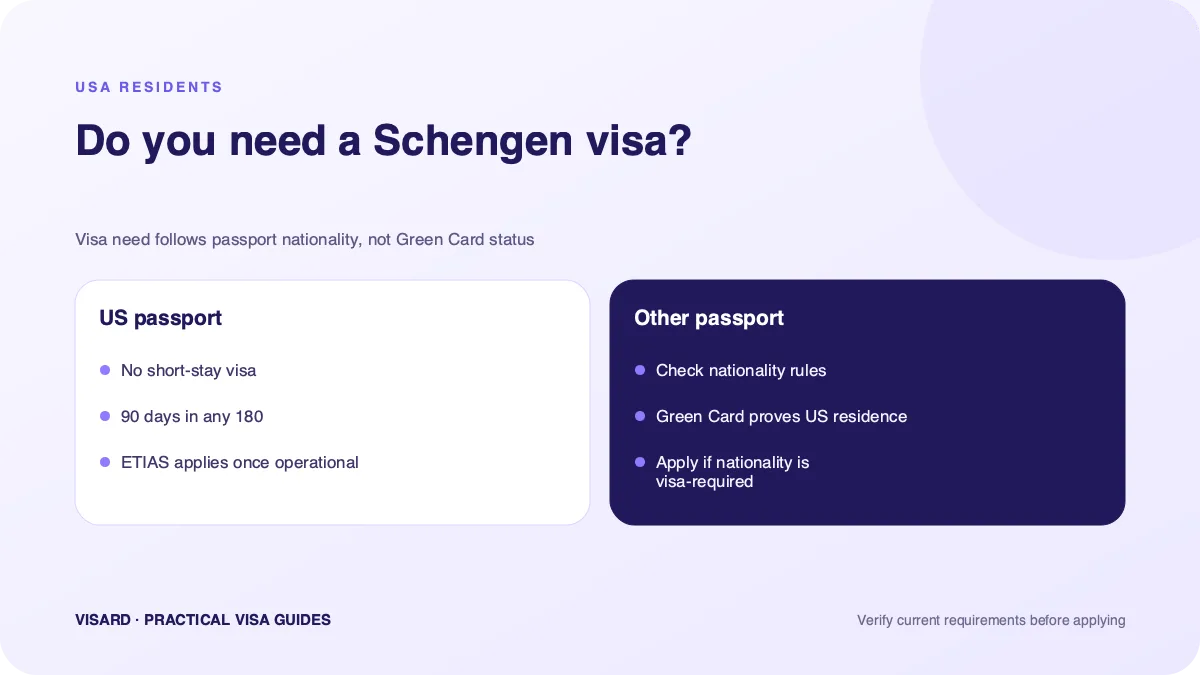
If you hold a US passport, you do NOT need a Schengen visa for tourism or business trips under 90 days. Green card holders and other US residents must apply for a visa based on their citizenship, regardless of residency status.
US Passport Holders - NO Visa Required
US citizens enjoy visa-free access to all 29 Schengen countries for tourism, business meetings, and family visits lasting up to 90 days within any 180-day period. This is the standard "90/180 rule" that applies to visa-exempt nationalities.
Starting in late 2026, US passport holders will need to apply for ETIAS (European Travel Information and Authorization System)—a €7 online authorization valid for three years. ETIAS is not a visa; it's a pre-travel screening similar to the US ESTA system. The application takes minutes to complete online.
Green Card Holders - Visa Required (Based on Citizenship)
Your green card proves US residency but does not grant visa-free access to the Schengen zone. European immigration authorities assess visa requirements based on your passport nationality, not where you currently live.
Example scenarios:
Mexican green card holder traveling to France: NO visa needed (Mexico is visa-exempt)
Indian green card holder traveling to France: Visa required (India is not visa-exempt)
Canadian green card holder traveling to Spain: NO visa needed (Canada is visa-exempt)
Pakistani green card holder traveling to Italy: Visa required (Pakistan is not visa-exempt)
The critical document is your passport, not your green card. However, green card holders can apply for their Schengen visa from US visa application centers rather than returning to their home country—a significant convenience.
Non-Immigrant Visa Holders (F1, H1B, J1, etc.)
Students on F1 visas, workers on H1B visas, and exchange visitors on J1 visas follow the same citizenship-based rule. If your nationality requires a Schengen visa, you must apply for one despite holding valid US immigration status.
The advantage: you can apply from the USA rather than your home country. The requirement: you must prove legal US residency with your valid visa documentation (I-20 for students, employment authorization for workers).
Understanding the Citizenship vs. Residency Rule
Official 2025 context: EU and Schengen-associated consulates received more than 12 million short-stay visa applications in 2025. The worldwide refusal rate was 14.6%, down from 14.8% in 2024; 51.7% of issued visas allowed multiple entries. These are global figures, not a prediction for an individual application. European Commission 2025 visa statistics.
Why Your Green Card Doesn't Grant Visa-Free Access
The Schengen visa system operates on bilateral agreements between the European Union and individual countries. These agreements classify nations as "visa-required" or "visa-exempt" based on diplomatic relations, security assessments, and reciprocity agreements.
Your green card proves you are a lawful permanent resident of the United States. It is not a travel document that replaces your passport. When you arrive at a European border, immigration officers check your passport nationality against their visa requirement database—your green card is irrelevant to this determination.
This principle applies globally. A Chinese green card holder needs a visa for the UK. A Nigerian green card holder needs a visa for Canada. Residency in one country does not transfer visa privileges from that country's passport.
Visa-Exempt Nationalities (Can Apply in USA Without Needing Visa)
If you hold citizenship from a visa-exempt country but still want to apply for a visa in the USA (perhaps for stays exceeding 90 days or for work purposes), you can do so at US application centers. Visa-exempt nationalities include:
Canada, Mexico
United Kingdom, Ireland
Australia, New Zealand, Japan, South Korea, Singapore
Most Latin American countries (Brazil, Argentina, Chile, etc.)
These applicants technically don't need a visa for tourism but may apply for one if planning extended stays or multiple long trips.
Visa-Required Nationalities (Most Common in USA)
The majority of green card holders in the USA come from countries that require Schengen visas. The largest applicant groups include citizens of:
India (largest applicant base from USA)
China, Philippines, Pakistan
Vietnam, Thailand
Nigeria, Egypt, Morocco
Turkey, Iran
For a complete list of visa-required nationalities, check the official EU visa requirements database at the European Commission website.
Understanding Schengen Visa Categories
Type C (Short-Stay Visa) - Most Common
The Type C visa is the standard short-stay visa for tourism, business, and family visits. It permits stays of up to 90 days within any 180-day period across all 29 Schengen countries.
Permitted activities include:
Tourism and sightseeing
Business meetings and conferences (no employment)
Visiting family or friends
Medical treatment
Cultural events and courses under 90 days
Type C visas do not permit employment, studying for more than 90 days, or establishing residency in a Schengen country.
Single-Entry vs. Multiple-Entry Visas
Single-entry visas allow one entry into the Schengen zone. Once you exit, the visa becomes invalid even if the validity period hasn't expired. These are typically issued for first-time applicants or those with limited travel history.
Multiple-entry visas allow unlimited entries during the visa's validity period, which can range from 6 months to 5 years. You can leave and re-enter the Schengen zone multiple times, but your total stay cannot exceed 90 days in any 180-day period.
Consulates typically grant multiple-entry visas to applicants with:
Established travel history to Schengen countries
Strong financial ties to the USA
Regular business travel requirements
Frequent family visit needs
Type A (Airport Transit Visa)
Type A visas are required only for specific nationalities transiting through Schengen airports without entering the country. Green card holders from most countries are exempt from airport transit visa requirements—you can transit through Schengen airports without a visa as long as you don't leave the international zone.
Check with your specific airline and transit country, as requirements vary by nationality and airport.
Selecting the Correct Schengen Country to Apply To
Single Destination Rule
If you're visiting only one Schengen country, apply for a visa from that country's consulate. This is the simplest scenario—planning a week in Paris means applying for a French visa, regardless of which city you fly into.
Multiple Destinations - Main Purpose or Longest Stay
For multi-country trips, apply to the consulate of your "main destination"—the country where you'll spend the most days or conduct your primary activity.
Example 1: 5 days in France + 3 days in Belgium = Apply for French visa (longest stay)
Example 2: 4 days in Italy + 4 days in Spain, attending a conference in Spain = Apply for Spanish visa (main purpose)
If days are exactly equal and no clear main purpose exists, apply to the consulate of your first entry point.
Equal Time - First Point of Entry
Example: 3 days in Netherlands + 3 days in Germany + 3 days in Austria, flying into Amsterdam = Apply for Netherlands visa (first entry)
Why This Matters (Visa Shopping = Rejection Risk)
Applying to the "easiest" consulate regardless of your actual travel plans is called "visa shopping." Consulates detect this through:
Flight itineraries that don't match the issuing country
Hotel bookings primarily in other Schengen countries
Stated travel plans that contradict the application
Visa shopping results in automatic rejection and creates red flags for future applications. Always apply to the correct consulate based on your genuine travel plans.
Visa Application Centers Across the USA
In 2026, three service providers operate Schengen visa application centers across the USA: TLScontact (France only), VFS Global (most countries), and BLS International (Spain and Germany). These private companies handle document collection and biometric processing on behalf of European consulates.
TLScontact Centers (France Only)
Critical 2026 Update: As of April 2025, all French visa applications in the USA transitioned from VFS Global to TLScontact exclusively.
TLScontact locations: Atlanta, Boston, Chicago, Houston, Los Angeles, Miami, New York, San Francisco, Seattle, Washington DC
Countries handled: France exclusively
TLScontact operates 10 centers specifically for French visa processing. If you're applying for any other Schengen country, you'll use VFS or BLS.
VFS Global Centers
VFS locations: Chicago, Houston, Miami, New York, San Francisco, Washington DC
Countries handled: Austria, Belgium, Croatia, Czech Republic, Denmark, Estonia, Finland, Greece, Hungary, Iceland, Italy, Latvia, Lithuania, Luxembourg, Malta, Netherlands, Norway, Poland, Portugal, Slovenia, Sweden, Switzerland
VFS processes applications for the majority of Schengen countries. Their centers are often shared facilities handling multiple countries in the same location.
BLS International Centers
BLS locations: Boston, Chicago, Houston, Los Angeles, Miami, New York, San Francisco, Washington DC
Countries handled: Spain (all centers), Germany (select centers only)
BLS primarily processes Spanish visa applications across all eight US locations. German visa processing through BLS is available only at specific centers—verify availability for your nearest location before booking.
Which Countries Use Which Provider
Destination Country | Service Provider | Nearest Centers |
|---|---|---|
France | TLScontact | 10 cities nationwide |
Spain | BLS International | 8 cities nationwide |
Germany | BLS International | Select cities only |
Italy | VFS Global | 6 major cities |
Portugal | VFS Global | 6 major cities |
Netherlands | VFS Global | 6 major cities |
Austria | VFS Global | 6 major cities |
Greece | VFS Global | 6 major cities |
Switzerland | VFS Global | 6 major cities |
For less common destinations (Iceland, Estonia, Croatia, etc.), check the VFS Global USA website for specific center assignments.
The 2026 Documentation Checklist for Green Card Holders
Passport Requirements
Your passport must meet specific validity and condition requirements:
Valid for at least 6 months beyond your intended return date (3 months minimum, 6 months recommended)
Issued within the last 10 years
Contains at least 2 blank visa pages
In good physical condition (no water damage, torn pages, or tampering)
If your passport expires soon, renew it before applying for your visa. Consulates will reject applications with insufficient passport validity.
US Residency Proof (CRITICAL for USA Applicants)
This is where green card holders differ from tourists applying from their home countries. You must prove legal US residency status with one of the following:
For Green Card Holders:
Original green card (front and back photocopies required)
Green card must be valid for at least 3 months beyond your planned return date from Europe
Recent green card renewals may require additional proof of continuous residence
For F1 Students:
Valid F1 visa stamp in passport
Original I-20 form signed by designated school official (within last year)
Letter of enrollment from university (dated within 30 days)
For H1B Workers:
Valid H1B visa stamp in passport
Employment verification letter on company letterhead (dated within 30 days)
Recent pay stubs (last 3 months)
Copy of employment authorization document
For J1 Exchange Visitors:
Valid J1 visa stamp
DS-2019 form (original)
Letter from exchange program sponsor
Expired US visas or green cards result in automatic application rejection—verify validity before booking your appointment.
Completed Visa Application Form
Complete the online visa application form through the specific consulate's official portal. Each Schengen country maintains its own application system (though most use the common "Schengen visa" interface).
Steps:
Fill out all sections accurately
Generate and save your unique application reference code
Print the completed form
Sign and date it
Do not submit handwritten or incomplete forms. Errors require resubmission and new appointment scheduling.
Biometric Photographs
Two recent passport-style photographs meeting ICAO (International Civil Aviation Organization) standards:
Taken within the last 6 months
35mm x 45mm size
White or light gray background
Face covering 70-80% of photo
Neutral expression, mouth closed
No glasses (if possible)
Religious headwear allowed if face visible
Most visa centers offer photo services on-site ($15-20), but arriving with compliant photos saves time.
Travel Insurance
Mandatory requirement: Medical travel insurance covering all Schengen countries with minimum €30,000 ($33,000) coverage.
Insurance must:
Cover the entire duration of your trip
Include medical emergencies, hospitalization, and medical repatriation
Be valid in all 29 Schengen states
Show coverage dates matching your travel dates
Purchase insurance after booking your appointment but before your visa interview. Many consulates recommend Schengen-specific insurance providers that guarantee policy acceptance.
Financial Evidence
Proof you can support yourself financially during your stay in Europe:
Bank statements: Last 3 months from checking or savings accounts showing:
Consistent balance history (sudden large deposits raise red flags)
Minimum recommended balance: $125 per day of travel
Account holder name matching passport
Employment documentation:
Employment verification letter on company letterhead
Letter should state position, salary, employment start date, and approved leave dates
Recent pay stubs (last 3 months)
For self-employed applicants:
Business registration documents
Bank statements showing business income
Tax returns from last year
For sponsored trips:
Sponsor's bank statements (last 3 months)
Sponsor's employment letter
Notarized sponsorship letter stating sponsor will cover all expenses
Proof of relationship to sponsor (if family)
Credit card statements alone are insufficient—consulates require liquid assets in bank accounts.
Travel Itinerary
Round-trip flight reservations: Show confirmed bookings (or refundable reservations) for both outbound and return flights. Do not purchase non-refundable tickets until after visa approval.
Hotel bookings: Confirmed reservations for each night of your stay. If staying with family/friends, provide:
Invitation letter from host
Copy of host's passport or residence permit
Proof of host's accommodation (lease agreement or property deed)
Day-by-day itinerary: Detailed travel plan showing:
Dates and cities you'll visit
Activities planned (sightseeing, business meetings, family visits)
Transportation between cities
A vague itinerary ("touring Europe") raises suspicion. Specific plans demonstrate genuine travel intent and help prevent visa shopping accusations.
Cover Letter
A one-page letter explaining:
Purpose of your trip (tourism, business, family visit)
Planned duration and specific dates
Ties to the USA proving intent to return (job, property ownership, family)
Why you're visiting now
The cover letter personalizes your application and provides context for supporting documents. Address it to the consulate of the country you're applying to.
Visa Fees for 2026
Consular Fees (EU Standard)
The European Union sets standard visa fees applied by all Schengen countries:
Adults (12+ years): €90 (~$99 USD)
Children (6-11 years): €45 (~$50 USD)
Children under 6: Free
These fees are non-refundable regardless of approval or rejection. Payment timing varies by service center—some require payment at application submission, others at appointment scheduling.
Service Center Fees (USA-Specific)
Service providers charge additional fees for document handling, appointment scheduling, and biometric collection. These fees vary significantly by country and provider:
Destination Country | Service Provider | Service Fee (USD) | Total Cost |
|---|---|---|---|
France | TLScontact | $49-55 | ~$148-154 |
Spain | BLS International | $20 | ~$119 |
Germany | BLS International | $46 | ~$145 |
Italy | VFS Global | $53 | ~$152 |
Austria | VFS Global | $53 | ~$152 |
Portugal | VFS Global | $53 | ~$152 |
Netherlands | VFS Global | $53 | ~$152 |
Switzerland | VFS Global | $53 | ~$152 |
Additional optional fees:
Premium appointment time slots: $50-100
SMS tracking updates: $5-10
Courier passport return: $25-35
Photo service: $15-20
Document photocopying: $0.50 per page
Service center fees are also non-refundable and must be paid regardless of visa outcome.
Total Cost Example
Single adult applying for France visa:
EU consular fee: €90 ($99)
TLScontact service fee: $52
Courier return: $30
Total: approximately $181
Family of four (2 adults, 1 child age 8, 1 child age 4) applying for Spain:
Adult 1: €90 ($99)
Adult 2: €90 ($99)
Child 1 (age 8): €45 ($50)
Child 2 (age 4): Free
BLS service fee: $20 per person ($80 total)
Total: approximately $328
Budget for these fees when planning your trip—they add significantly to travel costs for families.
Processing Times - What to Expect
2026 border update: The Entry/Exit System (EES) began its progressive rollout on 12 October 2025 and became fully operational across the Schengen area on 10 April 2026. It replaces routine passport stamping with digital entry and exit records; non-EU short-stay travellers should expect identity and biometric checks at the border. European Commission EES update.
Standard Processing (15 Calendar Days)
The official processing time for Schengen visas is 15 calendar days from the date of your biometric appointment. This is the standard timeframe written into EU regulations.
In practice, many applications from the USA clear within 10-15 working days due to efficient diplomatic channels and computerized systems. Simple tourism applications with complete documentation typically process fastest.
Extended Processing (Up to 45 Days)
Consulates can extend processing to 30 calendar days for applications requiring additional verification. Extensions to 45 days occur in exceptional circumstances such as:
Additional document requests (missing or unclear evidence)
Referral to immigration services in the destination country
High-volume periods overwhelming consular staff
Security or background check delays
You'll receive notification if your application requires extended processing. This is not necessarily a negative sign—it often reflects procedural requirements rather than problems with your application.
Peak Season Reality
Application volumes surge dramatically during peak travel seasons:
Summer (June-August): Highest demand period. French, Italian, and Spanish visas process slower due to holiday vacation travel. Expect processing times at the upper end of the 15-day window or beyond.
Christmas/New Year (December-January): Second highest volume. European consular offices operate on reduced schedules during this period, extending processing times.
Spring Break (March-April): Moderate increase in applications, particularly from students.
When to Apply
Earliest application: 6 months before your intended travel date (as of 2026)
Latest recommended application: 2-3 months before departure to account for processing time and potential delays
Absolute latest: 15 days before travel (official minimum, but extremely risky)
Applying early provides buffer time for unexpected delays, document requests, or the need to reapply if initially rejected.
The REAL Challenge - Getting an Appointment
Why Appointment Slots Disappear Instantly
Processing your visa application takes 10-15 days. Getting an appointment to submit that application can take weeks or months.
The USA visa market creates perfect storm conditions:
Seven major cities serve applicants from across the country
Millions of annual applications from the large US immigrant population
Limited appointment capacity at each visa center
Concentrated demand during summer and holiday periods
Indian and Chinese green card holders represent the largest applicant groups, creating particularly intense competition for slots to popular destinations like France and Italy.
When TLScontact releases French visa appointments, hundreds of applicants refresh their browsers simultaneously. Slots that appear "available" disappear within seconds—often before manual clickers can complete the booking form.
Manual Booking Reality
Attempting to book appointments manually means:
Daily website checks: Logging into VFS, TLS, or BLS portals multiple times per day, searching for newly released slots
The "refresh addiction" loop: Clicking reload hundreds of times, watching "No appointments available" flash repeatedly
Split-second competition: When a slot appears, you're racing against other applicants to claim it first
Lost opportunities: Missing slots while at work, sleeping, or away from computer
Weeks of frustration: Most manual bookers report 3-6 weeks of daily checking before successfully securing an appointment
This process is exhausting and unreliable. You can't take vacation days to watch appointment portals 24/7.
The Appointment Scarcity Problem
France (highest demand): TLScontact's 10 US centers release appointments in unpredictable batches. Wait times of 4-8 weeks for summer travel appointments are common. The April 2025 switch from VFS to TLScontact initially created backlogs that persisted through 2025.
Popular summer destinations: Italy, Spain, Greece face similar scarcity during June-August booking periods.
Multiple applicants: Families need synchronized appointments for all members. Finding 4 slots at the same date and time is exponentially harder than booking for one person.
The bottleneck isn't visa approval—it's simply getting into the room to submit your application.
How Visard Solves the Appointment Problem
24/7 Automated Monitoring
Visa appointment finder technology monitors TLScontact and VFS Global centers simultaneously, checking for new appointment slots every 3 seconds. That's 28,800 checks per day—impossible for any human to match.
When a slot opens at any of the monitored US centers, the system detects it instantly and takes action based on your service level.
The monitoring runs continuously without breaks. Slots that release at 3 AM Eastern Time get captured while you sleep. Appointments that appear during your work hours get flagged while you're in meetings.
Two Service Options for USA Residents
Notifications: $40 (1 country) or $60 (all countries)
You receive instant Telegram alerts the moment appointments become available for your selected destination countries. The notification includes:
Which center has availability (New York, Los Angeles, etc.)
How many slots are open
Direct link to the booking page
You still manually complete the booking, but you're notified within seconds of slots appearing—a massive advantage over checking portals manually every few hours.
The notification service monitors appointment availability for these destinations from USA:
France (via TLScontact)
Netherlands (via VFS Global)
Iceland (via VFS Global)
Austria (via VFS Global)
Portugal (via VFS Global)
Auto-Booking: $100 (1st applicant), $50 (each additional)
The system automatically secures your appointment without any action from you. You provide your application details once, and when a slot matching your requirements appears, the automation completes the entire booking process.
Currently available for this destination from USA:
Portugal (via VFS Global)
Note: For France, Netherlands, Iceland, and Austria, the notification service is available. Auto-booking for these destinations is on the waitlist for future development.
This is the most hands-off option for Portugal applicants—you wake up to a confirmed appointment notification.
Pay-After-Success Model
Auto-booking operates on a zero-risk payment structure. You don't pay the $100 service fee until after your appointment is successfully confirmed and you've received the booking reference.
If the system doesn't secure an appointment within your timeframe, you pay nothing. This eliminates the upfront risk common with traditional visa agents who charge $200-400 regardless of results.
Payment processing uses Stripe, providing standard credit card chargeback protection.
Family Coverage
One subscription covers all family members traveling together. For a family of four applying for Portugal:
First applicant: $100
Second applicant: $50
Third applicant: $50
Fourth applicant: $50
Total: $250
Compare this to traditional agents charging $200-300 per person ($800-1,200 for a family of four), and the value becomes clear.
All family members' appointments are synchronized for the same date and time at the same center—critical for group applications.
How It Works
Sign up via Telegram bot: Create your account through Telegram (free messaging app)
Select destination countries: Choose from France, Netherlands, Iceland, Austria, or Portugal
Receive alerts OR automated booking: Depending on your service level and destination
Average time to appointment: 4-7 days from signup to confirmed slot
The system eliminates the frustration of manual monitoring while providing transparency about availability and booking status through Telegram updates.
Application Process Step-by-Step
Step 1 - Determine Eligibility
Before starting the application process:
Check if your citizenship requires a visa: Use the EU's official visa requirement checker on the European Commission website. Enter your nationality (not residence) to see if you need a visa.
Verify green card or US visa validity: Your residency proof must be valid for at least 3 months beyond your planned return from Europe. Expired documents mean automatic rejection.
Confirm you can apply from the USA: You must have legal US residency status (green card, F1, H1B, J1, etc.). Tourist visa holders (B1/B2) must apply from their home country.
Step 2 - Gather Documents
Collect all required documents from the checklist in the documentation section:
Passport meeting validity requirements
Green card or US visa (original + photocopies)
Completed application form
Biometric photographs
Financial evidence (bank statements, employment letter)
Travel insurance
Flight and hotel reservations
Cover letter
Organize documents in the order required by your service center (each provides specific checklists on their website).
Step 3 - Complete Application Form Online
Navigate to the official visa application portal for your destination country. Most Schengen countries use a standardized online form system.
Fill out every section carefully:
Personal information exactly as shown in passport
Contact information (use reliable US address and phone)
Travel details matching your itinerary documents
Employment and financial information
Generate your unique application code after completing the form. This code links your online application to your appointment and biometric data.
Print the completed form, sign, and date it. Bring the printed form to your appointment.
Step 4 - Book Appointment
This is historically the hardest step—and where most applicants get stuck.
Manual option: Check VFS Global, TLScontact, or BLS International websites daily (often multiple times per day) for available slots. When you see availability, immediately complete the booking before other applicants claim the slot.
Automated option: Use Visard for instant notifications (France, Netherlands, Iceland, Austria, Portugal) or automatic booking (Portugal). The system handles monitoring while you focus on document preparation.
Appointments typically can't be booked more than 3 months in advance, so time your booking accordingly based on your travel dates.
Step 5 - Attend Visa Interview
Arrive at the visa application center 15 minutes before your scheduled time. Bring all original documents plus photocopies as specified.
What happens at the appointment:
Document submission: Staff verify your documents against the checklist. Incomplete applications are rejected on the spot—you must reschedule and resubmit.
Biometric data collection: Digital fingerprint scanning (all fingers) and photograph. This data enters the Visa Information System (VIS) shared across all Schengen countries.
Fee payment: Pay consular and service fees if not paid online during booking.
Interview (if required): Brief questions about travel purpose, itinerary, and ties to USA. Most routine tourism applications don't require extensive interviews.
The entire appointment typically takes 20-45 minutes depending on center volume.
Step 6 - Track Application
You'll receive a tracking number after your appointment. Use this number to check your application status online through the service center's portal.
Status updates typically show:
"Application received" (immediately after appointment)
"Under process at consulate" (documents sent to embassy)
"Decision made" (visa approved or denied)
"Ready for collection" (passport returned to center)
Processing updates aren't always real-time—don't panic if status doesn't change daily.
Step 7 - Collect Passport
Choose your passport return method during application:
In-person pickup: Return to the visa center during collection hours. Bring your receipt and government-issued ID.
Courier delivery: Service center mails your passport via tracked courier (additional $25-35 fee). Delivery takes 2-3 business days within the USA.
Verify visa details immediately when you receive your passport:
Correct name spelling
Accurate travel dates
Entry type (single vs multiple)
Destination country matches application
Report any errors to the consulate immediately—errors can cause border entry problems.
Entry/Exit System (EES) - Implemented October 2025
What is EES
The Entry/Exit System is the European Union's automated border control database that replaced traditional passport stamping. The progressive rollout began on October 12, 2025, and the system became fully operational across the Schengen area on April 10, 2026.
EES captures and stores:
Biometric data (facial image and 10 fingerprints)
Entry and exit dates/times
Border crossing location
Travel document details
This data automatically tracks your 90/180-day stay limit, eliminating manual stamp counting and reducing passport fraud.
What It Means for Green Card Holders
As a non-EU national entering the Schengen zone, you must register in the EES system at your first entry after October 12, 2025.
First-time registration process:
Present passport and visa at border control
Biometric capture (photo and fingerprints at automated kiosk or officer station)
Confirmation of registration
Normal entry processing continues
Registration takes an additional 2-3 minutes compared to pre-EES border processing. Budget extra time for this step, especially at busy airports.
Subsequent entries: Your biometric data remains in the system for 3 years. Future entries require only facial recognition match—no fingerprints needed unless the system fails to identify you.
First-Time Registration
Expect longer wait times at border control during your first post-EES entry to Europe. Major airports have deployed self-service EES kiosks to speed processing, but queues remain longer than pre-October 2025 travel.
Pro tip: If traveling as a family, one parent can register children while the other handles adult registration, reducing total family processing time.
ETIAS for US Passport Holders (Coming Late 2026)
What is ETIAS
ETIAS (European Travel Information and Authorization System) is a pre-travel authorization system for visa-exempt nationalities. It functions similarly to the US ESTA program for Europeans visiting America.
Important clarification: ETIAS is NOT a visa. It's an electronic travel authorization that visa-exempt travelers must obtain before boarding flights to Europe.
Who Needs ETIAS
US passport holders only. When ETIAS launches in late 2026, all US citizens traveling to the Schengen zone will need valid ETIAS authorization before departure.
Green card holders DO NOT need ETIAS if they require a Schengen visa based on their nationality. If you have a valid Schengen visa in your passport, ETIAS does not apply to you—the visa supersedes the ETIAS requirement.
Exception: Green card holders from visa-exempt countries (Canadian green card holders, Mexican green card holders, etc.) who travel on their passport without a visa WILL need ETIAS.
How to Apply (When Launched)
ETIAS applications will be submitted entirely online through the official ETIAS portal:
Fill out personal information (10-15 minutes)
Answer security and health questions
Upload passport data page
Pay €7 fee (~$7.50 USD)
Receive decision via email (typically within 72 hours)
Approved authorizations are valid for 3 years or until passport expiration, whichever comes first. You can make unlimited trips during the validity period as long as you stay within the 90/180-day limit.
ETIAS vs. Schengen Visa
Feature | ETIAS | Schengen Visa |
|---|---|---|
Who needs it | Visa-exempt nationalities | Visa-required nationalities |
Application | Online only (15 minutes) | In-person at visa center |
Processing | 72 hours average | 10-15 days average |
Cost | €7 (~$7.50) | €90 + service fees ($150+ total) |
Validity | 3 years | Varies (single trip to 5 years) |
Guarantees entry | No (border officers decide) | No (border officers decide) |
Both ETIAS and visas are pre-travel authorizations—neither guarantees entry. European border officers retain final authority to admit or refuse travelers regardless of visa or ETIAS status.
Common Mistakes That Lead to Rejection
Expired or Insufficient Green Card Validity
Green cards must remain valid for at least 3 months beyond your planned return date from Europe. Applications submitted with green cards expiring before this threshold are automatically rejected.
Conditional green card holders: If your green card shows an expiration date within 3 months of your trip, renew it before applying for your visa. Conditional green cards approaching expiration don't satisfy validity requirements even if you've already applied for permanent status.
Recently renewed green cards: If you recently received a new green card, verify the physical card arrived before booking your visa appointment. Approval notices aren't acceptable—you need the physical green card.
Applying to Wrong Country
"Visa shopping"—applying to whichever consulate seems easiest rather than your actual main destination—is a leading rejection cause.
Consulates detect visa shopping through:
Flight itineraries showing minimal time in the issuing country
Hotel bookings concentrated in other Schengen countries
Cover letters describing plans that don't match the application country
Patterns of previous visa shopping attempts
Consequences: Rejection, mandatory explanation in future applications, potential multi-year ban from that consulate.
How to avoid: Apply honestly to your actual main destination country. If plans change after approval, that's acceptable—but initial application must reflect genuine plans.
Insufficient Financial Proof
Consulates require evidence you can support yourself without working illegally or overstaying. Common financial proof mistakes:
Insufficient balance: Bank statements showing $500 for a 14-day Europe trip raise red flags. Maintain account balances of approximately $125 per day of travel.
Unexplained large deposits: Suddenly depositing $5,000 two days before your visa appointment looks like "borrowed" money. Consulates want to see consistent balances over 3 months.
Credit card limits instead of cash: Credit card statements showing available credit don't prove financial stability. You need liquid funds in checking or savings accounts.
Bank statements in someone else's name: If your spouse or parent holds the account, you need a notarized sponsorship letter explaining they'll fund your trip, plus proof of relationship.
Incomplete Travel Itinerary
Vague travel plans suggest:
You haven't actually planned the trip (fraud suspicion)
You might work illegally or overstay
You're applying speculatively rather than for specific travel
Rejected itineraries:
"I'll visit European cities" (which cities? when?)
"Touring around" (where? how long in each place?)
"Staying with friends" (who? where? prove you know them)
Acceptable itineraries:
"June 15-18: Paris (hotel: Hotel X), June 18-22: Nice (hotel: Hotel Y)"
Day-by-day activity plans even if not booked: "June 16: Louvre Museum, Eiffel Tower; June 17: Versailles day trip"
Be specific. Consular officers are experienced enough to spot fabricated itineraries, but detailed genuine plans demonstrate serious travel intent.
Missing Employment/Student Documentation
Ties to the USA are critical for proving you'll return after your trip. Most rejected applications lack convincing evidence of these ties.
For employed applicants:
Generic employment letters ("To whom it may concern: John works here") insufficient
Letters must state: position title, salary, hire date, approved vacation dates, confirmation of return to work
Self-employment requires business registration, client contracts, upcoming commitments
For students:
Generic enrollment confirmation insufficient
Need: I-20 signed by designated official, letter confirming enrollment for next semester, registration proof for upcoming courses
Summer break travel requires fall semester registration evidence
Red flags:
Unemployed applicants with no clear reason for return
New jobs started days before application (appears like leaving after getting visa)
Vague business ownership claims without documentation
Insurance Not Covering All Schengen States
Travel insurance must explicitly state coverage in all Schengen countries. Common insurance problems:
Policies covering only destination country: "France coverage" insufficient—must cover all 29 Schengen states
Policies showing "Europe" coverage: Some define Europe as EU only (excludes Switzerland, Iceland, Norway, Liechtenstein)
Insufficient coverage amounts: Must show minimum €30,000 medical coverage
Wrong coverage dates: Insurance dates must match or exceed travel dates (allowing buffer days is smart)
Recommendation: Purchase Schengen-specific insurance from providers specializing in visa insurance. These policies guarantee consular acceptance and cost $1-3 per day.
Biometric Data Requirements (VIS System)
Visa Information System (VIS)
VIS is the centralized biometric database storing fingerprints and facial images for all Schengen visa applicants. When you provide biometrics at your US visa appointment, this data is stored in VIS and shared across all 29 Schengen countries.
Storage period: Fingerprints remain in VIS for 59 months (approximately 5 years).
Purpose: Prevent visa fraud, verify identity at borders, link visa applications to correct individuals.
Who Must Provide Fingerprints
First-time Schengen visa applicants: If you've never applied for a Schengen visa, or your previous fingerprints were taken more than 59 months ago, you must provide fresh biometrics.
All applicants aged 12+: Children younger than 12 are exempt from fingerprinting.
Every Schengen visa application: Even if applying for multiple countries simultaneously, one biometric capture covers all applications within the 59-month window.
Exemptions
Children under 12: No fingerprints required. If a child turns 12 before the trip, they must provide fingerprints at that point.
Physical impossibility: Individuals with no fingers or hand injuries preventing capture may be temporarily exempted. Medical documentation required.
Heads of state and diplomats: Special diplomatic processing exempts from biometric requirements.
Previous VIS capture within 59 months: If your fingerprints are already in the system and haven't expired, you don't re-submit them. The consulate retrieves your existing biometric data.
Frequently Asked Questions
Do I need a Schengen visa if I have a green card?
Yes, if your citizenship requires a visa to enter the Schengen zone. Your green card proves US residency but doesn't grant visa-free European travel. Check EU visa requirements for your passport country. For example, Indian green card holders need a visa; Canadian green card holders don't (because Canada is visa-exempt).
Can US green card holders travel to Europe without a visa?
Only if you hold citizenship from a visa-exempt country. Mexican citizens with US green cards can travel visa-free to Schengen countries. Pakistani citizens with US green cards cannot—they must obtain a visa. Your citizenship determines requirements, not your US residency status.
How long does it take to get a Schengen visa from USA?
Standard processing is 10-15 working days after your biometric appointment. However, getting the appointment itself can take 3-6 weeks of manual booking attempts, or 4-7 days using automation services. Peak season applications (June-August) may extend processing to 30-45 days.
Where do I apply for Schengen visa in USA?
At visa application centers in major cities: New York, Los Angeles, Chicago, Miami, San Francisco, Washington DC, Houston (plus Atlanta, Boston, Seattle for French visas via TLScontact). The specific center depends on which Schengen country you're applying to and which service provider handles that country.
What documents do green card holders need for Schengen visa?
Essential documents: Valid passport (6+ months validity), valid green card (3+ months beyond return), completed visa application form, biometric photos, travel insurance (€30,000 coverage), bank statements (last 3 months), employment letter, flight reservations, hotel bookings, and cover letter. Students need I-20 forms; workers need employment authorization documents.
Is ETIAS the same as a Schengen visa?
No. ETIAS (launching late 2026) is a €7 travel authorization for visa-exempt travelers like US passport holders. It's approved online in 72 hours and lasts 3 years. A Schengen visa is required for visa-required nationalities, costs €90 plus service fees, requires in-person application, and processing takes 10-15 days. Green card holders from visa-required countries need visas, not ETIAS.
Can I apply for Schengen visa in USA on B1/B2 tourist visa?
No. You must have legal US residency status (green card, F1, H1B, J1, or other residence-based visa) to apply from the USA. B1/B2 tourist visa holders must return to their home country to apply for Schengen visas. The exception is if you're a visa-exempt national—but then you wouldn't need a Schengen visa anyway.
Does my green card validity matter for Schengen visa?
Yes, critically. Your green card must be valid for at least 3 months beyond your planned return date from Europe. If your green card expires during or shortly after your trip, consulates will reject your application. Renew expiring green cards before applying for your Schengen visa.
Country-Specific Visa Guides for US Residents
While this general guide covers the fundamentals, each Schengen country has specific nuances in their application process, documentation requirements, and processing times. Below are detailed guides for US residents applying to individual Schengen destinations:
Automated Appointment Services by Destination
Struggling to book your visa appointment at US centers? Visard's automated monitoring eliminates the manual search. Our system checks TLScontact and VFS Global booking systems every 3 seconds, 24/7.
Auto-booking available (appointments secured automatically, pay after success):
Notification service available (instant alerts when slots appear):
How it works:
Choose your destination country
Enable 24/7 monitoring (checks every 3 seconds)
Receive instant Telegram alerts or automatic booking
Pay only after your appointment is confirmed (auto-booking service)
Planning to Apply from Another Country?
If you're exploring visa application options from different locations or planning to apply with family members residing elsewhere, check our complete guides for other application countries:
Each guide covers country-specific requirements, local visa centres, and appointment booking strategies for that region.
Conclusion
Securing a Schengen visa as a US green card holder involves two distinct challenges: gathering the correct documentation and actually booking an appointment to submit it. The documentation process is straightforward once you understand that citizenship—not residency—determines your visa requirements.
Your green card proves you can apply from the USA rather than your home country, a significant convenience. But it doesn't grant visa-free travel to Europe. Indian passport holders need visas whether they live in India or hold US green cards. Canadian passport holders travel visa-free whether they live in Canada or hold US green cards. Your passport nationality is what matters at European borders.
The real frustration point for most USA applicants isn't visa approval—it's securing an appointment at VFS Global, TLScontact, or BLS International centers. Manual booking requires weeks of daily website monitoring, refreshing portals hoping to catch slots before other applicants claim them. For families needing synchronized appointments, manual booking becomes exponentially harder.
This is where automation solves the practical problem. Services like schengen visa telegram bot USA monitor TLScontact (France) and VFS Global (Netherlands, Iceland, Austria, Portugal) centers across major US cities. Instead of manually refreshing websites for weeks, you receive instant notifications or automatic bookings within days. The average time from signup to confirmed appointment is 4-7 days—compared to 3-6 weeks for manual attempts.
For USA residents specifically, the service monitors these five destinations: France, Netherlands, Iceland, Austria, and Portugal. Notification alerts are available for all five countries, while auto-booking is currently available for Portugal only. One subscription covers your entire family, with appointments synchronized for the same date and time.
If you would rather be told than keep checking, you can track Schengen appointment availability from the United States.
Schengen Visa from USA 2026: Complete Guide for Green Card Holders & US Residents
If you're a green card holder or US resident with a non-EU passport, you've likely encountered the confusing question: "Do I need a Schengen visa?" The answer depends entirely on your citizenship, not your US residency status. While US passport holders travel visa-free to Europe's Schengen zone, green card holders must apply for a visa based on their nationality.
This creates a unique challenge for the third-country nationals living in the USA who need a Schengen visa. You're navigating a system designed for tourists applying from their home countries, but you're doing it from visa application centers across New York, Los Angeles, Miami, and five other major US cities. The process itself is straightforward—but securing an appointment at these centers has become the real bottleneck.
In 2026, appointment slots at VFS Global, TLScontact, and BLS International centers fill within hours of release. Manual booking means refreshing websites daily for weeks, competing against thousands of other applicants for the same limited slots. This guide walks through the entire visa process specifically for USA-based applicants, clarifies which documents green card holders need, and explains how automation tools like Schengen Visa Telegram Bot help solve the appointment scarcity problem.
Whether you're planning a Paris honeymoon, attending a business conference in Berlin, or visiting family in Barcelona, understanding the citizenship vs. residency rule is your starting point.
Do You Need a Schengen Visa from USA? The Green Card Question
If you hold a US passport, you do NOT need a Schengen visa for tourism or business trips under 90 days. Green card holders and other US residents must apply for a visa based on their citizenship, regardless of residency status.
US Passport Holders - NO Visa Required
US citizens enjoy visa-free access to all 29 Schengen countries for tourism, business meetings, and family visits lasting up to 90 days within any 180-day period. This is the standard "90/180 rule" that applies to visa-exempt nationalities.
Starting in late 2026, US passport holders will need to apply for ETIAS (European Travel Information and Authorization System)—a €7 online authorization valid for three years. ETIAS is not a visa; it's a pre-travel screening similar to the US ESTA system. The application takes minutes to complete online.
Green Card Holders - Visa Required (Based on Citizenship)
Your green card proves US residency but does not grant visa-free access to the Schengen zone. European immigration authorities assess visa requirements based on your passport nationality, not where you currently live.
Example scenarios:
Mexican green card holder traveling to France: NO visa needed (Mexico is visa-exempt)
Indian green card holder traveling to France: Visa required (India is not visa-exempt)
Canadian green card holder traveling to Spain: NO visa needed (Canada is visa-exempt)
Pakistani green card holder traveling to Italy: Visa required (Pakistan is not visa-exempt)
The critical document is your passport, not your green card. However, green card holders can apply for their Schengen visa from US visa application centers rather than returning to their home country—a significant convenience.
Non-Immigrant Visa Holders (F1, H1B, J1, etc.)
Students on F1 visas, workers on H1B visas, and exchange visitors on J1 visas follow the same citizenship-based rule. If your nationality requires a Schengen visa, you must apply for one despite holding valid US immigration status.
The advantage: you can apply from the USA rather than your home country. The requirement: you must prove legal US residency with your valid visa documentation (I-20 for students, employment authorization for workers).
Understanding the Citizenship vs. Residency Rule
Official 2025 context: EU and Schengen-associated consulates received more than 12 million short-stay visa applications in 2025. The worldwide refusal rate was 14.6%, down from 14.8% in 2024; 51.7% of issued visas allowed multiple entries. These are global figures, not a prediction for an individual application. European Commission 2025 visa statistics.
Why Your Green Card Doesn't Grant Visa-Free Access
The Schengen visa system operates on bilateral agreements between the European Union and individual countries. These agreements classify nations as "visa-required" or "visa-exempt" based on diplomatic relations, security assessments, and reciprocity agreements.
Your green card proves you are a lawful permanent resident of the United States. It is not a travel document that replaces your passport. When you arrive at a European border, immigration officers check your passport nationality against their visa requirement database—your green card is irrelevant to this determination.
This principle applies globally. A Chinese green card holder needs a visa for the UK. A Nigerian green card holder needs a visa for Canada. Residency in one country does not transfer visa privileges from that country's passport.
Visa-Exempt Nationalities (Can Apply in USA Without Needing Visa)
If you hold citizenship from a visa-exempt country but still want to apply for a visa in the USA (perhaps for stays exceeding 90 days or for work purposes), you can do so at US application centers. Visa-exempt nationalities include:
Canada, Mexico
United Kingdom, Ireland
Australia, New Zealand, Japan, South Korea, Singapore
Most Latin American countries (Brazil, Argentina, Chile, etc.)
These applicants technically don't need a visa for tourism but may apply for one if planning extended stays or multiple long trips.
Visa-Required Nationalities (Most Common in USA)
The majority of green card holders in the USA come from countries that require Schengen visas. The largest applicant groups include citizens of:
India (largest applicant base from USA)
China, Philippines, Pakistan
Vietnam, Thailand
Nigeria, Egypt, Morocco
Turkey, Iran
For a complete list of visa-required nationalities, check the official EU visa requirements database at the European Commission website.
Understanding Schengen Visa Categories
Type C (Short-Stay Visa) - Most Common
The Type C visa is the standard short-stay visa for tourism, business, and family visits. It permits stays of up to 90 days within any 180-day period across all 29 Schengen countries.
Permitted activities include:
Tourism and sightseeing
Business meetings and conferences (no employment)
Visiting family or friends
Medical treatment
Cultural events and courses under 90 days
Type C visas do not permit employment, studying for more than 90 days, or establishing residency in a Schengen country.
Single-Entry vs. Multiple-Entry Visas
Single-entry visas allow one entry into the Schengen zone. Once you exit, the visa becomes invalid even if the validity period hasn't expired. These are typically issued for first-time applicants or those with limited travel history.
Multiple-entry visas allow unlimited entries during the visa's validity period, which can range from 6 months to 5 years. You can leave and re-enter the Schengen zone multiple times, but your total stay cannot exceed 90 days in any 180-day period.
Consulates typically grant multiple-entry visas to applicants with:
Established travel history to Schengen countries
Strong financial ties to the USA
Regular business travel requirements
Frequent family visit needs
Type A (Airport Transit Visa)
Type A visas are required only for specific nationalities transiting through Schengen airports without entering the country. Green card holders from most countries are exempt from airport transit visa requirements—you can transit through Schengen airports without a visa as long as you don't leave the international zone.
Check with your specific airline and transit country, as requirements vary by nationality and airport.
Selecting the Correct Schengen Country to Apply To
Single Destination Rule
If you're visiting only one Schengen country, apply for a visa from that country's consulate. This is the simplest scenario—planning a week in Paris means applying for a French visa, regardless of which city you fly into.
Multiple Destinations - Main Purpose or Longest Stay
For multi-country trips, apply to the consulate of your "main destination"—the country where you'll spend the most days or conduct your primary activity.
Example 1: 5 days in France + 3 days in Belgium = Apply for French visa (longest stay)
Example 2: 4 days in Italy + 4 days in Spain, attending a conference in Spain = Apply for Spanish visa (main purpose)
If days are exactly equal and no clear main purpose exists, apply to the consulate of your first entry point.
Equal Time - First Point of Entry
Example: 3 days in Netherlands + 3 days in Germany + 3 days in Austria, flying into Amsterdam = Apply for Netherlands visa (first entry)
Why This Matters (Visa Shopping = Rejection Risk)
Applying to the "easiest" consulate regardless of your actual travel plans is called "visa shopping." Consulates detect this through:
Flight itineraries that don't match the issuing country
Hotel bookings primarily in other Schengen countries
Stated travel plans that contradict the application
Visa shopping results in automatic rejection and creates red flags for future applications. Always apply to the correct consulate based on your genuine travel plans.
Visa Application Centers Across the USA
In 2026, three service providers operate Schengen visa application centers across the USA: TLScontact (France only), VFS Global (most countries), and BLS International (Spain and Germany). These private companies handle document collection and biometric processing on behalf of European consulates.
TLScontact Centers (France Only)
Critical 2026 Update: As of April 2025, all French visa applications in the USA transitioned from VFS Global to TLScontact exclusively.
TLScontact locations: Atlanta, Boston, Chicago, Houston, Los Angeles, Miami, New York, San Francisco, Seattle, Washington DC
Countries handled: France exclusively
TLScontact operates 10 centers specifically for French visa processing. If you're applying for any other Schengen country, you'll use VFS or BLS.
VFS Global Centers
VFS locations: Chicago, Houston, Miami, New York, San Francisco, Washington DC
Countries handled: Austria, Belgium, Croatia, Czech Republic, Denmark, Estonia, Finland, Greece, Hungary, Iceland, Italy, Latvia, Lithuania, Luxembourg, Malta, Netherlands, Norway, Poland, Portugal, Slovenia, Sweden, Switzerland
VFS processes applications for the majority of Schengen countries. Their centers are often shared facilities handling multiple countries in the same location.
BLS International Centers
BLS locations: Boston, Chicago, Houston, Los Angeles, Miami, New York, San Francisco, Washington DC
Countries handled: Spain (all centers), Germany (select centers only)
BLS primarily processes Spanish visa applications across all eight US locations. German visa processing through BLS is available only at specific centers—verify availability for your nearest location before booking.
Which Countries Use Which Provider
Destination Country | Service Provider | Nearest Centers |
|---|---|---|
France | TLScontact | 10 cities nationwide |
Spain | BLS International | 8 cities nationwide |
Germany | BLS International | Select cities only |
Italy | VFS Global | 6 major cities |
Portugal | VFS Global | 6 major cities |
Netherlands | VFS Global | 6 major cities |
Austria | VFS Global | 6 major cities |
Greece | VFS Global | 6 major cities |
Switzerland | VFS Global | 6 major cities |
For less common destinations (Iceland, Estonia, Croatia, etc.), check the VFS Global USA website for specific center assignments.
The 2026 Documentation Checklist for Green Card Holders
Passport Requirements
Your passport must meet specific validity and condition requirements:
Valid for at least 6 months beyond your intended return date (3 months minimum, 6 months recommended)
Issued within the last 10 years
Contains at least 2 blank visa pages
In good physical condition (no water damage, torn pages, or tampering)
If your passport expires soon, renew it before applying for your visa. Consulates will reject applications with insufficient passport validity.
US Residency Proof (CRITICAL for USA Applicants)
This is where green card holders differ from tourists applying from their home countries. You must prove legal US residency status with one of the following:
For Green Card Holders:
Original green card (front and back photocopies required)
Green card must be valid for at least 3 months beyond your planned return date from Europe
Recent green card renewals may require additional proof of continuous residence
For F1 Students:
Valid F1 visa stamp in passport
Original I-20 form signed by designated school official (within last year)
Letter of enrollment from university (dated within 30 days)
For H1B Workers:
Valid H1B visa stamp in passport
Employment verification letter on company letterhead (dated within 30 days)
Recent pay stubs (last 3 months)
Copy of employment authorization document
For J1 Exchange Visitors:
Valid J1 visa stamp
DS-2019 form (original)
Letter from exchange program sponsor
Expired US visas or green cards result in automatic application rejection—verify validity before booking your appointment.
Completed Visa Application Form
Complete the online visa application form through the specific consulate's official portal. Each Schengen country maintains its own application system (though most use the common "Schengen visa" interface).
Steps:
Fill out all sections accurately
Generate and save your unique application reference code
Print the completed form
Sign and date it
Do not submit handwritten or incomplete forms. Errors require resubmission and new appointment scheduling.
Biometric Photographs
Two recent passport-style photographs meeting ICAO (International Civil Aviation Organization) standards:
Taken within the last 6 months
35mm x 45mm size
White or light gray background
Face covering 70-80% of photo
Neutral expression, mouth closed
No glasses (if possible)
Religious headwear allowed if face visible
Most visa centers offer photo services on-site ($15-20), but arriving with compliant photos saves time.
Travel Insurance
Mandatory requirement: Medical travel insurance covering all Schengen countries with minimum €30,000 ($33,000) coverage.
Insurance must:
Cover the entire duration of your trip
Include medical emergencies, hospitalization, and medical repatriation
Be valid in all 29 Schengen states
Show coverage dates matching your travel dates
Purchase insurance after booking your appointment but before your visa interview. Many consulates recommend Schengen-specific insurance providers that guarantee policy acceptance.
Financial Evidence
Proof you can support yourself financially during your stay in Europe:
Bank statements: Last 3 months from checking or savings accounts showing:
Consistent balance history (sudden large deposits raise red flags)
Minimum recommended balance: $125 per day of travel
Account holder name matching passport
Employment documentation:
Employment verification letter on company letterhead
Letter should state position, salary, employment start date, and approved leave dates
Recent pay stubs (last 3 months)
For self-employed applicants:
Business registration documents
Bank statements showing business income
Tax returns from last year
For sponsored trips:
Sponsor's bank statements (last 3 months)
Sponsor's employment letter
Notarized sponsorship letter stating sponsor will cover all expenses
Proof of relationship to sponsor (if family)
Credit card statements alone are insufficient—consulates require liquid assets in bank accounts.
Travel Itinerary
Round-trip flight reservations: Show confirmed bookings (or refundable reservations) for both outbound and return flights. Do not purchase non-refundable tickets until after visa approval.
Hotel bookings: Confirmed reservations for each night of your stay. If staying with family/friends, provide:
Invitation letter from host
Copy of host's passport or residence permit
Proof of host's accommodation (lease agreement or property deed)
Day-by-day itinerary: Detailed travel plan showing:
Dates and cities you'll visit
Activities planned (sightseeing, business meetings, family visits)
Transportation between cities
A vague itinerary ("touring Europe") raises suspicion. Specific plans demonstrate genuine travel intent and help prevent visa shopping accusations.
Cover Letter
A one-page letter explaining:
Purpose of your trip (tourism, business, family visit)
Planned duration and specific dates
Ties to the USA proving intent to return (job, property ownership, family)
Why you're visiting now
The cover letter personalizes your application and provides context for supporting documents. Address it to the consulate of the country you're applying to.
Visa Fees for 2026
Consular Fees (EU Standard)
The European Union sets standard visa fees applied by all Schengen countries:
Adults (12+ years): €90 (~$99 USD)
Children (6-11 years): €45 (~$50 USD)
Children under 6: Free
These fees are non-refundable regardless of approval or rejection. Payment timing varies by service center—some require payment at application submission, others at appointment scheduling.
Service Center Fees (USA-Specific)
Service providers charge additional fees for document handling, appointment scheduling, and biometric collection. These fees vary significantly by country and provider:
Destination Country | Service Provider | Service Fee (USD) | Total Cost |
|---|---|---|---|
France | TLScontact | $49-55 | ~$148-154 |
Spain | BLS International | $20 | ~$119 |
Germany | BLS International | $46 | ~$145 |
Italy | VFS Global | $53 | ~$152 |
Austria | VFS Global | $53 | ~$152 |
Portugal | VFS Global | $53 | ~$152 |
Netherlands | VFS Global | $53 | ~$152 |
Switzerland | VFS Global | $53 | ~$152 |
Additional optional fees:
Premium appointment time slots: $50-100
SMS tracking updates: $5-10
Courier passport return: $25-35
Photo service: $15-20
Document photocopying: $0.50 per page
Service center fees are also non-refundable and must be paid regardless of visa outcome.
Total Cost Example
Single adult applying for France visa:
EU consular fee: €90 ($99)
TLScontact service fee: $52
Courier return: $30
Total: approximately $181
Family of four (2 adults, 1 child age 8, 1 child age 4) applying for Spain:
Adult 1: €90 ($99)
Adult 2: €90 ($99)
Child 1 (age 8): €45 ($50)
Child 2 (age 4): Free
BLS service fee: $20 per person ($80 total)
Total: approximately $328
Budget for these fees when planning your trip—they add significantly to travel costs for families.
Processing Times - What to Expect
2026 border update: The Entry/Exit System (EES) began its progressive rollout on 12 October 2025 and became fully operational across the Schengen area on 10 April 2026. It replaces routine passport stamping with digital entry and exit records; non-EU short-stay travellers should expect identity and biometric checks at the border. European Commission EES update.
Standard Processing (15 Calendar Days)
The official processing time for Schengen visas is 15 calendar days from the date of your biometric appointment. This is the standard timeframe written into EU regulations.
In practice, many applications from the USA clear within 10-15 working days due to efficient diplomatic channels and computerized systems. Simple tourism applications with complete documentation typically process fastest.
Extended Processing (Up to 45 Days)
Consulates can extend processing to 30 calendar days for applications requiring additional verification. Extensions to 45 days occur in exceptional circumstances such as:
Additional document requests (missing or unclear evidence)
Referral to immigration services in the destination country
High-volume periods overwhelming consular staff
Security or background check delays
You'll receive notification if your application requires extended processing. This is not necessarily a negative sign—it often reflects procedural requirements rather than problems with your application.
Peak Season Reality
Application volumes surge dramatically during peak travel seasons:
Summer (June-August): Highest demand period. French, Italian, and Spanish visas process slower due to holiday vacation travel. Expect processing times at the upper end of the 15-day window or beyond.
Christmas/New Year (December-January): Second highest volume. European consular offices operate on reduced schedules during this period, extending processing times.
Spring Break (March-April): Moderate increase in applications, particularly from students.
When to Apply
Earliest application: 6 months before your intended travel date (as of 2026)
Latest recommended application: 2-3 months before departure to account for processing time and potential delays
Absolute latest: 15 days before travel (official minimum, but extremely risky)
Applying early provides buffer time for unexpected delays, document requests, or the need to reapply if initially rejected.
The REAL Challenge - Getting an Appointment
Why Appointment Slots Disappear Instantly
Processing your visa application takes 10-15 days. Getting an appointment to submit that application can take weeks or months.
The USA visa market creates perfect storm conditions:
Seven major cities serve applicants from across the country
Millions of annual applications from the large US immigrant population
Limited appointment capacity at each visa center
Concentrated demand during summer and holiday periods
Indian and Chinese green card holders represent the largest applicant groups, creating particularly intense competition for slots to popular destinations like France and Italy.
When TLScontact releases French visa appointments, hundreds of applicants refresh their browsers simultaneously. Slots that appear "available" disappear within seconds—often before manual clickers can complete the booking form.
Manual Booking Reality
Attempting to book appointments manually means:
Daily website checks: Logging into VFS, TLS, or BLS portals multiple times per day, searching for newly released slots
The "refresh addiction" loop: Clicking reload hundreds of times, watching "No appointments available" flash repeatedly
Split-second competition: When a slot appears, you're racing against other applicants to claim it first
Lost opportunities: Missing slots while at work, sleeping, or away from computer
Weeks of frustration: Most manual bookers report 3-6 weeks of daily checking before successfully securing an appointment
This process is exhausting and unreliable. You can't take vacation days to watch appointment portals 24/7.
The Appointment Scarcity Problem
France (highest demand): TLScontact's 10 US centers release appointments in unpredictable batches. Wait times of 4-8 weeks for summer travel appointments are common. The April 2025 switch from VFS to TLScontact initially created backlogs that persisted through 2025.
Popular summer destinations: Italy, Spain, Greece face similar scarcity during June-August booking periods.
Multiple applicants: Families need synchronized appointments for all members. Finding 4 slots at the same date and time is exponentially harder than booking for one person.
The bottleneck isn't visa approval—it's simply getting into the room to submit your application.
How Visard Solves the Appointment Problem
24/7 Automated Monitoring
Visa appointment finder technology monitors TLScontact and VFS Global centers simultaneously, checking for new appointment slots every 3 seconds. That's 28,800 checks per day—impossible for any human to match.
When a slot opens at any of the monitored US centers, the system detects it instantly and takes action based on your service level.
The monitoring runs continuously without breaks. Slots that release at 3 AM Eastern Time get captured while you sleep. Appointments that appear during your work hours get flagged while you're in meetings.
Two Service Options for USA Residents
Notifications: $40 (1 country) or $60 (all countries)
You receive instant Telegram alerts the moment appointments become available for your selected destination countries. The notification includes:
Which center has availability (New York, Los Angeles, etc.)
How many slots are open
Direct link to the booking page
You still manually complete the booking, but you're notified within seconds of slots appearing—a massive advantage over checking portals manually every few hours.
The notification service monitors appointment availability for these destinations from USA:
France (via TLScontact)
Netherlands (via VFS Global)
Iceland (via VFS Global)
Austria (via VFS Global)
Portugal (via VFS Global)
Auto-Booking: $100 (1st applicant), $50 (each additional)
The system automatically secures your appointment without any action from you. You provide your application details once, and when a slot matching your requirements appears, the automation completes the entire booking process.
Currently available for this destination from USA:
Portugal (via VFS Global)
Note: For France, Netherlands, Iceland, and Austria, the notification service is available. Auto-booking for these destinations is on the waitlist for future development.
This is the most hands-off option for Portugal applicants—you wake up to a confirmed appointment notification.
Pay-After-Success Model
Auto-booking operates on a zero-risk payment structure. You don't pay the $100 service fee until after your appointment is successfully confirmed and you've received the booking reference.
If the system doesn't secure an appointment within your timeframe, you pay nothing. This eliminates the upfront risk common with traditional visa agents who charge $200-400 regardless of results.
Payment processing uses Stripe, providing standard credit card chargeback protection.
Family Coverage
One subscription covers all family members traveling together. For a family of four applying for Portugal:
First applicant: $100
Second applicant: $50
Third applicant: $50
Fourth applicant: $50
Total: $250
Compare this to traditional agents charging $200-300 per person ($800-1,200 for a family of four), and the value becomes clear.
All family members' appointments are synchronized for the same date and time at the same center—critical for group applications.
How It Works
Sign up via Telegram bot: Create your account through Telegram (free messaging app)
Select destination countries: Choose from France, Netherlands, Iceland, Austria, or Portugal
Receive alerts OR automated booking: Depending on your service level and destination
Average time to appointment: 4-7 days from signup to confirmed slot
The system eliminates the frustration of manual monitoring while providing transparency about availability and booking status through Telegram updates.
Application Process Step-by-Step
Step 1 - Determine Eligibility
Before starting the application process:
Check if your citizenship requires a visa: Use the EU's official visa requirement checker on the European Commission website. Enter your nationality (not residence) to see if you need a visa.
Verify green card or US visa validity: Your residency proof must be valid for at least 3 months beyond your planned return from Europe. Expired documents mean automatic rejection.
Confirm you can apply from the USA: You must have legal US residency status (green card, F1, H1B, J1, etc.). Tourist visa holders (B1/B2) must apply from their home country.
Step 2 - Gather Documents
Collect all required documents from the checklist in the documentation section:
Passport meeting validity requirements
Green card or US visa (original + photocopies)
Completed application form
Biometric photographs
Financial evidence (bank statements, employment letter)
Travel insurance
Flight and hotel reservations
Cover letter
Organize documents in the order required by your service center (each provides specific checklists on their website).
Step 3 - Complete Application Form Online
Navigate to the official visa application portal for your destination country. Most Schengen countries use a standardized online form system.
Fill out every section carefully:
Personal information exactly as shown in passport
Contact information (use reliable US address and phone)
Travel details matching your itinerary documents
Employment and financial information
Generate your unique application code after completing the form. This code links your online application to your appointment and biometric data.
Print the completed form, sign, and date it. Bring the printed form to your appointment.
Step 4 - Book Appointment
This is historically the hardest step—and where most applicants get stuck.
Manual option: Check VFS Global, TLScontact, or BLS International websites daily (often multiple times per day) for available slots. When you see availability, immediately complete the booking before other applicants claim the slot.
Automated option: Use Visard for instant notifications (France, Netherlands, Iceland, Austria, Portugal) or automatic booking (Portugal). The system handles monitoring while you focus on document preparation.
Appointments typically can't be booked more than 3 months in advance, so time your booking accordingly based on your travel dates.
Step 5 - Attend Visa Interview
Arrive at the visa application center 15 minutes before your scheduled time. Bring all original documents plus photocopies as specified.
What happens at the appointment:
Document submission: Staff verify your documents against the checklist. Incomplete applications are rejected on the spot—you must reschedule and resubmit.
Biometric data collection: Digital fingerprint scanning (all fingers) and photograph. This data enters the Visa Information System (VIS) shared across all Schengen countries.
Fee payment: Pay consular and service fees if not paid online during booking.
Interview (if required): Brief questions about travel purpose, itinerary, and ties to USA. Most routine tourism applications don't require extensive interviews.
The entire appointment typically takes 20-45 minutes depending on center volume.
Step 6 - Track Application
You'll receive a tracking number after your appointment. Use this number to check your application status online through the service center's portal.
Status updates typically show:
"Application received" (immediately after appointment)
"Under process at consulate" (documents sent to embassy)
"Decision made" (visa approved or denied)
"Ready for collection" (passport returned to center)
Processing updates aren't always real-time—don't panic if status doesn't change daily.
Step 7 - Collect Passport
Choose your passport return method during application:
In-person pickup: Return to the visa center during collection hours. Bring your receipt and government-issued ID.
Courier delivery: Service center mails your passport via tracked courier (additional $25-35 fee). Delivery takes 2-3 business days within the USA.
Verify visa details immediately when you receive your passport:
Correct name spelling
Accurate travel dates
Entry type (single vs multiple)
Destination country matches application
Report any errors to the consulate immediately—errors can cause border entry problems.
Entry/Exit System (EES) - Implemented October 2025
What is EES
The Entry/Exit System is the European Union's automated border control database that replaced traditional passport stamping. The progressive rollout began on October 12, 2025, and the system became fully operational across the Schengen area on April 10, 2026.
EES captures and stores:
Biometric data (facial image and 10 fingerprints)
Entry and exit dates/times
Border crossing location
Travel document details
This data automatically tracks your 90/180-day stay limit, eliminating manual stamp counting and reducing passport fraud.
What It Means for Green Card Holders
As a non-EU national entering the Schengen zone, you must register in the EES system at your first entry after October 12, 2025.
First-time registration process:
Present passport and visa at border control
Biometric capture (photo and fingerprints at automated kiosk or officer station)
Confirmation of registration
Normal entry processing continues
Registration takes an additional 2-3 minutes compared to pre-EES border processing. Budget extra time for this step, especially at busy airports.
Subsequent entries: Your biometric data remains in the system for 3 years. Future entries require only facial recognition match—no fingerprints needed unless the system fails to identify you.
First-Time Registration
Expect longer wait times at border control during your first post-EES entry to Europe. Major airports have deployed self-service EES kiosks to speed processing, but queues remain longer than pre-October 2025 travel.
Pro tip: If traveling as a family, one parent can register children while the other handles adult registration, reducing total family processing time.
ETIAS for US Passport Holders (Coming Late 2026)
What is ETIAS
ETIAS (European Travel Information and Authorization System) is a pre-travel authorization system for visa-exempt nationalities. It functions similarly to the US ESTA program for Europeans visiting America.
Important clarification: ETIAS is NOT a visa. It's an electronic travel authorization that visa-exempt travelers must obtain before boarding flights to Europe.
Who Needs ETIAS
US passport holders only. When ETIAS launches in late 2026, all US citizens traveling to the Schengen zone will need valid ETIAS authorization before departure.
Green card holders DO NOT need ETIAS if they require a Schengen visa based on their nationality. If you have a valid Schengen visa in your passport, ETIAS does not apply to you—the visa supersedes the ETIAS requirement.
Exception: Green card holders from visa-exempt countries (Canadian green card holders, Mexican green card holders, etc.) who travel on their passport without a visa WILL need ETIAS.
How to Apply (When Launched)
ETIAS applications will be submitted entirely online through the official ETIAS portal:
Fill out personal information (10-15 minutes)
Answer security and health questions
Upload passport data page
Pay €7 fee (~$7.50 USD)
Receive decision via email (typically within 72 hours)
Approved authorizations are valid for 3 years or until passport expiration, whichever comes first. You can make unlimited trips during the validity period as long as you stay within the 90/180-day limit.
ETIAS vs. Schengen Visa
Feature | ETIAS | Schengen Visa |
|---|---|---|
Who needs it | Visa-exempt nationalities | Visa-required nationalities |
Application | Online only (15 minutes) | In-person at visa center |
Processing | 72 hours average | 10-15 days average |
Cost | €7 (~$7.50) | €90 + service fees ($150+ total) |
Validity | 3 years | Varies (single trip to 5 years) |
Guarantees entry | No (border officers decide) | No (border officers decide) |
Both ETIAS and visas are pre-travel authorizations—neither guarantees entry. European border officers retain final authority to admit or refuse travelers regardless of visa or ETIAS status.
Common Mistakes That Lead to Rejection
Expired or Insufficient Green Card Validity
Green cards must remain valid for at least 3 months beyond your planned return date from Europe. Applications submitted with green cards expiring before this threshold are automatically rejected.
Conditional green card holders: If your green card shows an expiration date within 3 months of your trip, renew it before applying for your visa. Conditional green cards approaching expiration don't satisfy validity requirements even if you've already applied for permanent status.
Recently renewed green cards: If you recently received a new green card, verify the physical card arrived before booking your visa appointment. Approval notices aren't acceptable—you need the physical green card.
Applying to Wrong Country
"Visa shopping"—applying to whichever consulate seems easiest rather than your actual main destination—is a leading rejection cause.
Consulates detect visa shopping through:
Flight itineraries showing minimal time in the issuing country
Hotel bookings concentrated in other Schengen countries
Cover letters describing plans that don't match the application country
Patterns of previous visa shopping attempts
Consequences: Rejection, mandatory explanation in future applications, potential multi-year ban from that consulate.
How to avoid: Apply honestly to your actual main destination country. If plans change after approval, that's acceptable—but initial application must reflect genuine plans.
Insufficient Financial Proof
Consulates require evidence you can support yourself without working illegally or overstaying. Common financial proof mistakes:
Insufficient balance: Bank statements showing $500 for a 14-day Europe trip raise red flags. Maintain account balances of approximately $125 per day of travel.
Unexplained large deposits: Suddenly depositing $5,000 two days before your visa appointment looks like "borrowed" money. Consulates want to see consistent balances over 3 months.
Credit card limits instead of cash: Credit card statements showing available credit don't prove financial stability. You need liquid funds in checking or savings accounts.
Bank statements in someone else's name: If your spouse or parent holds the account, you need a notarized sponsorship letter explaining they'll fund your trip, plus proof of relationship.
Incomplete Travel Itinerary
Vague travel plans suggest:
You haven't actually planned the trip (fraud suspicion)
You might work illegally or overstay
You're applying speculatively rather than for specific travel
Rejected itineraries:
"I'll visit European cities" (which cities? when?)
"Touring around" (where? how long in each place?)
"Staying with friends" (who? where? prove you know them)
Acceptable itineraries:
"June 15-18: Paris (hotel: Hotel X), June 18-22: Nice (hotel: Hotel Y)"
Day-by-day activity plans even if not booked: "June 16: Louvre Museum, Eiffel Tower; June 17: Versailles day trip"
Be specific. Consular officers are experienced enough to spot fabricated itineraries, but detailed genuine plans demonstrate serious travel intent.
Missing Employment/Student Documentation
Ties to the USA are critical for proving you'll return after your trip. Most rejected applications lack convincing evidence of these ties.
For employed applicants:
Generic employment letters ("To whom it may concern: John works here") insufficient
Letters must state: position title, salary, hire date, approved vacation dates, confirmation of return to work
Self-employment requires business registration, client contracts, upcoming commitments
For students:
Generic enrollment confirmation insufficient
Need: I-20 signed by designated official, letter confirming enrollment for next semester, registration proof for upcoming courses
Summer break travel requires fall semester registration evidence
Red flags:
Unemployed applicants with no clear reason for return
New jobs started days before application (appears like leaving after getting visa)
Vague business ownership claims without documentation
Insurance Not Covering All Schengen States
Travel insurance must explicitly state coverage in all Schengen countries. Common insurance problems:
Policies covering only destination country: "France coverage" insufficient—must cover all 29 Schengen states
Policies showing "Europe" coverage: Some define Europe as EU only (excludes Switzerland, Iceland, Norway, Liechtenstein)
Insufficient coverage amounts: Must show minimum €30,000 medical coverage
Wrong coverage dates: Insurance dates must match or exceed travel dates (allowing buffer days is smart)
Recommendation: Purchase Schengen-specific insurance from providers specializing in visa insurance. These policies guarantee consular acceptance and cost $1-3 per day.
Biometric Data Requirements (VIS System)
Visa Information System (VIS)
VIS is the centralized biometric database storing fingerprints and facial images for all Schengen visa applicants. When you provide biometrics at your US visa appointment, this data is stored in VIS and shared across all 29 Schengen countries.
Storage period: Fingerprints remain in VIS for 59 months (approximately 5 years).
Purpose: Prevent visa fraud, verify identity at borders, link visa applications to correct individuals.
Who Must Provide Fingerprints
First-time Schengen visa applicants: If you've never applied for a Schengen visa, or your previous fingerprints were taken more than 59 months ago, you must provide fresh biometrics.
All applicants aged 12+: Children younger than 12 are exempt from fingerprinting.
Every Schengen visa application: Even if applying for multiple countries simultaneously, one biometric capture covers all applications within the 59-month window.
Exemptions
Children under 12: No fingerprints required. If a child turns 12 before the trip, they must provide fingerprints at that point.
Physical impossibility: Individuals with no fingers or hand injuries preventing capture may be temporarily exempted. Medical documentation required.
Heads of state and diplomats: Special diplomatic processing exempts from biometric requirements.
Previous VIS capture within 59 months: If your fingerprints are already in the system and haven't expired, you don't re-submit them. The consulate retrieves your existing biometric data.
Frequently Asked Questions
Do I need a Schengen visa if I have a green card?
Yes, if your citizenship requires a visa to enter the Schengen zone. Your green card proves US residency but doesn't grant visa-free European travel. Check EU visa requirements for your passport country. For example, Indian green card holders need a visa; Canadian green card holders don't (because Canada is visa-exempt).
Can US green card holders travel to Europe without a visa?
Only if you hold citizenship from a visa-exempt country. Mexican citizens with US green cards can travel visa-free to Schengen countries. Pakistani citizens with US green cards cannot—they must obtain a visa. Your citizenship determines requirements, not your US residency status.
How long does it take to get a Schengen visa from USA?
Standard processing is 10-15 working days after your biometric appointment. However, getting the appointment itself can take 3-6 weeks of manual booking attempts, or 4-7 days using automation services. Peak season applications (June-August) may extend processing to 30-45 days.
Where do I apply for Schengen visa in USA?
At visa application centers in major cities: New York, Los Angeles, Chicago, Miami, San Francisco, Washington DC, Houston (plus Atlanta, Boston, Seattle for French visas via TLScontact). The specific center depends on which Schengen country you're applying to and which service provider handles that country.
What documents do green card holders need for Schengen visa?
Essential documents: Valid passport (6+ months validity), valid green card (3+ months beyond return), completed visa application form, biometric photos, travel insurance (€30,000 coverage), bank statements (last 3 months), employment letter, flight reservations, hotel bookings, and cover letter. Students need I-20 forms; workers need employment authorization documents.
Is ETIAS the same as a Schengen visa?
No. ETIAS (launching late 2026) is a €7 travel authorization for visa-exempt travelers like US passport holders. It's approved online in 72 hours and lasts 3 years. A Schengen visa is required for visa-required nationalities, costs €90 plus service fees, requires in-person application, and processing takes 10-15 days. Green card holders from visa-required countries need visas, not ETIAS.
Can I apply for Schengen visa in USA on B1/B2 tourist visa?
No. You must have legal US residency status (green card, F1, H1B, J1, or other residence-based visa) to apply from the USA. B1/B2 tourist visa holders must return to their home country to apply for Schengen visas. The exception is if you're a visa-exempt national—but then you wouldn't need a Schengen visa anyway.
Does my green card validity matter for Schengen visa?
Yes, critically. Your green card must be valid for at least 3 months beyond your planned return date from Europe. If your green card expires during or shortly after your trip, consulates will reject your application. Renew expiring green cards before applying for your Schengen visa.
Country-Specific Visa Guides for US Residents
While this general guide covers the fundamentals, each Schengen country has specific nuances in their application process, documentation requirements, and processing times. Below are detailed guides for US residents applying to individual Schengen destinations:
Automated Appointment Services by Destination
Struggling to book your visa appointment at US centers? Visard's automated monitoring eliminates the manual search. Our system checks TLScontact and VFS Global booking systems every 3 seconds, 24/7.
Auto-booking available (appointments secured automatically, pay after success):
Notification service available (instant alerts when slots appear):
How it works:
Choose your destination country
Enable 24/7 monitoring (checks every 3 seconds)
Receive instant Telegram alerts or automatic booking
Pay only after your appointment is confirmed (auto-booking service)
Planning to Apply from Another Country?
If you're exploring visa application options from different locations or planning to apply with family members residing elsewhere, check our complete guides for other application countries:
Each guide covers country-specific requirements, local visa centres, and appointment booking strategies for that region.
Conclusion
Securing a Schengen visa as a US green card holder involves two distinct challenges: gathering the correct documentation and actually booking an appointment to submit it. The documentation process is straightforward once you understand that citizenship—not residency—determines your visa requirements.
Your green card proves you can apply from the USA rather than your home country, a significant convenience. But it doesn't grant visa-free travel to Europe. Indian passport holders need visas whether they live in India or hold US green cards. Canadian passport holders travel visa-free whether they live in Canada or hold US green cards. Your passport nationality is what matters at European borders.
The real frustration point for most USA applicants isn't visa approval—it's securing an appointment at VFS Global, TLScontact, or BLS International centers. Manual booking requires weeks of daily website monitoring, refreshing portals hoping to catch slots before other applicants claim them. For families needing synchronized appointments, manual booking becomes exponentially harder.
This is where automation solves the practical problem. Services like schengen visa telegram bot USA monitor TLScontact (France) and VFS Global (Netherlands, Iceland, Austria, Portugal) centers across major US cities. Instead of manually refreshing websites for weeks, you receive instant notifications or automatic bookings within days. The average time from signup to confirmed appointment is 4-7 days—compared to 3-6 weeks for manual attempts.
For USA residents specifically, the service monitors these five destinations: France, Netherlands, Iceland, Austria, and Portugal. Notification alerts are available for all five countries, while auto-booking is currently available for Portugal only. One subscription covers your entire family, with appointments synchronized for the same date and time.
If you would rather be told than keep checking, you can track Schengen appointment availability from the United States.
Related posts

Portugal Visa from the USA 2026: VFS Fees and Documents

Netherlands Visa from the USA 2026: Fees and Timelines

Iceland Visa from the USA 2026: Fees and VFS Centres

France Visa from the USA 2026: TLScontact and Fees

Austria Visa from the USA 2026: Fees and VFS Centres
Schengen Visa for Green Card Holders: 2026 Rules
Related posts
Related posts