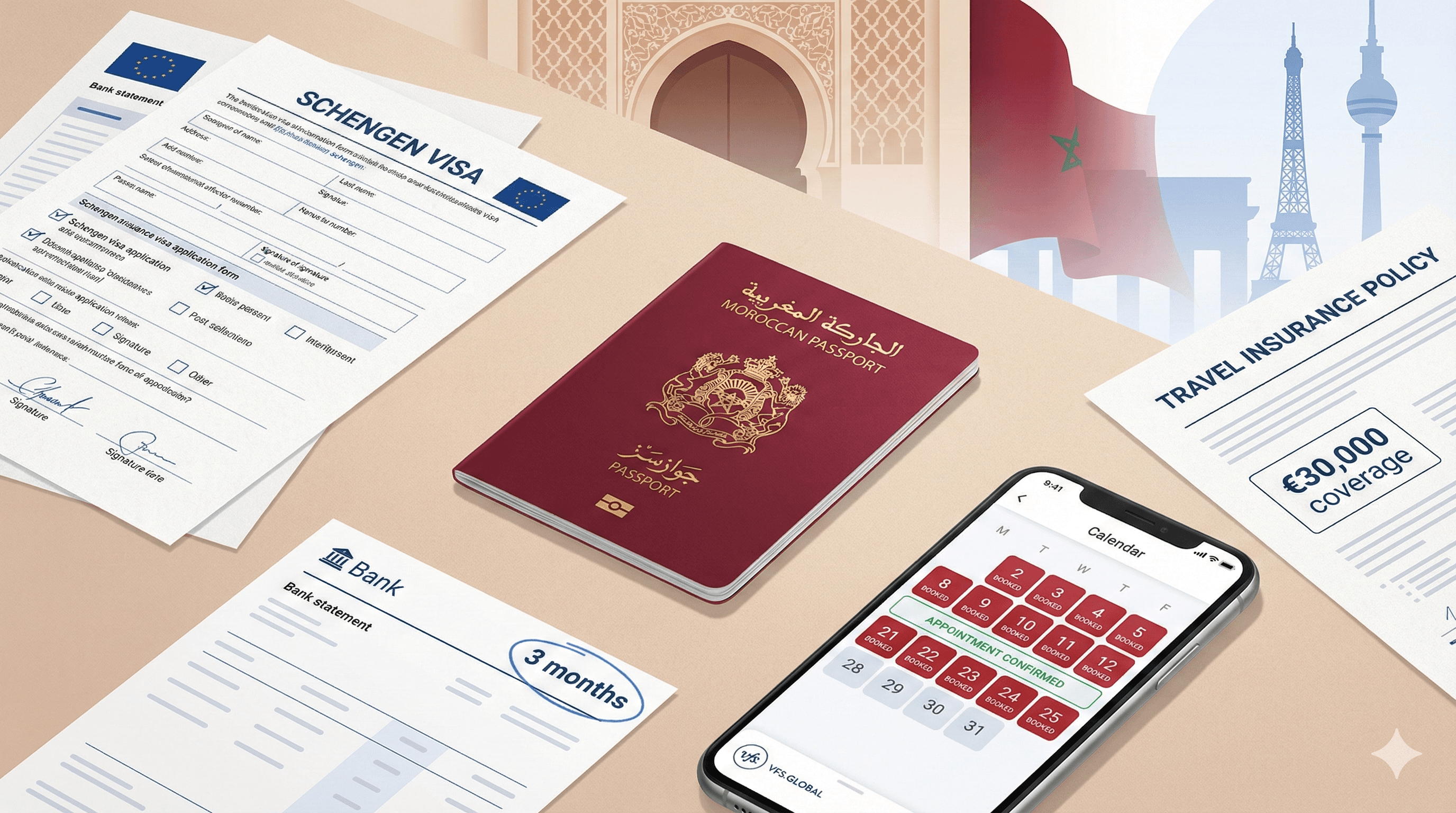
Schengen Visa from Morocco 2026: Complete Guide for Moroccan Residents
Last updated: 7 August 2026. Requirements, fees, providers and representation arrangements can change; confirm the route-specific checklist linked in the official sources before submitting.
If you're a Moroccan resident staring at "No appointments available" on VFS Global or TLScontact websites, you're not alone. The Schengen visa appointment system in Morocco—across Rabat, Casablanca, Tangier, and Marrakech—has become a digital battleground where slots disappear within seconds. You refresh the page dozens of times daily, only to watch that brief "1 slot available" vanish before you can even click.
This isn't a technical glitch. This is the reality of applying for a Schengen visa from Morocco in 2026, where demand from North African applicants far exceeds the capacity of visa centres. Whether you're a Moroccan citizen planning a European holiday, a foreign national residing in Morocco, or a family coordinating travel for multiple members, securing that initial appointment has become the biggest obstacle—often more challenging than the visa application itself.
This guide covers everything Moroccan residents need to know about Schengen visa applications in 2026: which documents you need, what the actual costs are, how long processing takes, and most importantly, how to navigate the appointment booking system that stands between you and your European travel plans. We'll also introduce you to a visa appointment bot solution that monitors availability 24/7, so you don't have to.

Who Needs a Schengen Visa from Morocco?
All Moroccan citizens require a Schengen visa for any travel to the Schengen Area, regardless of trip duration or purpose. Morocco is not on the EU's visa-free list, meaning Moroccan passport holders must obtain a visa before traveling to any of the 29 Schengen member states.
Moroccan Citizens Requiring Visas
Moroccan citizens need a Schengen visa for all travel purposes, including:
Tourism and leisure travel
Business meetings and conferences
Visiting family members in Europe
Short courses or cultural exchanges
Any stay regardless of duration
There is no visa-free period for Moroccan passport holders—a visa is required even for a single-day visit to the Schengen Area.
Foreign Residents in Morocco
If you hold a non-Moroccan passport and live in Morocco with a valid residence permit (Carte de Séjour), you must apply for a Schengen visa from Morocco. Your Moroccan residence card must be valid for at least 3 months after your planned return date from Europe.
Special Case: Multiple-Entry Visa Holders
Moroccan citizens who hold valid multiple-entry Schengen visas can use them for multiple trips within the visa's validity period. The 90/180-day rule applies—you cannot spend more than 90 days in the Schengen Area within any 180-day period, even with a multiple-entry visa valid for several years.
Understanding Schengen Visa Categories
Official 2025 context: EU and Schengen-associated consulates received more than 12 million short-stay visa applications in 2025. The worldwide refusal rate was 14.6%, down from 14.8% in 2024; 51.7% of issued visas allowed multiple entries. These are global figures, not a prediction for an individual application. European Commission 2025 visa statistics.
The Schengen visa system offers different visa types depending on your travel purpose and duration.
Type C (Short-Stay Visa) - Most Common
The Type C visa is what most applicants from Morocco need. This uniform Schengen visa allows stays of up to 90 days within any 180-day period across all Schengen member states. Valid purposes include:
Tourism and leisure: Holiday travel, sightseeing, visiting attractions
Business meetings: Conferences, negotiations, trade fairs (not employment)
Family visits: Visiting relatives who are EU residents or citizens
Cultural or sporting events: Attending festivals, concerts, sports competitions
Type C visas are issued as single-entry (one trip), double-entry (two separate trips), or multiple-entry (unlimited trips during validity).
Type A (Airport Transit Visa)
Required only if you're transiting through a Schengen airport without entering the Schengen Area. Moroccan citizens generally need this visa for airport transit, so check requirements for your specific route.
Multiple-Entry Visa Eligibility
If you have a strong travel history and proven ties to Morocco, you can receive multiple-entry Schengen visas valid for up to 5 years. Consulates typically start with shorter validity (6 months or 1 year) and extend it on subsequent applications if you've demonstrated reliable return patterns.
Selecting the Correct Country for Your Application
Applying to the wrong Schengen country is one of the most common reasons for rejection. The rules are strict.
Single Destination Rule
If you're visiting only one Schengen country, you must apply to that country's consulate. Visiting France only? Apply for a France visa through TLScontact in Morocco.
Multiple Destinations Rule
When visiting multiple countries, apply to the consulate of the country where you'll spend the most time. If you're spending 5 days in Spain and 3 days in Italy, apply through BLS International for a Spain visa.
Equal Time Rule
If you're spending equal time in multiple countries (e.g., 4 days in Switzerland, 4 days in France), apply to the country where you'll make your first entry into the Schengen Area.
Why This Matters
Applying to the "wrong" country because appointments are easier to get elsewhere is called "visa shopping" and will result in immediate rejection. Consulates share databases and will know if your actual itinerary doesn't match your application.
Visa Application Centres Across Morocco
Morocco has comprehensive coverage of Schengen visa centres operated by three main service providers.
TLScontact Centres
TLScontact handles applications for France, Germany, and Belgium from Morocco:
Locations:
Rabat: Millennium Business Center, Av. Mehdi Ben Barka, Rabat 10170
Casablanca: 3 Bd Ghandi, Casablanca
Tangier: Résidence Aymana, Avenue Sidi Mohamed Ben Abdellah
Marrakech: Résidence Henri 13, Rue Ibn El Cadi, Hivernage
Additional centres: Fez, Oujda, Agadir (for France applications)
Important note: Germany is handled by TLScontact in Morocco, unlike many other countries where VFS Global processes German visas.

BLS International Centres
BLS International processes applications for Spain and Portugal:
Locations:
Casablanca: Corner of Blvd Abdelmoumen and Blvd Anoual, No. 15, Anoual Capital Center
Rabat: (Center confirmed, specific address available on BLS website)
Tangier, Nador, Tetouan, Agadir: Regional centres available
Jurisdiction requirement: Spain enforces strict consular districts. You must apply at the centre covering your Moroccan residence region—Casablanca residents cannot apply in Rabat.
VFS Global Centres
VFS Global handles applications for Italy, Switzerland, Austria, Denmark, Finland, Norway, Sweden, Malta, Croatia, and Iceland.
Locations:
Rabat: Rue Al Koufa (next to Bab Rwah); Jasmine Shopping Centre (for UK and other services)
Casablanca: Centre confirmed (specific location on VFS website)
Tangier: Tasnim Plaza, Angle Avenue Abdellah Guennoun et Rue Abi Jarir Tabari
The 2026 Documentation Checklist
Schengen visa applications from Morocco require both standard Schengen documents and Morocco-specific additions.
Passport Requirements
Your passport must meet strict criteria:
Validity: At least 6 months beyond your intended departure date from the Schengen Area
Blank pages: Minimum 2 blank visa pages
Condition: No damage, water stains, or missing pages
Copies: Photocopies of the bio-data page and any previous Schengen visas
Financial Evidence
Financial proof requirements are more stringent when applying from Morocco due to historical rejection rates.
For Employed Applicants:
Bank statements for the last 3 months (originals with bank stamps)
Certificate of employment on company letterhead
CNSS declaration (Certificate of declaration of wages to CNSS) - this is unique to Morocco and mandatory
Recent pay slips
For Self-Employed:
Business registration documents
Tax declarations
Bank statements showing business income
For Sponsored Travel:
Sponsor's bank statements and employment proof
Formal invitation letter with sponsor's signature
Relationship proof (marriage certificate, birth certificate)
Minimum balance guidelines: While not officially published, expect to demonstrate approximately €65-100 per day of stay.
Travel Insurance
Mandatory for all Schengen visa applications:
Minimum coverage: €30,000 for medical emergencies and repatriation
Geographic scope: Valid in all Schengen member states
Duration: Must cover your entire stay plus a few extra days
Morocco-approved providers include AXA Schengen, Europ Assistance, and Allianz
Accommodation and Travel Bookings
Hotel reservations: Confirmed bookings (use refundable options until visa is approved)
Flight itinerary: Reservation showing entry/exit dates (don't purchase non-refundable tickets before approval)
Day-by-day itinerary: Detailed travel plan showing cities and dates
Biometric Photograph
Specifications: 35mm x 45mm, white background, taken within last 6 months
Requirements: Face must occupy 70-80% of frame, neutral expression, both eyes visible
Professional photo studios in Morocco are familiar with Schengen requirements
Morocco-Specific Documents
These additional documents are unique to applications from Morocco:
For Moroccan Citizens:
CNIE (Carte Nationale d'Identité Électronique): Photocopy required
Employment documentation: CNSS/CNOPS declaration (social security proof)
Property documents: If you own property in Morocco (demonstrates ties)
Family status: Marriage certificate, children's birth certificates
For Foreign Residents:
Carte de Séjour: Valid Moroccan residence permit (minimum 3 months validity after return)
Proof of legal status: Work permit or student enrollment in Morocco
Translation requirement: Documents in Arabic may require certified French, English, or Spanish translation depending on destination country.
Visa Fees for 2026
Schengen visa costs from Morocco include both the EU consular fee and the service provider's fee.
Consular Fees (EU Standard)
These are set by the European Union and identical across all Schengen countries:
Adults: €90 (approximately 960-980 MAD)
Children 6-12 years: €45 (approximately 480-490 MAD)
Children under 6: Free
Service Centre Fees by Country
Service providers add fees for processing your application:
Destination Country | Service Provider | Service Fee (MAD) |
|---|---|---|
France | TLScontact | 330 MAD |
Germany | TLScontact | 275-330 MAD |
Belgium | TLScontact | 275-330 MAD |
Spain | BLS International | 160-180 MAD |
Portugal | BLS International | 160-180 MAD |
Italy | VFS Global | 334 MAD |
Switzerland | VFS Global | 300 MAD |
Austria | VFS Global | 300-334 MAD |
Nordic Countries (SE, NO, DK, FI) | VFS Global | 300-334 MAD |
Optional services:
Premium lounge (faster processing at centre): 440 MAD (BLS)
SMS tracking updates: 30-50 MAD
Courier passport return: 100-150 MAD
Total Cost Example
France visa for one adult:
Consular fee: €90 (975 MAD)
TLS service fee: 330 MAD
Total: 1,305 MAD
Spain visa for family of 4 (2 adults, 2 children ages 8 and 5):
Adult 1: €90 = 975 MAD
Adult 2: €90 = 975 MAD
Child 1 (8 years): €45 = 490 MAD
Child 2 (5 years): €0 = 0 MAD
BLS service fees (4 people × 170 MAD): 680 MAD
Total: 3,120 MAD
Processing Times - What to Expect
Understanding realistic processing timelines helps you plan your application timing.
Standard Processing
The official Schengen processing time is 15 calendar days from the date of your biometric appointment. This is not 15 working days—weekends and holidays count.
Extended Processing
Consulates can extend processing up to 45 calendar days if they need to:
Verify documents with Moroccan authorities
Conduct additional security checks
Request supplementary information
Handle high application volumes during peak seasons
Peak Season Reality
Morocco experiences significant delays during:
Summer (June-August): School holidays drive maximum demand
Pre-Eid periods: Families planning Eid travel abroad
Year-end holidays (December-January): Christmas and New Year travel
Ramadan: Reduced processing capacity at some consulates
Official guidance: Apply 6 months in advance (the maximum allowed) during peak seasons to ensure your visa is processed before your travel date.
The Real Challenge: Getting an Appointment
Here's what no official website tells you: the processing time is irrelevant if you can't book an appointment. Currently, securing an appointment at VFS Global, TLScontact, or BLS centres in Morocco can take weeks or even months of daily checking, which is where the real bottleneck exists.
The Appointment Booking Challenge
The visa application process theoretically starts when you book an appointment. In practice, this is where most Moroccan applicants get stuck.
Why Slots Disappear in Seconds
Demand-supply mismatch: In 2025, Morocco was the fifth-largest source of Schengen visa applications worldwide, at around 620,000 applications, but visa centres have limited appointment capacity. Rabat, Casablanca, Tangier, and Marrakech centres collectively handle thousands of daily applications, yet slots are released in small batches—sometimes as few as 10-20 appointments per day per destination.
High regional demand: North Africa as a region has intense Schengen visa demand. You're competing not just with other Moroccan applicants, but with the broader Mediterranean applicant pool during peak seasons.
Automated scalpers: Third-party agents and unauthorized bots grab slots immediately when released and resell them at inflated prices. While technically against centre policies, enforcement is minimal.
Sporadic release schedules: Unlike some countries where slots are released at predictable times, Moroccan centres release appointments irregularly. BLS Spain typically releases batches weekly (often late week or Saturday at 1 PM for certain categories), but VFS Global and TLScontact have no published schedule—slots simply appear and vanish.
Manual Booking Reality
If you're attempting to book manually:
Week 1-2: You log in daily, refreshing the appointment page multiple times. You see "No appointments available" consistently. You try different times of day—morning, afternoon, midnight—based on rumors in WhatsApp groups about when slots might drop.
Week 3-4: You've now refreshed the page hundreds of times. Occasionally you see a slot flicker into existence—"1 appointment available" appears for literally 2-3 seconds before it's gone. You clicked as fast as possible but someone else was faster.
Week 5+: You're checking every few hours. Your family is asking when you'll book. Your planned travel dates are getting closer. You're considering paying an agent 2,000-3,000 MAD extra just to bypass this nightmare.
This is not an exaggeration. This is the documented experience of thousands of Moroccan residents trying to apply for Schengen visas through official channels in 2026.
How Visard Solves the Appointment Problem
While we can't fix the broken appointment system, we can help you beat it with technology. Visard is a schengen visa telegram bot that monitors visa centre websites 24/7 so you don't have to.
24/7 Automated Monitoring
Instead of manually refreshing the page dozens of times daily, Visard's system checks appointment availability every 3 seconds—that's 28,800 checks per day across VFS Global centres in Morocco. The moment a slot appears at any Moroccan centre (Rabat, Casablanca, Tangier), you receive an instant Telegram notification with the direct booking link.
Why this matters: When slots appear, they're gone within 10-30 seconds. Manual checking means you might see the slot 5 minutes after it appeared—too late. Automated 3-second monitoring means you're alerted within seconds of availability, giving you the actual chance to click and book before others.
The system monitors appointment availability for the following destinations from Morocco:
Switzerland, Austria, Italy, Finland, Croatia, Malta, Denmark, Sweden, Norway, and Iceland.
Two Service Options
Notification Service:
Pricing: $25 for one destination country / $50 for all supported countries
How it works: You receive instant Telegram alerts when appointments appear. You click the provided link and complete the booking yourself through the official centre website.
Best for: Applicants who can check Telegram immediately and act fast when notified.
Auto-Booking Service:
Status: Not currently supported for Morocco market
Reason: Morocco's VFS systems require specific local verification that auto-booking doesn't yet support.
How It Works
Sign up via Telegram: Connect to the Visard bot through our Telegram channel (no app download needed).
Select destinations: Choose which Schengen country appointments you need—Switzerland, Austria, Italy, Finland, Croatia, Malta, Denmark, Sweden, Norway, or Iceland.
Receive instant alerts: When a slot opens at any Moroccan VFS Global centre for your selected destination, you get a Telegram notification within seconds.
Click and book: Follow the provided link directly to the official booking page and complete your appointment.
One subscription covers all family members: If you're applying for 4 people, one notification subscription alerts you to appointments for all applicants.
Average Success Rate
Moroccan residents using Visard typically secure appointments within 7-14 days of starting monitoring. This is dramatically faster than the 4-8 weeks most manual attempts require, and infinitely better than the growing number of applicants who give up entirely after months of failed clicking.
Why it works: The difference between checking every 3 seconds versus checking every few hours is the difference between seeing 28,800 availability windows per day versus seeing 5-10. More opportunities equals exponentially higher success rates.
Application Process Step-by-Step
Once you've secured an appointment (either manually or through monitoring), here's the complete application process.
Step 1 - Determine Your Main Destination
Review your travel itinerary carefully:
If visiting one country only: Apply to that country
If visiting multiple countries: Apply to where you'll spend the most nights
If equal time in multiple countries: Apply to your first entry point
Double-check your dates. Consulates verify this against your hotel bookings and flight itinerary.
Step 2 - Gather Documents
Use the checklist from the "2026 Documentation Checklist" section above. Country-specific requirements are listed on each consulate's Morocco page:
France: france-visas.gouv.ma
Spain: blsspainmorocco.com
Italy, Switzerland, Austria, Nordics: vfsglobal.com/morocco
Start gathering documents at least 2-3 weeks before your appointment. Financial documents (bank statements, employment certificates) must be recent—typically no older than 30 days.
Step 3 - Book Appointment
Manual option: Log into the appropriate centre website (TLS, VFS, or BLS) and check daily for availability.
Automated option: Use Visard monitoring to receive instant notifications when appointments appear. This removes the weeks of manual checking frustration.
Once you secure an appointment slot, you'll receive a confirmation email with your appointment date, time, location, and a reference number. Print this confirmation—you'll need it at the centre.
Step 4 - Complete Online Application Form
Each destination country has its own online application portal:
France: france-visas.gouv.fr/fr_FR/web/france-visas/formulaire-de-demande-de-visa
Spain: blsspainmorocco.com (register and fill application)
Italy/Switzerland/Nordics: vfsglobal.com portals
Critical tips:
Use consistent information across all documents
If dates are uncertain, use "approximately" rather than inventing specific dates
For "Host in Schengen Area," provide hotel details or private host contact information
Employment information must match your CNSS documentation exactly
Print the completed application form and sign it. Some consulates require two printed copies.
Step 5 - Attend Appointment
Arrive at your scheduled appointment time (VFS/TLS/BLS centres in Morocco strictly enforce appointment times—late arrivals may be turned away).
What to bring:
Printed appointment confirmation
All original documents plus photocopies
Completed visa application form (signed)
Passport-sized photos
Payment method (cash or card—confirm with your specific centre)
At the centre:
Document verification: Staff review your documents for completeness
Biometric data collection: Digital fingerprints and photograph (exemption if you provided biometrics within last 59 months)
Payment: Pay consular fee + service fee
Interview (if applicable): Some nationalities or visa types require brief interview questions about travel purpose and ties to Morocco
Duration: Plan for 30-60 minutes at the centre.
Step 6 - Track Application
After your appointment, you'll receive a tracking reference number. Use this to monitor your application status:
TLScontact: tlscontact.com/ma (login with reference number)
VFS Global: vfsglobal.com/morocco/track (enter reference number)
BLS International: blsspainmorocco.com (tracking section)
Status updates typically show:
"Under process at Consulate"
"Decision made"
"Ready for collection"
SMS updates are available for 30-50 MAD extra.
Step 7 - Collect Passport
When your status shows "Ready for collection," you can collect your passport from the centre. Options:
Personal collection: Return to the visa centre with your receipt
Authorized representative: Send someone with authorization letter and your receipt
Courier delivery: Pre-paid option (100-150 MAD) delivers passport to your address
If approved: Your visa sticker will be in your passport with validity dates clearly marked. Verify all details immediately (name spelling, dates, number of entries).
If rejected: The visa page will show a rejection stamp with a reason code. You can appeal (limited success rate) or reapply after addressing the rejection reason.
Entry/Exit System (EES) for 2026
The European Union's Entry/Exit System is scheduled for full implementation in 2026, affecting how Moroccan travelers enter the Schengen Area.
What is EES
EES replaces manual passport stamping with automated biometric registration. When you enter the Schengen Area, border officials will:
Scan your passport
Take facial image and fingerprints
Record entry date, location, and purpose
When you exit, they'll record your departure. This data is stored for 3 years.
Automatic 90/180 Tracking
EES automatically calculates your remaining days. If you've already spent 70 days in the Schengen Area in the last 180 days, border guards will know immediately that you can only stay 20 more days. No more confusion about stamp dates or manual counting.
How It Affects Moroccan Travelers
For Moroccan visa holders: EES automatically tracks your entry and exit dates, making overstay detection foolproof. Your visa validity dates remain primary, but EES ensures you respect the 90/180 rule even with a multiple-entry visa. The system eliminates confusion about stamp dates or manual counting of allowed days.
First-time registration: Allow extra time at your first Schengen border crossing in 2026 for EES enrollment.
Common Mistakes That Lead to Rejection
Morocco has higher Schengen visa rejection rates than some European countries, typically ranging from 15-25% depending on destination. Most rejections are preventable.
Expired or Insufficient Passport Validity
The mistake: Passport expires 4 months after planned return from Europe.
The rule: Passport must be valid for at least 6 months beyond your last day in Schengen Area.
Solution: Renew your passport if it expires within 9 months of your application.
Morocco-Specific Document Errors
Missing CNSS declaration: Employed applicants from Morocco must provide the "Certificate of declaration of wages to CNSS" (Attestation de déclaration de salaires à la CNSS). This is unique to Morocco and non-negotiable. Consulates reject applications without it.
Inadequate proof of ties to Morocco: Consulates need evidence you'll return. Provide:
Property ownership documents (house, apartment, land)
Long-term employment contracts (showing employment continues after your return)
Family ties (spouse, children remaining in Morocco)
Business ownership registration
Insufficient Carte de Séjour validity: Foreign residents must have residence permits valid at least 3 months after return. A permit expiring 1 month after return will cause rejection.
Inadequate Financial Proof
Bank statements showing 50,000 MAD deposited 2 days before application look suspicious. Consulates want to see:
Consistent income over 3 months (not sudden large deposits)
Balance proportionate to trip cost and duration
Employment stability reflected in regular salary deposits
Unofficial guideline: Demonstrate at least 65-100 EUR per day × number of days, plus return funds.
Insurance Not Covering All Schengen States
Travel insurance must explicitly state "Valid in all Schengen states" or list all 29 countries. Policies covering only your destination country (e.g., "Valid in France") will cause rejection because your visa allows travel anywhere in Schengen.
Applying to Wrong Country
The scenario: You're spending 3 days in France, 7 days in Spain, but you applied for a France visa because Spain appointments were fully booked.
The result: Automatic rejection for "visa shopping." Consulates share databases and verify your actual itinerary against your application. Apply to the country where you'll spend the most time, even if appointments are harder to get.
Inconsistent Travel Itinerary
Your flight reservation shows you arriving in Paris on June 1 and leaving from Rome on June 15. Your hotel bookings show Paris (June 1-8), Barcelona (June 9-12), Rome (June 13-15). Your application claims "main destination: Italy."
The problem: You're spending most time in France, not Italy. This inconsistency triggers rejection.
Solution: Ensure all documents tell the same story—flight dates match hotel dates match itinerary match application form.
Lack of Proof of Ties to Morocco
Single applicants aged 18-35 without property, family, or long-term employment face higher scrutiny. Consulates fear you'll overstay and work illegally.
Strengthen your case:
Enrolled in Moroccan university (provide enrollment letter and exam schedules)
Employed with signed contract showing employment continues after return
Family business partner (registration documents)
Property ownership (even small properties demonstrate ties)
Biometric Data Requirements
VIS System (Visa Information System)
All Schengen visa applicants must provide biometric data: digital fingerprints (all 10 fingers) and a facial photograph. This data is stored in the Visa Information System (VIS) shared across all Schengen countries.
59-Month Fingerprint Validity
Once you've provided biometrics for a Schengen visa, they're valid for 59 months (approximately 5 years). If you apply for another Schengen visa within this period, you generally don't need to provide fingerprints again—consulates can retrieve them from VIS.
Exception: You must provide fresh biometrics if:
Your previous biometrics are older than 59 months
Your appearance has significantly changed
You previously provided biometrics to a non-Schengen country (UK, Ireland) which don't share the VIS system
The system cannot retrieve your stored biometrics (technical issues)
Exemptions
Children under 12 years are exempt from fingerprinting
People with physical disabilities preventing fingerprint capture
Heads of state and government officials (diplomatic/official passports)
Where Biometrics Are Collected
All biometric data is collected at your appointment at VFS Global, TLScontact, or BLS centres in Morocco. The equipment is standardized across all centres and takes approximately 5 minutes.
FAQ Section
How long does it take to get a Schengen visa from Morocco?
The official processing time is 15 calendar days from your appointment date. However, during peak seasons (June-August, December-January, pre-Eid periods), processing can extend to 30-45 days. The bigger challenge is securing the appointment itself, which can take weeks or months of manual checking. With automated monitoring tools, most Moroccan residents secure appointments within 7-14 days.
Can I apply for a Schengen visa in Morocco if I'm not Moroccan?
Yes, if you're a legal resident of Morocco holding a valid Carte de Séjour. Your residence permit must be valid for at least 3 months after your planned return date from Europe. You'll need to provide both your passport and your Moroccan residence card as part of your application.
Where do I apply for a Schengen visa in Morocco?
Depends on your destination country:
France, Germany, Belgium: TLScontact centres (Rabat, Casablanca, Tangier, Marrakech)
Spain, Portugal: BLS International (Rabat, Casablanca, Tangier, and other cities)
Italy, Switzerland, Austria, Nordics: VFS Global (Rabat, Casablanca, Tangier)
Check the specific centre website for your destination to confirm locations and book appointments.
What is the success rate for Schengen visas from Morocco?
Official statistics aren't published by country, but Morocco's approval rate is estimated at 75-85% for tourist visas. Rejection rates are higher for first-time applicants, single travelers aged 18-35, and applications with weak financial documentation or insufficient ties to Morocco.
Do I need an appointment to apply?
Yes, walk-ins are not accepted at any Moroccan visa centre in 2026. All applications require pre-booked appointments through the official centre websites. This is why appointment availability has become the primary bottleneck in the application process.
Can I apply for multiple Schengen countries at once?
No. You can only submit one Schengen visa application at a time. If you're visiting multiple countries, determine which is your "main destination" (most nights spent) and apply there. Your approved visa will be valid for travel throughout the entire Schengen Area regardless of which country issued it.
What happens if my visa is rejected?
You'll receive your passport with a rejection stamp and a reason code. Options:
Appeal: Limited success rate, requires strong new evidence addressing the rejection reason
Reapply: Wait at least 2-3 months, gather stronger documentation, and submit a new application
Alternative destination: If rejected by France, consider applying to a different Schengen country with a valid travel purpose
Rejected visa fees are non-refundable.
Is using a visa bot legal?
Yes. Appointment monitoring services like Visard don't interfere with the actual visa application or decision process. They simply check appointment availability on official websites and notify you when slots appear—the same action you'd perform manually, just automated and much faster. Your visa decision is made entirely by consular officers based on your documents and qualifications.
Will a bot affect my visa decision?
No. How you booked your appointment is irrelevant to the visa officer reviewing your application. They assess your documents, financial situation, travel plans, and ties to Morocco. The method you used to secure the appointment slot has zero impact on approval or rejection.
Can I get a multiple entry Schengen visa from Morocco?
Yes, if you demonstrate:
Strong previous Schengen visa history (you've held and properly used previous visas)
Compelling reason for frequent travel (business meetings, family visits)
Solid financial situation and employment stability
Clear ties to Morocco
Consulates typically issue 6-month or 1-year multiple-entry visas initially, extending to 2-5 years on subsequent applications if you've maintained clean travel records.
Conclusion
Applying for a Schengen visa from Morocco in 2026 requires understanding two distinct challenges: assembling the correct documentation and securing an appointment. While the documentation process is straightforward if you follow country-specific requirements—including Morocco's unique CNSS declaration and proof-of-ties documents—the appointment booking system remains the primary obstacle most Moroccan residents face.
The good news is that both challenges are solvable. Prepare your documents methodically using this guide's checklist, ensuring you have the Morocco-specific items that consulates expect from applicants in this region. For the appointment bottleneck, consider whether spending weeks manually refreshing websites aligns with your timeline, or whether automated 24/7 monitoring through services like Visard better serves your needs.
Most importantly, start early. The old advice of applying "3 weeks before travel" no longer reflects reality in high-demand markets like Morocco. If you're planning summer 2026 travel, begin the appointment hunting process in March or April. For Eid travel, start 3-4 months in advance.
The Schengen Area remains accessible to Moroccan residents in 2026—it just requires navigating a system that prioritizes persistence and preparation over convenience.
Planning to Apply from Another Country?
If you're exploring visa application options from different locations or planning to apply with family members residing elsewhere, check our complete guides for other application countries:
Application Country Guides:
Each guide covers country-specific requirements, local visa centres, and appointment booking strategies for that region.
Country-Specific Visa Guides
This general guide covers Morocco-wide requirements. Each Schengen destination has specific nuances in documentation, consular fees, and processing timelines. Detailed guides for Moroccan residents applying to individual Schengen countries:
Automated Appointment Services by Destination
If you've been refreshing VFS Global appointment pages in Rabat, Casablanca, or Tangier for weeks without success, Visard's automated monitoring removes the manual search. Our system checks Moroccan VFS Global centres every 3 seconds, 24/7.
Notification service available (instant Telegram alerts when slots appear):
How it works:
Choose your destination country
Enable 24/7 monitoring (every 3 seconds)
Receive instant Telegram alerts when slots appear
One subscription covers your entire family — $25 (single country) or $50 (all countries)
Skip the Appointment Hunt: Automate Your Booking
For Morocco residents specifically, our schengen visa telegram bot Morocco monitors VFS Global centres in Rabat, Casablanca, and Tangier 24/7, securing appointment notifications within 7-14 days on average.
How it works:
Monitors VFS Global centres across Morocco every 3 seconds
Instant Telegram alerts when slots appear
Notification service: $25 (1 country) / $50 (all countries)
One subscription covers your entire family
Average booking success: 7-14 days

Official sources checked for this update
Use these primary sources to verify the current rule or route before applying.
European Commission, Directorate-General for Migration and Home Affairs — Page claim that "Morocco has approximately 2-3 million annual Schengen visa applications"
If you would rather be told than keep checking, you can track Schengen appointment availability from Morocco.
Schengen Visa from Morocco 2026: Complete Guide for Moroccan Residents
Last updated: 7 August 2026. Requirements, fees, providers and representation arrangements can change; confirm the route-specific checklist linked in the official sources before submitting.
If you're a Moroccan resident staring at "No appointments available" on VFS Global or TLScontact websites, you're not alone. The Schengen visa appointment system in Morocco—across Rabat, Casablanca, Tangier, and Marrakech—has become a digital battleground where slots disappear within seconds. You refresh the page dozens of times daily, only to watch that brief "1 slot available" vanish before you can even click.
This isn't a technical glitch. This is the reality of applying for a Schengen visa from Morocco in 2026, where demand from North African applicants far exceeds the capacity of visa centres. Whether you're a Moroccan citizen planning a European holiday, a foreign national residing in Morocco, or a family coordinating travel for multiple members, securing that initial appointment has become the biggest obstacle—often more challenging than the visa application itself.
This guide covers everything Moroccan residents need to know about Schengen visa applications in 2026: which documents you need, what the actual costs are, how long processing takes, and most importantly, how to navigate the appointment booking system that stands between you and your European travel plans. We'll also introduce you to a visa appointment bot solution that monitors availability 24/7, so you don't have to.
Who Needs a Schengen Visa from Morocco?
All Moroccan citizens require a Schengen visa for any travel to the Schengen Area, regardless of trip duration or purpose. Morocco is not on the EU's visa-free list, meaning Moroccan passport holders must obtain a visa before traveling to any of the 29 Schengen member states.
Moroccan Citizens Requiring Visas
Moroccan citizens need a Schengen visa for all travel purposes, including:
Tourism and leisure travel
Business meetings and conferences
Visiting family members in Europe
Short courses or cultural exchanges
Any stay regardless of duration
There is no visa-free period for Moroccan passport holders—a visa is required even for a single-day visit to the Schengen Area.
Foreign Residents in Morocco
If you hold a non-Moroccan passport and live in Morocco with a valid residence permit (Carte de Séjour), you must apply for a Schengen visa from Morocco. Your Moroccan residence card must be valid for at least 3 months after your planned return date from Europe.
Special Case: Multiple-Entry Visa Holders
Moroccan citizens who hold valid multiple-entry Schengen visas can use them for multiple trips within the visa's validity period. The 90/180-day rule applies—you cannot spend more than 90 days in the Schengen Area within any 180-day period, even with a multiple-entry visa valid for several years.
Understanding Schengen Visa Categories
Official 2025 context: EU and Schengen-associated consulates received more than 12 million short-stay visa applications in 2025. The worldwide refusal rate was 14.6%, down from 14.8% in 2024; 51.7% of issued visas allowed multiple entries. These are global figures, not a prediction for an individual application. European Commission 2025 visa statistics.
The Schengen visa system offers different visa types depending on your travel purpose and duration.
Type C (Short-Stay Visa) - Most Common
The Type C visa is what most applicants from Morocco need. This uniform Schengen visa allows stays of up to 90 days within any 180-day period across all Schengen member states. Valid purposes include:
Tourism and leisure: Holiday travel, sightseeing, visiting attractions
Business meetings: Conferences, negotiations, trade fairs (not employment)
Family visits: Visiting relatives who are EU residents or citizens
Cultural or sporting events: Attending festivals, concerts, sports competitions
Type C visas are issued as single-entry (one trip), double-entry (two separate trips), or multiple-entry (unlimited trips during validity).
Type A (Airport Transit Visa)
Required only if you're transiting through a Schengen airport without entering the Schengen Area. Moroccan citizens generally need this visa for airport transit, so check requirements for your specific route.
Multiple-Entry Visa Eligibility
If you have a strong travel history and proven ties to Morocco, you can receive multiple-entry Schengen visas valid for up to 5 years. Consulates typically start with shorter validity (6 months or 1 year) and extend it on subsequent applications if you've demonstrated reliable return patterns.
Selecting the Correct Country for Your Application
Applying to the wrong Schengen country is one of the most common reasons for rejection. The rules are strict.
Single Destination Rule
If you're visiting only one Schengen country, you must apply to that country's consulate. Visiting France only? Apply for a France visa through TLScontact in Morocco.
Multiple Destinations Rule
When visiting multiple countries, apply to the consulate of the country where you'll spend the most time. If you're spending 5 days in Spain and 3 days in Italy, apply through BLS International for a Spain visa.
Equal Time Rule
If you're spending equal time in multiple countries (e.g., 4 days in Switzerland, 4 days in France), apply to the country where you'll make your first entry into the Schengen Area.
Why This Matters
Applying to the "wrong" country because appointments are easier to get elsewhere is called "visa shopping" and will result in immediate rejection. Consulates share databases and will know if your actual itinerary doesn't match your application.
Visa Application Centres Across Morocco
Morocco has comprehensive coverage of Schengen visa centres operated by three main service providers.
TLScontact Centres
TLScontact handles applications for France, Germany, and Belgium from Morocco:
Locations:
Rabat: Millennium Business Center, Av. Mehdi Ben Barka, Rabat 10170
Casablanca: 3 Bd Ghandi, Casablanca
Tangier: Résidence Aymana, Avenue Sidi Mohamed Ben Abdellah
Marrakech: Résidence Henri 13, Rue Ibn El Cadi, Hivernage
Additional centres: Fez, Oujda, Agadir (for France applications)
Important note: Germany is handled by TLScontact in Morocco, unlike many other countries where VFS Global processes German visas.
BLS International Centres
BLS International processes applications for Spain and Portugal:
Locations:
Casablanca: Corner of Blvd Abdelmoumen and Blvd Anoual, No. 15, Anoual Capital Center
Rabat: (Center confirmed, specific address available on BLS website)
Tangier, Nador, Tetouan, Agadir: Regional centres available
Jurisdiction requirement: Spain enforces strict consular districts. You must apply at the centre covering your Moroccan residence region—Casablanca residents cannot apply in Rabat.
VFS Global Centres
VFS Global handles applications for Italy, Switzerland, Austria, Denmark, Finland, Norway, Sweden, Malta, Croatia, and Iceland.
Locations:
Rabat: Rue Al Koufa (next to Bab Rwah); Jasmine Shopping Centre (for UK and other services)
Casablanca: Centre confirmed (specific location on VFS website)
Tangier: Tasnim Plaza, Angle Avenue Abdellah Guennoun et Rue Abi Jarir Tabari
The 2026 Documentation Checklist
Schengen visa applications from Morocco require both standard Schengen documents and Morocco-specific additions.
Passport Requirements
Your passport must meet strict criteria:
Validity: At least 6 months beyond your intended departure date from the Schengen Area
Blank pages: Minimum 2 blank visa pages
Condition: No damage, water stains, or missing pages
Copies: Photocopies of the bio-data page and any previous Schengen visas
Financial Evidence
Financial proof requirements are more stringent when applying from Morocco due to historical rejection rates.
For Employed Applicants:
Bank statements for the last 3 months (originals with bank stamps)
Certificate of employment on company letterhead
CNSS declaration (Certificate of declaration of wages to CNSS) - this is unique to Morocco and mandatory
Recent pay slips
For Self-Employed:
Business registration documents
Tax declarations
Bank statements showing business income
For Sponsored Travel:
Sponsor's bank statements and employment proof
Formal invitation letter with sponsor's signature
Relationship proof (marriage certificate, birth certificate)
Minimum balance guidelines: While not officially published, expect to demonstrate approximately €65-100 per day of stay.
Travel Insurance
Mandatory for all Schengen visa applications:
Minimum coverage: €30,000 for medical emergencies and repatriation
Geographic scope: Valid in all Schengen member states
Duration: Must cover your entire stay plus a few extra days
Morocco-approved providers include AXA Schengen, Europ Assistance, and Allianz
Accommodation and Travel Bookings
Hotel reservations: Confirmed bookings (use refundable options until visa is approved)
Flight itinerary: Reservation showing entry/exit dates (don't purchase non-refundable tickets before approval)
Day-by-day itinerary: Detailed travel plan showing cities and dates
Biometric Photograph
Specifications: 35mm x 45mm, white background, taken within last 6 months
Requirements: Face must occupy 70-80% of frame, neutral expression, both eyes visible
Professional photo studios in Morocco are familiar with Schengen requirements
Morocco-Specific Documents
These additional documents are unique to applications from Morocco:
For Moroccan Citizens:
CNIE (Carte Nationale d'Identité Électronique): Photocopy required
Employment documentation: CNSS/CNOPS declaration (social security proof)
Property documents: If you own property in Morocco (demonstrates ties)
Family status: Marriage certificate, children's birth certificates
For Foreign Residents:
Carte de Séjour: Valid Moroccan residence permit (minimum 3 months validity after return)
Proof of legal status: Work permit or student enrollment in Morocco
Translation requirement: Documents in Arabic may require certified French, English, or Spanish translation depending on destination country.
Visa Fees for 2026
Schengen visa costs from Morocco include both the EU consular fee and the service provider's fee.
Consular Fees (EU Standard)
These are set by the European Union and identical across all Schengen countries:
Adults: €90 (approximately 960-980 MAD)
Children 6-12 years: €45 (approximately 480-490 MAD)
Children under 6: Free
Service Centre Fees by Country
Service providers add fees for processing your application:
Destination Country | Service Provider | Service Fee (MAD) |
|---|---|---|
France | TLScontact | 330 MAD |
Germany | TLScontact | 275-330 MAD |
Belgium | TLScontact | 275-330 MAD |
Spain | BLS International | 160-180 MAD |
Portugal | BLS International | 160-180 MAD |
Italy | VFS Global | 334 MAD |
Switzerland | VFS Global | 300 MAD |
Austria | VFS Global | 300-334 MAD |
Nordic Countries (SE, NO, DK, FI) | VFS Global | 300-334 MAD |
Optional services:
Premium lounge (faster processing at centre): 440 MAD (BLS)
SMS tracking updates: 30-50 MAD
Courier passport return: 100-150 MAD
Total Cost Example
France visa for one adult:
Consular fee: €90 (975 MAD)
TLS service fee: 330 MAD
Total: 1,305 MAD
Spain visa for family of 4 (2 adults, 2 children ages 8 and 5):
Adult 1: €90 = 975 MAD
Adult 2: €90 = 975 MAD
Child 1 (8 years): €45 = 490 MAD
Child 2 (5 years): €0 = 0 MAD
BLS service fees (4 people × 170 MAD): 680 MAD
Total: 3,120 MAD
Processing Times - What to Expect
Understanding realistic processing timelines helps you plan your application timing.
Standard Processing
The official Schengen processing time is 15 calendar days from the date of your biometric appointment. This is not 15 working days—weekends and holidays count.
Extended Processing
Consulates can extend processing up to 45 calendar days if they need to:
Verify documents with Moroccan authorities
Conduct additional security checks
Request supplementary information
Handle high application volumes during peak seasons
Peak Season Reality
Morocco experiences significant delays during:
Summer (June-August): School holidays drive maximum demand
Pre-Eid periods: Families planning Eid travel abroad
Year-end holidays (December-January): Christmas and New Year travel
Ramadan: Reduced processing capacity at some consulates
Official guidance: Apply 6 months in advance (the maximum allowed) during peak seasons to ensure your visa is processed before your travel date.
The Real Challenge: Getting an Appointment
Here's what no official website tells you: the processing time is irrelevant if you can't book an appointment. Currently, securing an appointment at VFS Global, TLScontact, or BLS centres in Morocco can take weeks or even months of daily checking, which is where the real bottleneck exists.
The Appointment Booking Challenge
The visa application process theoretically starts when you book an appointment. In practice, this is where most Moroccan applicants get stuck.
Why Slots Disappear in Seconds
Demand-supply mismatch: In 2025, Morocco was the fifth-largest source of Schengen visa applications worldwide, at around 620,000 applications, but visa centres have limited appointment capacity. Rabat, Casablanca, Tangier, and Marrakech centres collectively handle thousands of daily applications, yet slots are released in small batches—sometimes as few as 10-20 appointments per day per destination.
High regional demand: North Africa as a region has intense Schengen visa demand. You're competing not just with other Moroccan applicants, but with the broader Mediterranean applicant pool during peak seasons.
Automated scalpers: Third-party agents and unauthorized bots grab slots immediately when released and resell them at inflated prices. While technically against centre policies, enforcement is minimal.
Sporadic release schedules: Unlike some countries where slots are released at predictable times, Moroccan centres release appointments irregularly. BLS Spain typically releases batches weekly (often late week or Saturday at 1 PM for certain categories), but VFS Global and TLScontact have no published schedule—slots simply appear and vanish.
Manual Booking Reality
If you're attempting to book manually:
Week 1-2: You log in daily, refreshing the appointment page multiple times. You see "No appointments available" consistently. You try different times of day—morning, afternoon, midnight—based on rumors in WhatsApp groups about when slots might drop.
Week 3-4: You've now refreshed the page hundreds of times. Occasionally you see a slot flicker into existence—"1 appointment available" appears for literally 2-3 seconds before it's gone. You clicked as fast as possible but someone else was faster.
Week 5+: You're checking every few hours. Your family is asking when you'll book. Your planned travel dates are getting closer. You're considering paying an agent 2,000-3,000 MAD extra just to bypass this nightmare.
This is not an exaggeration. This is the documented experience of thousands of Moroccan residents trying to apply for Schengen visas through official channels in 2026.
How Visard Solves the Appointment Problem
While we can't fix the broken appointment system, we can help you beat it with technology. Visard is a schengen visa telegram bot that monitors visa centre websites 24/7 so you don't have to.
24/7 Automated Monitoring
Instead of manually refreshing the page dozens of times daily, Visard's system checks appointment availability every 3 seconds—that's 28,800 checks per day across VFS Global centres in Morocco. The moment a slot appears at any Moroccan centre (Rabat, Casablanca, Tangier), you receive an instant Telegram notification with the direct booking link.
Why this matters: When slots appear, they're gone within 10-30 seconds. Manual checking means you might see the slot 5 minutes after it appeared—too late. Automated 3-second monitoring means you're alerted within seconds of availability, giving you the actual chance to click and book before others.
The system monitors appointment availability for the following destinations from Morocco:
Switzerland, Austria, Italy, Finland, Croatia, Malta, Denmark, Sweden, Norway, and Iceland.
Two Service Options
Notification Service:
Pricing: $25 for one destination country / $50 for all supported countries
How it works: You receive instant Telegram alerts when appointments appear. You click the provided link and complete the booking yourself through the official centre website.
Best for: Applicants who can check Telegram immediately and act fast when notified.
Auto-Booking Service:
Status: Not currently supported for Morocco market
Reason: Morocco's VFS systems require specific local verification that auto-booking doesn't yet support.
How It Works
Sign up via Telegram: Connect to the Visard bot through our Telegram channel (no app download needed).
Select destinations: Choose which Schengen country appointments you need—Switzerland, Austria, Italy, Finland, Croatia, Malta, Denmark, Sweden, Norway, or Iceland.
Receive instant alerts: When a slot opens at any Moroccan VFS Global centre for your selected destination, you get a Telegram notification within seconds.
Click and book: Follow the provided link directly to the official booking page and complete your appointment.
One subscription covers all family members: If you're applying for 4 people, one notification subscription alerts you to appointments for all applicants.
Average Success Rate
Moroccan residents using Visard typically secure appointments within 7-14 days of starting monitoring. This is dramatically faster than the 4-8 weeks most manual attempts require, and infinitely better than the growing number of applicants who give up entirely after months of failed clicking.
Why it works: The difference between checking every 3 seconds versus checking every few hours is the difference between seeing 28,800 availability windows per day versus seeing 5-10. More opportunities equals exponentially higher success rates.
Application Process Step-by-Step
Once you've secured an appointment (either manually or through monitoring), here's the complete application process.
Step 1 - Determine Your Main Destination
Review your travel itinerary carefully:
If visiting one country only: Apply to that country
If visiting multiple countries: Apply to where you'll spend the most nights
If equal time in multiple countries: Apply to your first entry point
Double-check your dates. Consulates verify this against your hotel bookings and flight itinerary.
Step 2 - Gather Documents
Use the checklist from the "2026 Documentation Checklist" section above. Country-specific requirements are listed on each consulate's Morocco page:
France: france-visas.gouv.ma
Spain: blsspainmorocco.com
Italy, Switzerland, Austria, Nordics: vfsglobal.com/morocco
Start gathering documents at least 2-3 weeks before your appointment. Financial documents (bank statements, employment certificates) must be recent—typically no older than 30 days.
Step 3 - Book Appointment
Manual option: Log into the appropriate centre website (TLS, VFS, or BLS) and check daily for availability.
Automated option: Use Visard monitoring to receive instant notifications when appointments appear. This removes the weeks of manual checking frustration.
Once you secure an appointment slot, you'll receive a confirmation email with your appointment date, time, location, and a reference number. Print this confirmation—you'll need it at the centre.
Step 4 - Complete Online Application Form
Each destination country has its own online application portal:
France: france-visas.gouv.fr/fr_FR/web/france-visas/formulaire-de-demande-de-visa
Spain: blsspainmorocco.com (register and fill application)
Italy/Switzerland/Nordics: vfsglobal.com portals
Critical tips:
Use consistent information across all documents
If dates are uncertain, use "approximately" rather than inventing specific dates
For "Host in Schengen Area," provide hotel details or private host contact information
Employment information must match your CNSS documentation exactly
Print the completed application form and sign it. Some consulates require two printed copies.
Step 5 - Attend Appointment
Arrive at your scheduled appointment time (VFS/TLS/BLS centres in Morocco strictly enforce appointment times—late arrivals may be turned away).
What to bring:
Printed appointment confirmation
All original documents plus photocopies
Completed visa application form (signed)
Passport-sized photos
Payment method (cash or card—confirm with your specific centre)
At the centre:
Document verification: Staff review your documents for completeness
Biometric data collection: Digital fingerprints and photograph (exemption if you provided biometrics within last 59 months)
Payment: Pay consular fee + service fee
Interview (if applicable): Some nationalities or visa types require brief interview questions about travel purpose and ties to Morocco
Duration: Plan for 30-60 minutes at the centre.
Step 6 - Track Application
After your appointment, you'll receive a tracking reference number. Use this to monitor your application status:
TLScontact: tlscontact.com/ma (login with reference number)
VFS Global: vfsglobal.com/morocco/track (enter reference number)
BLS International: blsspainmorocco.com (tracking section)
Status updates typically show:
"Under process at Consulate"
"Decision made"
"Ready for collection"
SMS updates are available for 30-50 MAD extra.
Step 7 - Collect Passport
When your status shows "Ready for collection," you can collect your passport from the centre. Options:
Personal collection: Return to the visa centre with your receipt
Authorized representative: Send someone with authorization letter and your receipt
Courier delivery: Pre-paid option (100-150 MAD) delivers passport to your address
If approved: Your visa sticker will be in your passport with validity dates clearly marked. Verify all details immediately (name spelling, dates, number of entries).
If rejected: The visa page will show a rejection stamp with a reason code. You can appeal (limited success rate) or reapply after addressing the rejection reason.
Entry/Exit System (EES) for 2026
The European Union's Entry/Exit System is scheduled for full implementation in 2026, affecting how Moroccan travelers enter the Schengen Area.
What is EES
EES replaces manual passport stamping with automated biometric registration. When you enter the Schengen Area, border officials will:
Scan your passport
Take facial image and fingerprints
Record entry date, location, and purpose
When you exit, they'll record your departure. This data is stored for 3 years.
Automatic 90/180 Tracking
EES automatically calculates your remaining days. If you've already spent 70 days in the Schengen Area in the last 180 days, border guards will know immediately that you can only stay 20 more days. No more confusion about stamp dates or manual counting.
How It Affects Moroccan Travelers
For Moroccan visa holders: EES automatically tracks your entry and exit dates, making overstay detection foolproof. Your visa validity dates remain primary, but EES ensures you respect the 90/180 rule even with a multiple-entry visa. The system eliminates confusion about stamp dates or manual counting of allowed days.
First-time registration: Allow extra time at your first Schengen border crossing in 2026 for EES enrollment.
Common Mistakes That Lead to Rejection
Morocco has higher Schengen visa rejection rates than some European countries, typically ranging from 15-25% depending on destination. Most rejections are preventable.
Expired or Insufficient Passport Validity
The mistake: Passport expires 4 months after planned return from Europe.
The rule: Passport must be valid for at least 6 months beyond your last day in Schengen Area.
Solution: Renew your passport if it expires within 9 months of your application.
Morocco-Specific Document Errors
Missing CNSS declaration: Employed applicants from Morocco must provide the "Certificate of declaration of wages to CNSS" (Attestation de déclaration de salaires à la CNSS). This is unique to Morocco and non-negotiable. Consulates reject applications without it.
Inadequate proof of ties to Morocco: Consulates need evidence you'll return. Provide:
Property ownership documents (house, apartment, land)
Long-term employment contracts (showing employment continues after your return)
Family ties (spouse, children remaining in Morocco)
Business ownership registration
Insufficient Carte de Séjour validity: Foreign residents must have residence permits valid at least 3 months after return. A permit expiring 1 month after return will cause rejection.
Inadequate Financial Proof
Bank statements showing 50,000 MAD deposited 2 days before application look suspicious. Consulates want to see:
Consistent income over 3 months (not sudden large deposits)
Balance proportionate to trip cost and duration
Employment stability reflected in regular salary deposits
Unofficial guideline: Demonstrate at least 65-100 EUR per day × number of days, plus return funds.
Insurance Not Covering All Schengen States
Travel insurance must explicitly state "Valid in all Schengen states" or list all 29 countries. Policies covering only your destination country (e.g., "Valid in France") will cause rejection because your visa allows travel anywhere in Schengen.
Applying to Wrong Country
The scenario: You're spending 3 days in France, 7 days in Spain, but you applied for a France visa because Spain appointments were fully booked.
The result: Automatic rejection for "visa shopping." Consulates share databases and verify your actual itinerary against your application. Apply to the country where you'll spend the most time, even if appointments are harder to get.
Inconsistent Travel Itinerary
Your flight reservation shows you arriving in Paris on June 1 and leaving from Rome on June 15. Your hotel bookings show Paris (June 1-8), Barcelona (June 9-12), Rome (June 13-15). Your application claims "main destination: Italy."
The problem: You're spending most time in France, not Italy. This inconsistency triggers rejection.
Solution: Ensure all documents tell the same story—flight dates match hotel dates match itinerary match application form.
Lack of Proof of Ties to Morocco
Single applicants aged 18-35 without property, family, or long-term employment face higher scrutiny. Consulates fear you'll overstay and work illegally.
Strengthen your case:
Enrolled in Moroccan university (provide enrollment letter and exam schedules)
Employed with signed contract showing employment continues after return
Family business partner (registration documents)
Property ownership (even small properties demonstrate ties)
Biometric Data Requirements
VIS System (Visa Information System)
All Schengen visa applicants must provide biometric data: digital fingerprints (all 10 fingers) and a facial photograph. This data is stored in the Visa Information System (VIS) shared across all Schengen countries.
59-Month Fingerprint Validity
Once you've provided biometrics for a Schengen visa, they're valid for 59 months (approximately 5 years). If you apply for another Schengen visa within this period, you generally don't need to provide fingerprints again—consulates can retrieve them from VIS.
Exception: You must provide fresh biometrics if:
Your previous biometrics are older than 59 months
Your appearance has significantly changed
You previously provided biometrics to a non-Schengen country (UK, Ireland) which don't share the VIS system
The system cannot retrieve your stored biometrics (technical issues)
Exemptions
Children under 12 years are exempt from fingerprinting
People with physical disabilities preventing fingerprint capture
Heads of state and government officials (diplomatic/official passports)
Where Biometrics Are Collected
All biometric data is collected at your appointment at VFS Global, TLScontact, or BLS centres in Morocco. The equipment is standardized across all centres and takes approximately 5 minutes.
FAQ Section
How long does it take to get a Schengen visa from Morocco?
The official processing time is 15 calendar days from your appointment date. However, during peak seasons (June-August, December-January, pre-Eid periods), processing can extend to 30-45 days. The bigger challenge is securing the appointment itself, which can take weeks or months of manual checking. With automated monitoring tools, most Moroccan residents secure appointments within 7-14 days.
Can I apply for a Schengen visa in Morocco if I'm not Moroccan?
Yes, if you're a legal resident of Morocco holding a valid Carte de Séjour. Your residence permit must be valid for at least 3 months after your planned return date from Europe. You'll need to provide both your passport and your Moroccan residence card as part of your application.
Where do I apply for a Schengen visa in Morocco?
Depends on your destination country:
France, Germany, Belgium: TLScontact centres (Rabat, Casablanca, Tangier, Marrakech)
Spain, Portugal: BLS International (Rabat, Casablanca, Tangier, and other cities)
Italy, Switzerland, Austria, Nordics: VFS Global (Rabat, Casablanca, Tangier)
Check the specific centre website for your destination to confirm locations and book appointments.
What is the success rate for Schengen visas from Morocco?
Official statistics aren't published by country, but Morocco's approval rate is estimated at 75-85% for tourist visas. Rejection rates are higher for first-time applicants, single travelers aged 18-35, and applications with weak financial documentation or insufficient ties to Morocco.
Do I need an appointment to apply?
Yes, walk-ins are not accepted at any Moroccan visa centre in 2026. All applications require pre-booked appointments through the official centre websites. This is why appointment availability has become the primary bottleneck in the application process.
Can I apply for multiple Schengen countries at once?
No. You can only submit one Schengen visa application at a time. If you're visiting multiple countries, determine which is your "main destination" (most nights spent) and apply there. Your approved visa will be valid for travel throughout the entire Schengen Area regardless of which country issued it.
What happens if my visa is rejected?
You'll receive your passport with a rejection stamp and a reason code. Options:
Appeal: Limited success rate, requires strong new evidence addressing the rejection reason
Reapply: Wait at least 2-3 months, gather stronger documentation, and submit a new application
Alternative destination: If rejected by France, consider applying to a different Schengen country with a valid travel purpose
Rejected visa fees are non-refundable.
Is using a visa bot legal?
Yes. Appointment monitoring services like Visard don't interfere with the actual visa application or decision process. They simply check appointment availability on official websites and notify you when slots appear—the same action you'd perform manually, just automated and much faster. Your visa decision is made entirely by consular officers based on your documents and qualifications.
Will a bot affect my visa decision?
No. How you booked your appointment is irrelevant to the visa officer reviewing your application. They assess your documents, financial situation, travel plans, and ties to Morocco. The method you used to secure the appointment slot has zero impact on approval or rejection.
Can I get a multiple entry Schengen visa from Morocco?
Yes, if you demonstrate:
Strong previous Schengen visa history (you've held and properly used previous visas)
Compelling reason for frequent travel (business meetings, family visits)
Solid financial situation and employment stability
Clear ties to Morocco
Consulates typically issue 6-month or 1-year multiple-entry visas initially, extending to 2-5 years on subsequent applications if you've maintained clean travel records.
Conclusion
Applying for a Schengen visa from Morocco in 2026 requires understanding two distinct challenges: assembling the correct documentation and securing an appointment. While the documentation process is straightforward if you follow country-specific requirements—including Morocco's unique CNSS declaration and proof-of-ties documents—the appointment booking system remains the primary obstacle most Moroccan residents face.
The good news is that both challenges are solvable. Prepare your documents methodically using this guide's checklist, ensuring you have the Morocco-specific items that consulates expect from applicants in this region. For the appointment bottleneck, consider whether spending weeks manually refreshing websites aligns with your timeline, or whether automated 24/7 monitoring through services like Visard better serves your needs.
Most importantly, start early. The old advice of applying "3 weeks before travel" no longer reflects reality in high-demand markets like Morocco. If you're planning summer 2026 travel, begin the appointment hunting process in March or April. For Eid travel, start 3-4 months in advance.
The Schengen Area remains accessible to Moroccan residents in 2026—it just requires navigating a system that prioritizes persistence and preparation over convenience.
Planning to Apply from Another Country?
If you're exploring visa application options from different locations or planning to apply with family members residing elsewhere, check our complete guides for other application countries:
Application Country Guides:
Each guide covers country-specific requirements, local visa centres, and appointment booking strategies for that region.
Country-Specific Visa Guides
This general guide covers Morocco-wide requirements. Each Schengen destination has specific nuances in documentation, consular fees, and processing timelines. Detailed guides for Moroccan residents applying to individual Schengen countries:
Automated Appointment Services by Destination
If you've been refreshing VFS Global appointment pages in Rabat, Casablanca, or Tangier for weeks without success, Visard's automated monitoring removes the manual search. Our system checks Moroccan VFS Global centres every 3 seconds, 24/7.
Notification service available (instant Telegram alerts when slots appear):
How it works:
Choose your destination country
Enable 24/7 monitoring (every 3 seconds)
Receive instant Telegram alerts when slots appear
One subscription covers your entire family — $25 (single country) or $50 (all countries)
Skip the Appointment Hunt: Automate Your Booking
For Morocco residents specifically, our schengen visa telegram bot Morocco monitors VFS Global centres in Rabat, Casablanca, and Tangier 24/7, securing appointment notifications within 7-14 days on average.
How it works:
Monitors VFS Global centres across Morocco every 3 seconds
Instant Telegram alerts when slots appear
Notification service: $25 (1 country) / $50 (all countries)
One subscription covers your entire family
Average booking success: 7-14 days
Official sources checked for this update
Use these primary sources to verify the current rule or route before applying.
European Commission, Directorate-General for Migration and Home Affairs — Page claim that "Morocco has approximately 2-3 million annual Schengen visa applications"
If you would rather be told than keep checking, you can track Schengen appointment availability from Morocco.
Related posts

Switzerland Visa Requirements from Morocco

Sweden Visa Requirements from Morocco 2026

Norway Visa Requirements from Morocco 2026

Malta Visa Documents from Morocco 2026
Italy Visa Guide from Morocco 2026

Iceland Visa Requirements from Morocco 2026

Finland Visa Requirements from Morocco 2026
Denmark Schengen Visa from Morocco in 2026
Croatia Visa Requirements from Morocco 2026
Austria Schengen Visa from Morocco: 2026 Guide
Related posts
Related posts